On Immigration, Americans Must Examine Their Conscience: Catholic Tradition can Help
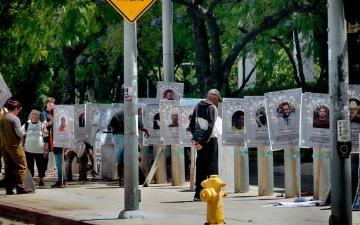
A pedestrian stops to look at a line of photos of people who died while in detention in front of the Federal Building in downtown Los Angeles on Monday, May 4, 2026. (AP Photo/Richard Vogel)
Bishop Oscar Cantú has served as the bishop of San Jose, California, since 2019. He is the chairman of the U.S. bishops' Subcommittee on Hispanic Affairs. David E. DeCosse is the director of religious and Catholic ethics, and William O'Neill S.J. is the director of immigration ethics, both with the Markkula Center for Applied Ethics. Views are their own.
This article, "On Immigration, Americans Must Examine Their Conscience: Catholic Tradition can Help" is reprinted by permission of NCR Publishing Company.
At the Second Vatican Council in 1965 Catholic bishops from around the world declared, "In a wonderful manner conscience reveals that law which is fulfilled by love of God and neighbor."
The words chosen then by the church provide the key for a sorely needed task now: The development of an examination of conscience about immigration enforcement in the United States.
We are aware of possible objections to our application of the language of love to such a public, political matter. Some may argue that our appeal to love is sectarian, having little to say in our pluralist society to nonbelievers and non-Christians. Others may argue that aspects of love like mercy and forgiveness only pertain to our interpersonal life. In this view, government must be guided by a spirit of justice, while love is consigned to the private realm.
We respectfully disagree with such arguments. We neither wish to impose a vision of Christian love on nonbelievers nor to sharply separate love from justice. Instead, Catholic teaching holds that the law of love is foundational for social ethics because it underwrites three universal values — truth, dignity and justice — by which the civil law should be judged. Inspired by these values, Pope Leo XIV and the American Catholic bishops have sharply criticized the vilification of immigrants and the practice of family separation associated with the mass deportation and detention policies undertaken in the name of the rule of law by the Trump Administration.
Drawing on the law of love, our aim is to apply the demands of truth, dignity and justice to an examination of conscience, which is a time-honored Catholic practice to evaluate moral action. Surely, the arguments we make here may resonate more with Catholics. We also hope what we say will appeal to all believers and nonbelievers alike.
An excellent starting point for an examination of conscience is a reflection on the meaning of conscience itself. In general terms, conscience refers to an abiding awareness of moral responsibility. Catholic moral theology specifies this general understanding of conscience by saying we are morally responsible to a law that we didn't create but that is "written on our hearts" (Romans 2:15): that we are to love God and our neighbor as ourselves. To be sure, conscience can lose sight of this law and be mistaken, whether as a matter of personal fault or as the result of social media campaigns designed specifically to confuse conscience.
For this very reason, conscience must be rightly formed, for love rests in truth — in reality as it is and not as we want it to be. Thus when we consider an issue like immigration enforcement, facts matter – whether we are talking about the approximately 14 million undocumented immigrants in the country; or about the 71% of persons detained by federal immigration officers in the last year who had no criminal convictions; or about asylum-seekers who have legal status until their cases are fully adjudicated. Leo has said that we live at a time when it is imperative to reconnect words to the realities they represent. In the U.S., his concern is more applicable to immigration than to any other issue. Conscience must find and hold fast to truth, including factual truth.
The moral wisdom of the Catholic tradition can also help conscience to see that the love command expresses universal truths. Biblical mandates, that is, are underwritten by moral law. In the Bible, the commandment to love your neighbor notably includes love for the migrant and stranger. Save for the command to love God, no command is repeated more often in the Old Testament: "You shall love the alien as yourself for you were aliens in the land of Egypt" (Leviticus 19:34). In the Gospel of Matthew, Jesus says that our final judgment will depend on whether we welcome the stranger. The biblical price is high for not doing so. In the Hebrew Scriptures, dismissal of the alien or stranger is tantamount to apostasy. In the New Testament, not to welcome the stranger is not to welcome Christ himself.
These biblical mandates neither require "open borders" nor prohibit deportation. But they require reflection on several essential points. First, that the migrant experience is a special object of divine love and thus merits an abiding respect that defies the lies and crude stereotypes now routinely applied to whole classes if not to all immigrants. Second, there is a likeness and common humanity presumed between the vulnerability and otherness of migrants and the lives of those already settled on the gift of land.
In his 2015 speech to the United States Congress, Pope Francis referred to such a likeness between migrant and citizen in terms of the Golden Rule, which is cited in the Gospel of Matthew and which many religious and moral traditions regard as a universal moral truth: "Do unto others as you would have them do unto you" (Matthew 7:12). Francis added: "This Rule points us in a clear direction. Let us treat others with the same passion and compassion with which we want to be treated. Let us seek for others the same possibilities we seek for ourselves."
In recognizing the universal truth of the Golden Rule, the church affirms its belief in the inalienable and infinite dignity of each person, whatever their migration status. Each person is "created in the image and likeness of God" (Genesis 1:26-27). "Dignity" is a philosophical way of referring to this sacredness. At the least, love means respecting such dignity in every person. Whether migrant or citizen, all persons have equal dignity and the right to be treated equally with respect to dignity's essential requirements.
For purposes of formation of conscience in light of immigration enforcement, it can be helpful to understand the elemental requirements of dignity as deriving from the inherent, shared qualities of persons that make life worth living: A desire for an unconditional love; to be free and responsible and able to determine a future; to enjoy family and friends; to satisfy basic needs for food and shelter and health.
Recognizing the claims of dignity lays the foundation for the church's social teaching on basic justice and human rights. In Catholic moral thought, government has the responsibility to foster order by upholding basic claims of justice, especially where such claims are most threatened. It is unjust for government not to do so. And migrants are no less bound by justice and the rule of law. But the rule of law has itself been betrayed by unjust enforcement actions in the last year undertaken by ICE (U.S. Immigration and Customs Enforcement) and CBP (U.S. Customs and Border Protection): Deporting treasured community members for nothing more than a civil violation of immigration law; intentionally deceiving persons who in good faith report to immigration court; separating parents from young children; providing fatally substandard medical care to detainees; sending detainees far from families to dangerous countries with which they have no connection; moving detainees quickly out of jurisdictions in order to avoid habeas corpus hearings; and more.
Given these demands of truth, dignity and justice underwritten by the law of love, what steps of reflection follow for an examination of conscience about immigration enforcement?
First, love demands truth: Do we recognize the moral truth that we should respect the dignity of each person, without regard to immigration status or nationality or skin color? Committed to such respect, do we seek factual information about immigration that is vetted and verified and credible?
Second, love recognizes that our dignity is bound up with the dignity of others: Do we ask ourselves what we would think or feel if we experienced the violation of things essential to dignity like family separation or the lack of due process or the impossibility while detained of accessing basic medical care? Do we recognize the inherently equal dignity that exists between every citizen and every undocumented immigrant?
Third, love bears fruit in justice: Am I acting with integrity in light of my role and responsibilities whether as a citizen or noncitizen; secular or religious; ICE agent or community organizer; and more? Have I considered how my beliefs may require expression in political engagement of all kinds ranging from voting and community organizing to conscientious objection to unjust orders in law enforcement to nonviolent public protest (including civil disobedience where appropriate)?
We understand that many persons employed to carry out these policies have jobs and families to consider. We also recognize that the Catholic Church urges obedience to civil law and recognizes the right of the state lawfully to manage its borders, e.g., through establishing legal points of entry and paths of naturalization. But no president or preacher can finally command our conscience — each person is accountable. And when civil law and government practice depart from the law of love, the law or practice must be revised or opposed.
It is time for the consciences of Catholics and all citizens to examine policies of detention and deportation in light of the demands of love, truth, dignity and justice — and to act.