Kendra Sharp: ‘Building partnerships is true to who I am’
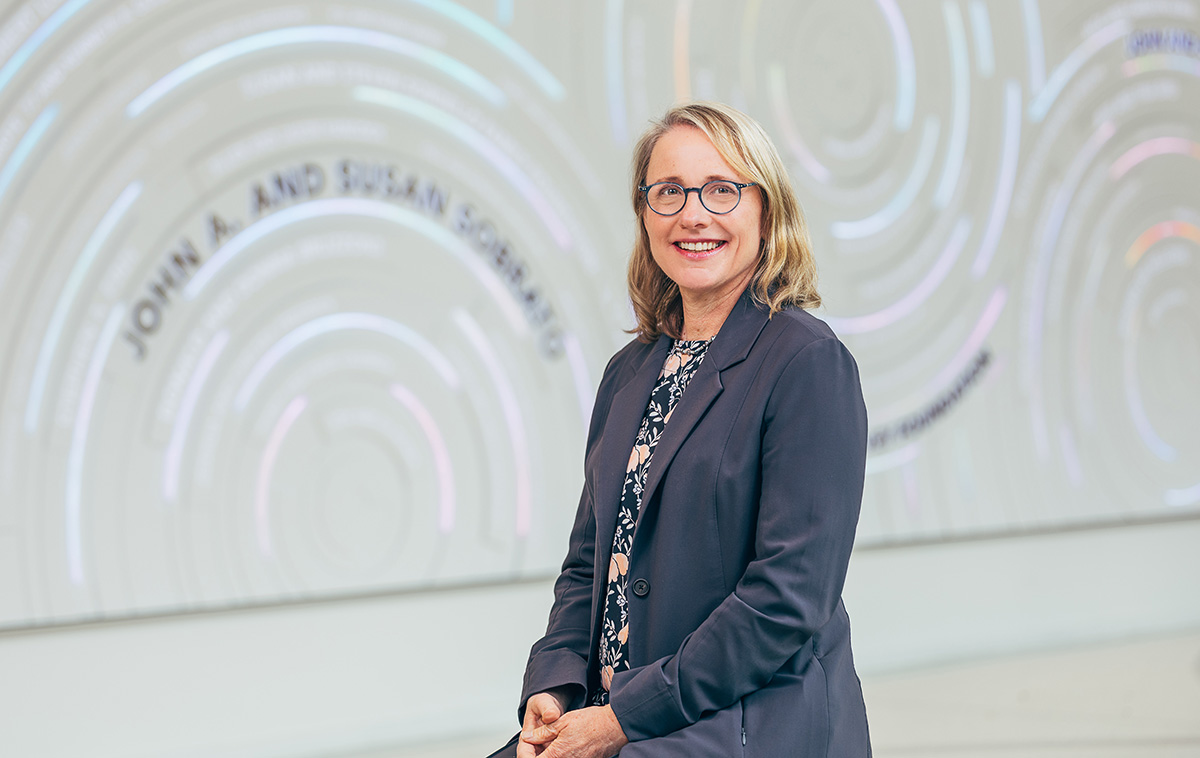
There are a few moments from Kendra Sharp’s time as head of the Office of International Science and Engineering at the U.S. National Science Foundation (NSF) that feel surreal looking back—like dining with colleagues and the U.S. Ambassador to India at his residence in Delhi, or finding herself in the White House Situation Room.
But meeting world leaders and dignitaries wasn’t what she most enjoyed about the job. It was building partnerships and creating opportunities to advance science in support of the NSF’s mission.
The same is true today in her new role as dean of the School of Engineering at Santa Clara University. As she considers the different companies and research labs in Silicon Valley, she doesn’t just see the top innovators in the world. She sees potential partners that can help Santa Clara solve the world’s most pressing problems.
“Building partnerships is true to who I am,” Sharp says. “When I’m talking to faculty about what they do, what they're interested in, and what excites them, I’m thinking of the matchmaking I can do to create opportunities.”
This isn’t her first tenure in higher education, with previous stops at Penn State and Oregon State, but the landscape for creating opportunities is far different at Santa Clara because of its location in Silicon Valley.
Since starting at Santa Clara in March, Sharp has already helped bring several important conferences to campus, including Bay Learn, the 2025 IEEE Symposium on Technology and Society, and “Reimagining the Future of the Electric Grid: The Good, the Bad, and the Ugly.” Recently, Sharp sat down to discuss her work with the NSF, new initiatives in the School of Engineering, and how Santa Clara can best tap into the power of Silicon Valley.
After you left the NSF, you had the opportunity to return to Oregon State, where you founded the Humanitarian Engineering Program in 2015. Why did you choose to come to Santa Clara instead?
Santa Clara has such a great foundation. We have terrific faculty, great students, we’re positioned well in Silicon Valley, and I feel there’s an opportunity to grow in an exciting direction. Having a mission like Santa Clara’s is also important to me. When you have a mission, it helps define how we do our work and how we prioritize things. Our mission at the NSF was to serve the nation in science and technology. When I taught at Penn State and both taught and worked in leadership at Oregon State, their missions as land-grant institutions were to provide access to education and advance research that has positive impacts in their states, the nation, and the world. As a private institution, Santa Clara’s mission is a little different, but creating a more humane, just, and sustainable world really spoke to me.
You’ve mentioned that building partnerships between Santa Clara and Silicon Valley companies and research labs is a priority for you. Why is that so valuable?
I think it makes for more impactful science. At NSF, we were able to double the bilateral government-to-government partnerships between NSF and foreign governments, which had a huge impact. We also launched a new multilateral funding program, Global Centers, with three other countries in the first year and five other countries in the second year. We were bringing together the best experts in the world to solve big problems. It also allowed us to leverage our investment for greater impact. For example, if the NSF put $30 million toward a project and the other countries combined put up $52 million, we would get $82 million in research instead of just $30 million.
I think the same is true for Santa Clara and Silicon Valley. Federal dollars are going to be even more competitive now. Fortunately, Santa Clara has not traditionally depended on federal funds as much as the large public research universities, but we should be looking to diversify our funding sources regardless. Given our location and expertise, it really makes sense to look for opportunities to collaborate with industry on research.
What makes orchestrating these partnerships challenging?
It’s about finding the right matches. Partnerships have to be mutually beneficial, which takes a lot of planning and attention to detail. At NSF, there were a lot of people involved. We organized diplomatic meetings between partners from multiple government agencies across the countries. You have to do your homework and anticipate problems. There was a lot of persistence before getting to yes.
In my first few months here, we’ve been asking faculty, especially our junior faculty, about their research interests and what routes they’ve tried for funding. We want our fundraising and partnership staff to understand the work we can do so they can look for corporate, philanthropic, or foundation opportunities that fit. I’ve also arranged meetings with different prospective tech partners.
To add, industry partnerships come in many forms. It’s not just funded faculty research. It could be internship/co-op pipelines, Senior Design sponsorship, guest lecturers, or faculty fellowships. Or volunteer judges at our Senior Design Conference. There’s a whole range of things we’re looking to grow.
Why should a tech company choose to partner with Santa Clara compared to other universities?
I’d argue we all bring something different, but for us, having this mission that everyone believes in is important. Being private, we also have more flexibility in our curriculum and how we work, meaning that we can evolve to meet industry needs more quickly than a public institution. We offer exceptional faculty, excellent faculty-to-student ratios and close mentoring of undergraduate and graduate researchers. I also think the work ethic and the caliber of our students are outstanding.
I think a lot about impact, and who we should be serving. What are we here to do? I'd argue that we’re here to serve students and provide an education, but we’re also here to contribute to our communities, whether they’re local or global or even the tech community. Not all of our engineers will work in tech, but the ones who do drive where society is going. It’s important they have a grounding in ethics and humanities.
Santa Clara hosted several engineering conferences this fall. Why are those types of events important?
We want people to know that we have exceptional students and faculty who conduct high-caliber research—a lot of which is externally funded. Bay Learn was a great example. It’s a conference that is normally hosted by companies, but this year it was on our campus. That’s unique. It also means that researchers in artificial intelligence and machine learning were on campus. So, as we’re creating our AI practicum within the new M.S. in AI graduate program, our faculty had a chance to meet local industry and consider where we might collaborate on projects.
What types of new opportunities can our engineering students expect in the future?
I want to explore developing more industry-focused graduate programs. We want to ensure we understand industry needs and that we prepare students to advance technology in ethical ways. That’s something Santa Clara can do really well. And when you have faculty engaging with industry on the cutting edge of the technology, that expertise also comes into the undergraduate classroom and offers opportunities for undergraduate students to get involved in research. If we have gifts coming from industry, we can offer our undergraduate students access to industry-standard programming and technology platforms. We’ll also have new connections for internships and co-ops with these relationships.
What’s exciting to you about Santa Clara’s new AI graduate program in comparison to how some other schools are doing it?
I would say the structure. Our program has two tracks: a hardware track and a software track. We’re also making sure every student has an AI practicum where they work with industry during the program. We have partnerships with several companies in place already, and I’ve been in conversations with a couple of others as well. Our partnership with Miller Center for Global Impact is also exciting. Students will work with social entrepreneurs who are trying to figure out what AI means for them, which is another cool opportunity that aligns with our mission.
We’re approaching AI from several different angles, and I think that’s important. Engineers are logical thinkers. We’re systematic and analytical. So we’re taking a similar approach with AI: looking not necessarily at the hype, but what it actually does. When I look across the AI research our faculty are involved in, there’s a common theme of applying AI to a broad range of domains from medical imaging to communications to search engines to infrastructure. And of course, being Santa Clara, responsible AI is at the heart of what we do.
What are some of the research projects that get you excited about in terms of real-world impact?
Oh, there are so many to choose from. Our faculty across the School of Engineering are living out our mission every day in the work they do. On Shun Pak, in mechanical engineering, is collaborating with other institutions on cutting-edge work in microfluidics. They’re working with these cool nanobots that can help improve cancer treatments. David Anastasiu, in computer science and engineering, is developing real-time models for anomaly anticipation. The goal is to prevent pedestrian accidents in small city environments. Maria Kyrarini, in electrical and computer engineering, and Fatemah Davoudi, in mechanical engineering, are part of a team that is working to make robotic arms in manufacturing safer to work alongside humans by using AI. Hisham Said, in civil engineering, is conducting interesting research with small modular reactors, which will help our unionized electrical industry play a leading role in building America’s next-generation clean energy infrastructure. Bill Lu, in bioengineering, is doing really important work on Alzheimer’s. I could go on and on. I’m really so proud of our faculty and I'm excited to see where they will take their research as we build more relationships and secure more resources.
You went to UC Berkeley for your Master’s degree. What's it like being back in California after all these years?
It’s been great. I spent my high school years in the Chicago area, but I love the West Coast vibe. I love the access to nature—I have a real place in my heart for the High Sierras in California, like climbing in Tuolumne Meadows or hiking down near Mammoth. I just enjoy a lot of outdoor recreation. I love California, and am looking forward to planning some backpacking and climbing in the Sierras with my family next summer.

Guided by our Jesuit, Catholic values, we are committed to the highest in academic and ethical achievement. Our mission is to fuel engineering students’ intellectual curiosity in support of building a more just, humane, and sustainable world. Through our undergraduate and graduate programs, we focus on educating the whole person.