Skin-like micropump could dose cancer, diabetes medicine without electricity
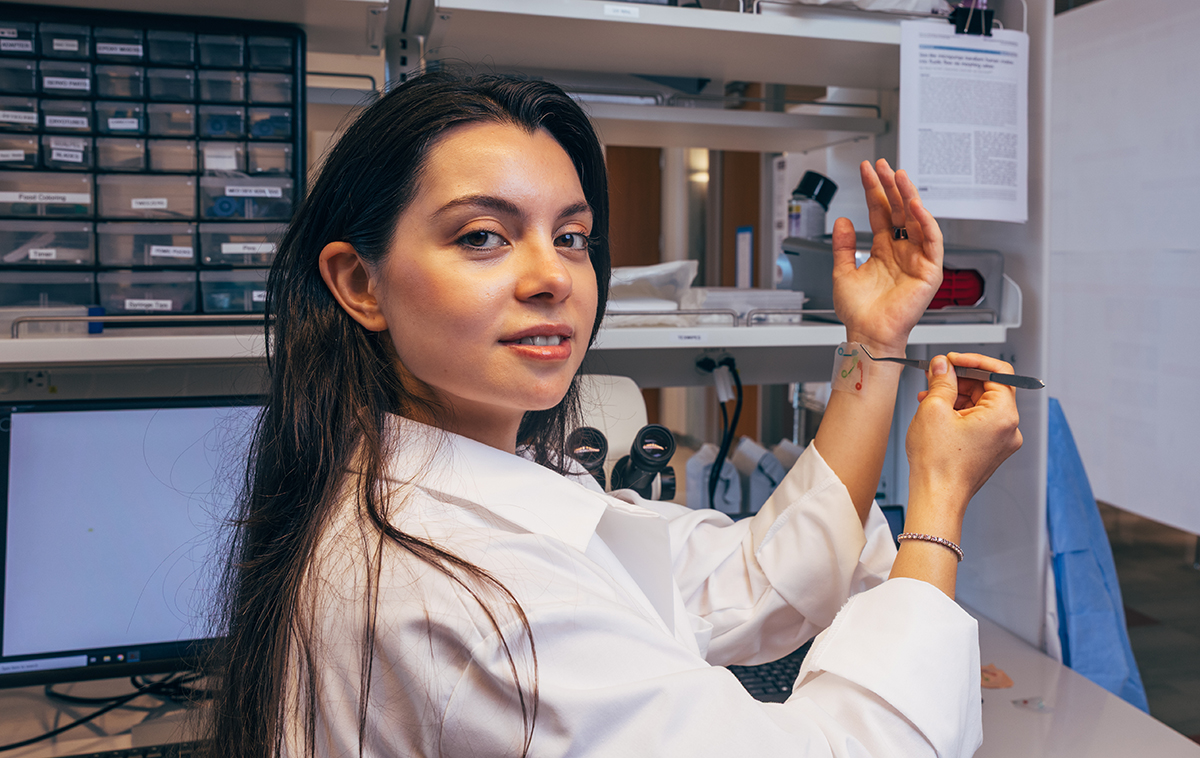
In recent years, great hope has been placed by doctors and patients alike on biological pumps that can be worn on the skin to dose medicines and other fluids direct into or out of the body. The most common are insulin and chemotherapy pumps that help diabetics and cancer patients manage their diseases. But these devices are typically rigid, bulky, and require electrical power.
An engineering doctoral candidate and her advisor at Santa Clare University took a different approach. They developed a flexible, skin-like polymer material with integrated tubes, chambers, and valves that uses the body’s own movement to pump fluids. The device is driven by the natural stretch and contraction of the wearer’s muscle–no batteries required.
The researchers call it OSMiPump, and they think it could have benefits everywhere from athletics to drug delivery. They introduce OSMiPump in a recent paper in the journal Nature Microsystems & Nanoengineering.
“OSMiPump enables fluid delivery and removal with no additional hardware or power source,” says Rana Altay Ph.D. ’26, first author of the paper who earned her doctorate developing the pump. “It opens pathways in wound care and drug delivery and even to a new age of wearable robotics, activity tracking and sensing.”
“Dr. Altay is an innovative engineer who has created a device that could have important implications for physical therapy management and personalized medicine far down the road,” says Emre Araci, an associate professor of engineering and expert in microfluidics as well as senior author of the paper. “Our flexible microfluidic patches respond depending on the quality, intensity, and mechanics of specific exercises and joints, and this will help people with all mobility levels train smarter, recover faster, and maintain long-term musculoskeletal health.”
Inspired by nature
The precise control of fluid flow is critical in such applications and the real engineering challenge behind the work, says Altay. For inspiration, she looked to nature, noting that certain insects (e.g., locusts and cockroaches) can direct airflow using rhythmic tracheal compressions, while the human heart and intestines show that muscle movements can generate strong and efficient fluid flows.
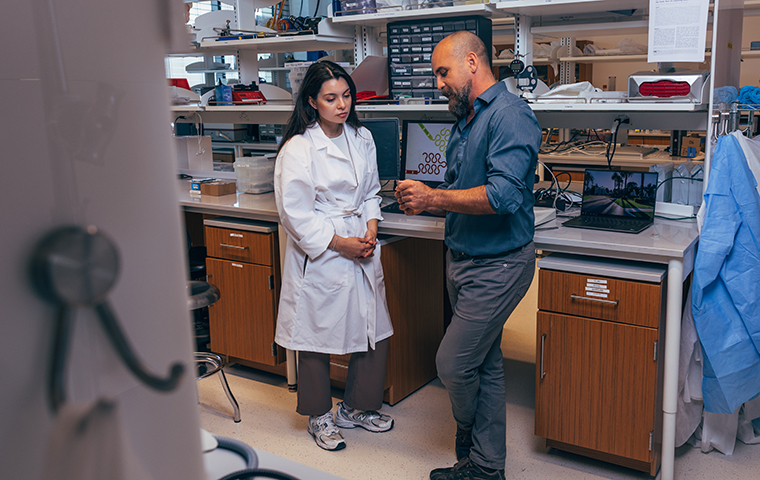
Rana Altay and Emre Araci (right) recently co-published a paper on the OSMiPump in the journal Nature Microsystems & Nanoengineering.
At its most basic level, OSMiPump works like other pumps, which create pressure imbalances to draw and push fluids. When OSMiPump’s flexible material is stretched, it pulls the fluid from a reservoir and then, when the material returns to its neutral configuration, pushes the fluid through one-way valves toward the administration site. The valves prevent backflow to keep the fluids moving in the desired direction.
But unlike traditional pumps, OSMiPump relies less on pressure and more on controlling the direction of the flow. In this regard, the valves are critical to OSMiPump’s performance. They keep fluids moving in the right direction. Testing several variations of valve arrangements, the team found that a series of smaller valves is superior to a single larger valve. The pump can be adapted to flow in either direction. Altay says that someday she can imagine bi-directional OSMiPumps that extract fluids for sampling and then deliver other fluids (medications) in response.
Altay describes potential uses including diabetes care where an OSMiPump-based device could sample fluids in the feet, where chronic wounds often lead to amputation, and then deliver drug treatments. She can also foresee wearable pumps that sample glucose in the blood and carefully mete out insulin as needed to keep blood sugar at optimal levels. Other potential wearables might sample blood or sweat during physical activity and deliver medications or nutritional supplements based on the body’s instantaneous biochemistry.
“Whenever you create skin strain—it can be walking, it can be bending a shoulder or elbow—the pump is activated,” she says. “Conversely, the pumping action can be reduced or completely stopped through positioning, since certain body positions minimize the skin deformation that drives the device. This allows the user to naturally activate or deactivate pumping through movement.”
Getting personal
In her research, Altay has discovered that output control of the device varies from person to person and application location on the body. Some people and certain muscle groups naturally generate more strain than others, she says.
“It’s really a form of personalized medicine,” Altay says. “Not everyone generates the same skin strain, but we can map individual skin strain before we place the pumps to control the exact amount of pumping."
Beyond fluid delivery and extraction, the researchers are also exploring OSMiPump as a platform for physical rehabilitation monitoring. Because the device output directly reflects skin strain and body movement, it can serve as a passive indicator of motion quality, joint usage and rehabilitation progress.
“Physical rehabilitation is one of the first applications we are actively tackling,” Altay says. “The device not only responds to movement but also provides information about the magnitude and frequency of motion. That creates opportunities for tracking rehabilitation exercises, monitoring patient compliance and assessing recovery progress using a soft wearable system that requires no electronics or batteries.”
Overall, Altay and Araci are upbeat about the prospects for their clever pump. OSMiPump can be adapted to several forms, including being integrated in sock-like materials or as Band-Aid-like adhesive stickers that can be easily mounted on key points on the body. In one test, Altay mounted an OSMiPump sticker behind the knee. Another was mounted to the ankle.
"I think it could make a big difference, especially for wound care and drug delivery, where we are still dependent on the hard and rigid pump components,” Altay predicts. “These flexible, skin-like pumps would be much easier to apply and much more comfortable for the user."

From developing miniaturized and implantable microfluidic devices and imaging technologies for disease diagnosis to researching how to fight "superbugs" that have become immune to antibiotics, our faculty and staff are at the forefront of bioengineering. Work side-by-side with us in our research labs to gain hands-on experience and help uncover solutions to the world’s pressing concerns.