Sections:
Different understandings of office hours
Talking about office hours in class
Alternative approaches to office hours
Additional resources
Office Hours & Student Learning
Research has shown that contact with faculty supports student learning (Kuh, et. al., 2010; Chambliss & Takacs, 2014). Office hours are one example of this type of contact, and they have the potential to increase student engagement and interest in course material (Guerrero & Rod, 2014). Because office hours can be part of the hidden curriculum - and because faculty and students can have different understandings of office hours - it is useful to discuss them in class, clarify their purpose, and articulate expectations. In order to meet student needs, it can also be helpful to consider alternative approaches to office hours.
Different understandings of office hours
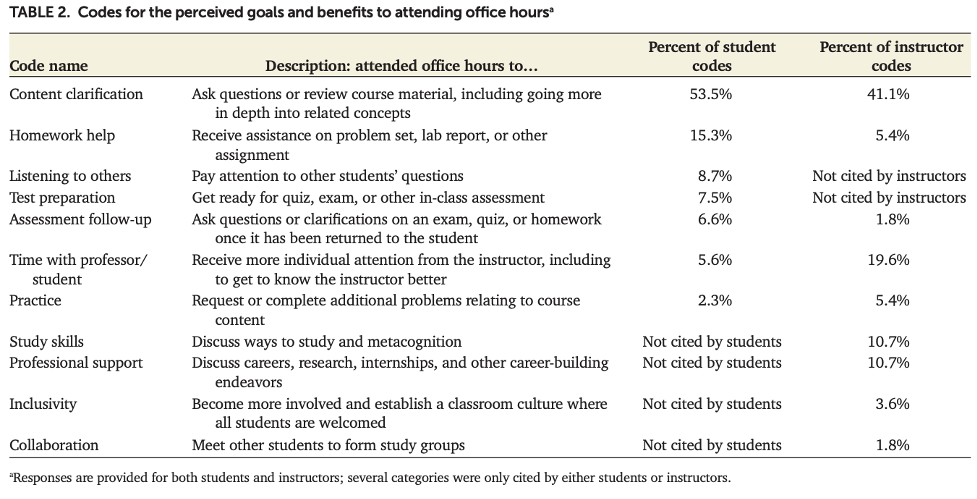
As demonstrated by Hsu et al. 2022, instructors and students have different understandings of office hours. Both groups cite content clarification as the most frequent reason to attend office hours, but instructors are more inclined to view one-on-one time with the instructor, the improvement of study skills, and professional support as reasons to attend, while students view help with homework, learning from other students’ questions, and preparing for tests and quizzes as being primary goals of visiting office hours. These differences are visible in the table below, taken from Hsu et al.’s article:
Just as research has shown that students and instructors have different understandings of office hours, so it has demonstrated that student-faculty interactions are shaped by students’ class position (Thiele, 2016). Students who come from middle- and working-class backgrounds are less likely to engage with faculty than their peers who come from upper-class contexts. Students and faculty members thus bring to the classroom distinct conceptions of office hours and of student-faculty interactions more broadly, and those conceptions are shaped by their lived experiences.
Talking about office hours in class
Given the differences in instructor and student understandings, communicating directly and frequently about office hours is important to making this resource available and comprehensible to all students.
Basics
During class sessions, on the syllabus, and on Camino, clarify:
- What office hours are
- When and where you can be found
- What your norms are
- Do you expect students to bring questions to office hours, or are you open to them attending office hours without particular questions in mind?
- Do you request that they sign up for a time or can they just show up?
- Is there a Zoom option?
It can be helpful to cover this information not just at the beginning of the quarter, but also at crucial points throughout the term (e.g. after the first exam).
Connecting office hours to class (and vice versa)
If a theme emerges frequently during office hours conversations, consider bringing it up during class. It can also be a good idea to make some time in class for students to ask questions they might bring up during office hours. For example, you can ask students to pose questions anonymously via a “question pot” or “silly questions” activity, where they can ask things that they think might benefit other students but that they might be hesitant to ask without anonymity. You can then reassure students that it is fine to bring that type of question to office hours.
Alternative approaches to office hours
Forsythe, et al. 2024 have shown that instructors have varied approaches to office hours, some more student-centered and some more instructor-centered. Here are some ways to hold office hours that may differ from conventional approaches and may help to meet student need:
- Hold office hours in a student-centered space (library, Benson, etc.) (Nunn, 2018)
- Blend in-person office hours with online office hours
- Some data suggests that students find virtual office hours more convenient and less intimidating than in-person office hours (Hsu, et al. 2022).
- Make office hours a group experience, encouraging students to come with friends from the class.
- Blend drop-in and by-appointment approaches to capture the largest number of students.
- Host a Slack or Discord channel for the class where they can drop in questions during the week. Then, hold virtual office hours on the platform where you: 1) answer the questions; and 2) engage with other students as new questions arise.
- This approach preserves a record of the questions asked and allows students to interact in a virtual space that they may find more comfortable.
- Be sure to let the students know that the questions will be answered during the virtual session, rather than immediately after posting.
Additional resources
Chambliss, D. & Takacs, C. 2014. How College Works. Cambridge, MA: Harvard University Press.
Hsu, J. 2025. “Office Hours: An Old Tool for New Challenges.” Inside Higher Ed.
Kuh, G., J. Kinzie, J. Schuh, & E. Whitt. 2010. Student Success in College:Creating Conditions that Matter. San Francisco, CA: Jossey Bass.
Thiele, M. 2016. “Resource or Obstacle? Classed Reports of Student-Faculty Interactions.” The Sociological Quarterly 57.2, pp. 333-355.
This digital resource for teaching was created by Loring Pfeiffer and Desirée Forsythe for the Center for Teaching Excellence and Faculty Development. Last updated 12/15/2025.