
Key Takeaways
- MBA and master's programs differ in purpose, experience level, curriculum, career direction, program structure, and cost.
- MBA programs prepare you for leadership and strategic roles, while master's degrees lead to technical or specialized positions.
- MBAs are designed for professionals with work experience; master's programs are often open to recent graduates.
- MBAs are typically longer and more expensive, but offer strong returns through advancement; master's degrees are shorter, more affordable, and offer quicker entry into specialized roles.
When people consider graduate school, the decision often starts with a feeling: I'm ready for more. What comes next is figuring out what exactly that "more" means for you.
You may be drawn to mastering a field you already enjoy. Or you might be more interested in seeking roles where you guide projects and help shape bigger decisions.
Understanding the difference between an MBA and a master's degree can help you see which direction fits the kind of growth you want: deeper expertise, broader leadership, or a blend of both.
What Is an MBA?
An MBA is a graduate degree designed for people who want to expand their responsibilities at work and learn how decisions are made across an entire organization. Instead of focusing on a single discipline, the MBA helps students understand how finance, marketing, operations, analytics, and leadership fit together in day-to-day business practice.

MBA students are usually early- to mid-career professionals who want to strengthen their ability to manage projects, guide teams, or move into roles that require broader judgment. The coursework often mirrors the kinds of challenges that come with those responsibilities, such as solving problems with others, working through uncertainty, and practicing how to structure decisions clearly. The broader foundation is what makes the MBA a strong fit for people who want to redirect their career path or open doors beyond their existing area of expertise.
Because students pursue an MBA at different points in their careers, universities offer the degree in multiple formats. At Santa Clara University's Leavey School of Business, this includes Evening, Executive, Online, and a STEM-designated option. These formats give students room to choose how they want to build leadership and management skills while continuing to grow professionally.
What Is a Master’s Degree?
A master's degree is a postgraduate qualification that provides advanced knowledge within a defined discipline. Unlike the general scope of the MBA, these programs examine one field in greater depth, developing specialized expertise and research-based understanding.
Master's programs often attract individuals who are early in their professional development looking to strengthen their academic and technical foundations. They promote analytical precision, intellectual independence, and a strong command of subject matter within a chosen area of study.
At Santa Clara University's Leavey School of Business, master's programs include the M.S. in Business Analytics, M.S. in Finance and Analytics, M.S. in Information Systems, M.S. in Marketing, and M.S. in Sports Business.
What you gain from our master's programs goes beyond technical expertise. You'll learn from faculty who stay active in their industries, gain experience with the tools shaping today's business world, and strengthen your skills through coursework that emphasizes real application and collaboration.
MBA vs Master’s: Key Differences at a Glance
The decision between an MBA and a master's degree depends on your professional background and the kind of growth you seek. Both are advanced degrees, but they differ in purpose, scope, approach, and structure.
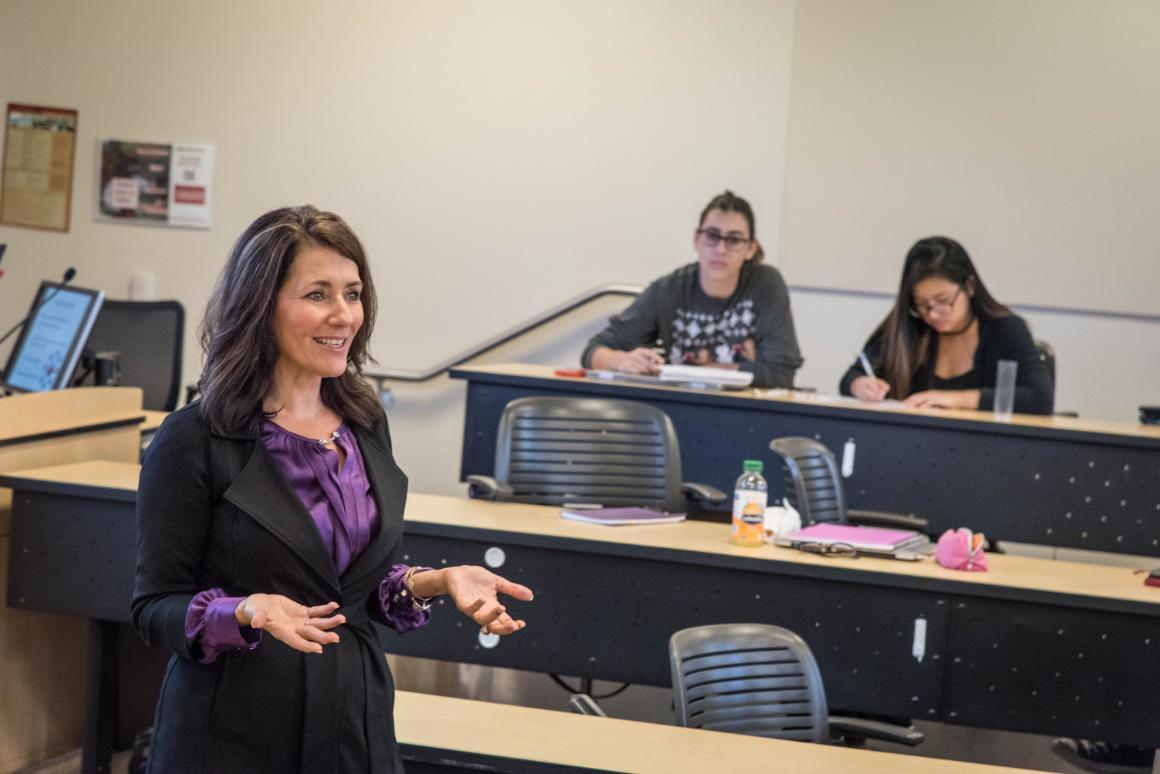
Understanding the distinctions can help you identify which degree option best fits your experience and direction.
Focus and curriculum
An MBA is built around breadth to provide students with a wide understanding of how different areas work together to shape organizational decisions. A master's degree, on the other hand, is built around depth, allowing students to specialize intensely in one discipline and develop advanced technical capability.
Both approaches align with Santa Clara University's philosophy of combining breadth and depth in all students' education, although each emphasizes a different starting point. Applicants can use this lens to think about which path matches their current strengths and the kind of expertise they want to build next.
Admission requirements
For most MBA programs, professional experience is a core expectation. Applicants are typically several years into their careers, which allows them to engage fully with leadership-centered coursework and contribute practical insight to class discussions.
Leavey's MBA admissions team looks for candidates with at least three years of work experience, though all undergraduate majors are accepted. What matters most is your potential for advancement. Applications are evaluated based on a combination of:
- Academic records
- Career progression
- Leadership capacity
By contrast, many master's programs are built for students earlier in their professional timeline. Some enroll immediately after completing a bachelor's degree; others apply after a year or two of work once they've discovered the field they want to specialize in.
At Santa Clara, the M.S. programs do not require prior work experience, though it can strengthen an application. These degrees are intentionally structured for students who want to build:
- Technical or analytical depth
- A strong academic foundation in a focused discipline
- Early career momentum
Career goals and outcomes
MBA graduates are often positioned to lead. Many transition into management or executive roles where they're responsible for guiding teams, allocating resources, and making strategic decisions that impact the entire organization.
The degree also supports those interested in entrepreneurship, providing the broad business foundation needed to evaluate opportunities, understand market dynamics, manage risk, build teams, and navigate early-stage growth. It is especially valuable for professionals moving from individual contributor roles into positions that require oversight, influence, and long-term planning.

Graduates with a master's degree, on the other hand, usually remain closer to the technical or analytical core of the business. They become the go-to experts in their field and focus on solving specific, high-level problems within their domain. Rather than managing entire departments, they deliver depth of insight that drives smarter decisions within a particular function.
Program duration and structure
How you learn can matter as much as what you learn. Some programs are designed for speed and focus, while others emphasize collaboration, leadership growth, and real-world immersion.
An MBA is typically longer, often spread over two to three years, and includes interactive learning like team-based projects, leadership workshops, and case studies drawn from actual business scenarios. Programs at Santa Clara University are built with working professionals in mind, offering evening, weekend, and online options to balance career and coursework.
For business master's programs, since the curriculum stays within one discipline, the timeline is shorter and the progression more focused. Students spend their time building depth by strengthening technical foundations, applying field-specific tools, and completing experiential capstones or practicums that tie their learning to practical challenges. At Santa Clara University, the master's programs follow this same logic and, like the MBA, they are scheduled to accommodate professionals who want to build expertise while continuing to work.
If you're looking for a more immersive, leadership-focused experience with cross-functional collaboration, the MBA delivers that. If your goal is a faster, skill-specific academic path, a master's program is often more direct.
Cost and return on investment (ROI)
When considering cost, think of it in terms of what the degree unlocks, how soon, and how far it takes you.
An MBA typically requires a larger financial commitment, but it's designed to pay off through long-term career growth. Graduates often see greater access to leadership roles, salary increases tied to managerial responsibility, and a broader network that opens doors throughout their careers.
A master's degree usually involves a lower upfront cost and delivers returns more quickly. It qualifies you for roles that demand advanced technical skills, often in areas like data science, finance, or marketing analytics. These positions may not start at executive levels, but they're in demand and well-compensated from the start.
If your goal is to accelerate into senior management and influence strategic decisions, the MBA supports that trajectory. If you're looking to sharpen your expertise and enter a specialized field with immediate impact, a master's program offers a faster return.
Which One Should You Choose?
Your career stage is often the clearest starting point. If you're just entering the workforce or have limited experience, a master's degree can give you a competitive edge by developing specialized skills that employers recognize immediately. If you've already gained professional traction and want to take on greater responsibility, an MBA offers the strategic and managerial training needed to lead.

Choose an MBA if you want to:
- Transition into leadership or executive roles.
- Switch industries or broaden your career path.
- Gain a comprehensive understanding of business functions.
- Grow your professional network.
- Start or scale your own business.
Choose a master's degree if you want to:
- Build advanced skills in a specific area like analytics or finance.
- Enter technical or specialist roles shortly after undergrad.
- Focus on research, data, or conceptual frameworks.
- Earn your degree in a shorter time frame.
- Develop subject-matter depth before pursuing management.
Conclusion
Although an MBA is a master's degree, it differs significantly from most programs in its focus, structure, purpose, and outcomes. Neither is better than the other, only better suited to different goals.
Your choice depends entirely on where you are in your career and what you're looking for in the next stage. Whether you're aiming to lead teams or deepen your expertise in a specialized field, Santa Clara University's Leavey School of Business offers both MBA and M.S. programs designed to meet your needs.
Explore our programs, reflect on your direction, and apply to the one that aligns with your ambitions. Whichever path you choose, you'll be learning in the heart of Silicon Valley, surrounded by faculty, peers, and opportunities that help move you forward.
FAQs
Is an MBA harder than an M.S.?
It depends on your strengths. MBA programs challenge students with leadership growth, group projects, and strategic decision-making. M.S. programs demand a deep technical or analytical focus in a specific field. Each has its own kind of rigor.
Is an MBA considered a Masters?
Yes. An MBA is a type of Master's degree, but it differs from most others by offering a broader, cross-functional approach to business rather than deep specialization.
Can you pursue both an M.S. and an MBA?
Yes. Many professionals earn an M.S. to build early expertise, then pursue an MBA later to move into leadership roles. Because the skill sets complement one another, some students intentionally combine them. At Santa Clara University, for example, the dual-degree option in the M.S. in Sports Business and the MBA offers a structured way to pair specialization with leadership training.
Can you pursue an MBA without first earning a master’s degree?
Absolutely! Most MBA programs only require a bachelor's degree and several years of work experience; no previous graduate degree is needed.
Discover Your Next Step
This will only take a moment.