| Trouble viewing this email? Read it online. |

| July 11, 2025 | Submit a Note |
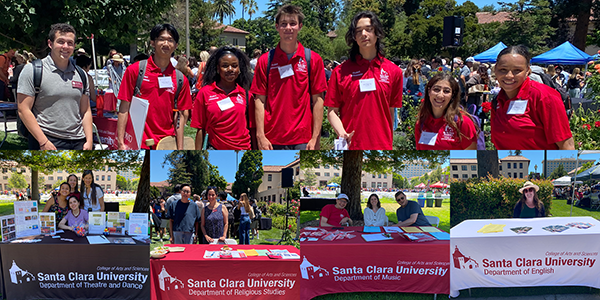
Orientation has begun! The College of Arts and Sciences Student Engagement Team, led by Assistant Dean Denise Ho, has started welcoming and advising the Class of 2029! Top: Calvin Miller with the summer peer advisors. Bottom: Departments at the Resource Fair.
I hope you are enjoying a wonderful summer. During this much-needed break between academic years, College Notes has shifted to a monthly rather than biweekly cadence. Our next issue will be released on Aug. 8. Last spring the American Conference of Academic Deans (ACAD) asked me to reflect on the work of a dean and the life of the mind. Alongside colleagues from three other universities—Heidi Bostic, dean of the Helen Way Klingler College of Arts and Sciences at Marquette University; Donna LaVoie, dean of the College of Arts and Sciences at Saint Louis University; and Brad Elliott Stone, associate dean of Bellarmine College of Liberal Arts at Loyola Marymount University—I shared my thoughts in the May issue of the ACAD newsletter. Perhaps not surprisingly, our perspectives vary as do our strategies for nourishing our scholarly minds. I encourage you to read all of the essays; I think you will discover some valuable insights. But, I am sharing my essay in particular with the hope that it will shed some light on how I approach my role as dean. Since our last issue of College Notes on June 6, two exciting developments have taken place. Jaime Van Wormer has joined University Relations as Senior Director of Development supporting CAS. Jamie, who served most recently as the Director of Advancement at Walla Walla Catholic Schools in Washington, comes to us with a robust fundraising background and we are excited to work with her. It is also my great pleasure to announce our 2025-27 Frank Sinatra Chair in the Performing Arts, Kristin Kusanovich! Kristin will be collaborating with members of an international dance company during her two-year term as Sinatra Chair. Please keep an eye out for a full press release with more details later this summer. Finally, as we are approaching the midpoint of our summer pause, I leave you with a summer poem by Arthur Sze, who was the first poet laureate of Santa Fe, New Mexico, and a professor emeritus of the Institute of American Indian Arts. Sincerely, Daniel Midsummer By Arthur Sze
Highlights
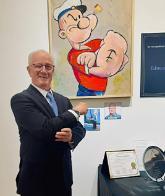
He has taught thousands of students at Santa Clara University over his 43-year career as a professor of art and guided many into successful careers in the arts. Kelly has worked to bring diverse local and international communities together by advocating for, planning, and facilitating international exhibitions and artist exchanges from countries including Japan, Korea, and others. He has represented the City of Santa Clara well in his many artistic forays into museums and galleries throughout the country and abroad.
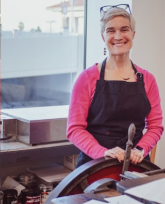
SCU acquired a platen letterpress and a collection of type in 2018 thanks primarily to the generous donation of local printer Tom Davis. Since then, we have added supplies to the studio to support teaching. If you are interested in learning more about our presses or even scheduling a class or event printing experience (we have a mobile press), email Kirstyn, kleuner@scu.edu.
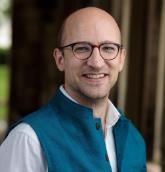
The article reconstructs the life of Nur Allah Budhanwi, an eighteenth-century legal scholar and Sufi, to suggest the limitations of current models of Islamic reform in South Asia. Generally speaking, Islamic reform is studied in a sociological mode (through network analysis) or through the analysis of technical treatises largely removed from social context. Instead, he shows how micro-historical methods—reconstructing as far as possible the intellectual and social lifeworld of an individual by reading textual fragments against the grain—allow us to perceive the contestations and hesitations that accompanied the process of early modern Islamic reform. For those interested, the article is free to read for the next couple of months.
Image: Juan Velasco-Moreno in Spain at the presentation of the two books at the IV Muros Conference.
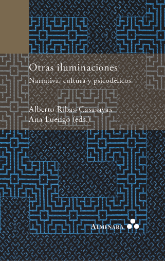
Alberto Ribas-Casasayas (Modern Languages and Literatures) published the volume Otras iluminaciones: Narrativa, cultura y psicodélicos, co-edited with Ana Luengo (San Francisco State University) with Almenara Press. This peer-reviewed volume contains 13 academic essays and two non-fiction pieces focusing on discourses about the psychedelic/entheogenic experience in contemporary discourse and reception in Spanish-speaking territories, and also a critical perspective from the humanities to what has been called (or hyped as) a “psychedelic renaissance” in the global North. The volume contains Alberto’s contributions, “A Lucid Stream: Notes towards a Psychoactive Critique of Literature and Culture,” co-authored with Ana Luengo, and “Latin American Studies versus the Psychedelic Renaissance.” The latter chapter originated as a talk first given at SCU in May 2024, as a joint event of the tUrn and the Brown Bag Humanities initiatives. Alberto was also invited to deliver a revised and updated version of this talk before an audience of students and faculty at UC Santa Barbara on May 29. Alberto presented Otras iluminaciones at the LASA conference in San Francisco, where he also chaired the panel “Experiencing Pleasure, Exploring the Unsayable, Visualizing the Unimaginable: The Psychedelic Experience in 21st-Century Latin American Literature," where he also delivered his talk “Towards a Latin American Focus in the Psychedelic Humanities.”
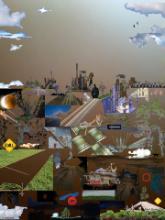
Tim’s poem “Intersection” also appeared in Caesura Magazine, along with an art piece called "Evening City." Image: "Evening City" by Tim J. Myers.
Amy Lueck (English), Kai Lukoff (Computer Science and Engineering), Lee Panich (Anthropology), Danielle Heitmuller (Art and Art History), Ohlone community members, and an interdisciplinary team of students led by Madi Nguyen '25 (Web Design and Engineering) and Isabella Gomez '27 (Philosophy), have received a $100,000 Digital Justice Development grant from the Association of Colleges and Learned Societies (ACLS) to support further development of the Thámien Ohlone AR Tour that illuminates Ohlone heritage at SCU. You can view the existing tour stops by downloading the tour from the Apple Store (Android to be released soon!). This project has received generous internal support from the Whitham Family Collaborative Scholarship Grant, and is now receiving recognition at the national level. The ACLS Digital Justice Grants Program funds digital projects across the humanities and social sciences that critically engage with the interests and histories of people of color and other historically marginalized communities through the ethical use of digital tools and methods. For 2025, eight start-up projects have been awarded ACLS Digital Justice Seed Grants of up to $25,000, and seven established projects were awarded ACLS Digital Justice Development Grants of up to $100,000.
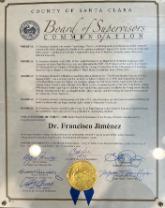
On May 18, at the Santa Clara University Board of Regents meeting in Paso Robles, Francisco Jiménez (Modern Languages and Literatures, Emeritus) presented the historical and literary context for the screening of The Unbroken Sky, an award-winning short dramatic film adapted from his memoirs, which portrays his family’s migration from Mexico to California as farmworkers. In conjunction with receiving the Jorge Escobar Achievement in Education Award from the Latino Education Advancement Foundation, he was also honored with a commendation from the County of Santa Clara Board of Supervisors. The commendation recognizes “his transformative impact on education and the community, exemplifying the values of the Latino Education Advancement Foundation Jorge Escobar Achievement in Education Award.” Francisco also made a virtual visit to a class of students at Frank Ledesma Elementary School in Soledad, California, who had read The Circuit with their teacher.
Iris Stewart-Frey (Environmental Studies and Sciences), Jake Dialesandro (ESS) and the Water and Climate Justice Lab collaborated with the Community Water Center, the California Rural Legal Assistance, the Environmental Law Foundation, Clean Water Action, the Leadership Council for Justice and Accountability, Monterey Waterkeepers, the California Coastkeeper Alliance and the Natural Resources Defense Council to organize a 1-Day bi-lingual conference at SCU. Representatives from environmental organizations, community committees, and academia heard community testimony, shared information, and developed strategic goals for nitrate regulatory programs (such as CV-SALTS, Ag 4.0, and the Dairy Order) and clean water advocacy. Iris and Jake presented new findings on how nitrate in groundwater varies in space and time, especially near Concentrated Animal Feeding Operations (CAFOs). Student lab members Elyse Kenyon '25 (Environmental Science), Stephanie Davis '25 (Environmental Studies), and Samantha Lei '26 (Environmental Science) contributed to the presentation; Victory Chika-Okafor '27 (Environmental Science), Sophia Toribo '27 (Political Science, Environmental Science), and Briana Guingona '25 (Environmental Studies) supported the logistics.
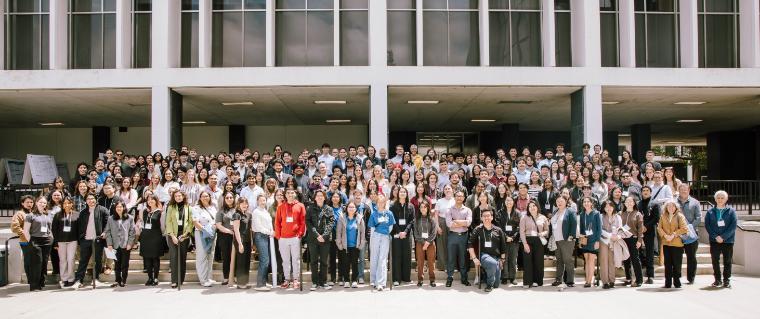
Students mentored by faculty in the Department of Chemistry and Biochemistry presented oral presentations and research posters at San Jose State University on Saturday, May 3 at the annual American Chemical Society Northern California Undergraduate Research Symposium (NCURS). The event this year featured 89 posters and 18 oral presentations. A number of research students from the laboratories of Linda Brunauer, Korin Wheeler, Robin Grotjahn, Ben Stokes, Paul Abbyad, Meaghan Deegan, Grace Stokes, and Amelia Fuller attended the symposium. Three SCU students gave oral presentations and eight research posters were presented.
Image: Iris Stewart-Frey (top) and Irina Raicu (bottom).
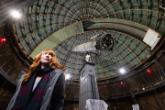
In this piece, Kimberly argues that the construction of the Thirty Meter Telescope (TMT) on the Big Island of Hawaii's Mauna Kea materially signals and further enshrines the ongoing epistemic inequality that still obtains between Native Hawaiian and scientific (e.g., astronomical) communities. Though the proposed, astronomical questions towards which the TMT is aimed are fascinating, she maintains that the nonconsensual construction of the Thirty Meter Telescope constitutes both a structural ethical and epistemic—that is, knowledge-based—harm. It is epistemically problematic, for its mandated construction is a public declaration of the primacy given to Western scientific inquiry and analysis over Traditional (Hawaiian) Ways of Knowing. It is a matter of ethics and social justice, for its construction further perpetuates an ongoing set of harms to Native Hawaiians (Kānaka 'Ōiwi)—culturally, techno-materially, relationally, politically, and through the destructive law enforcement practices that have been employed contra front-line protestors bravely standing in defense of that which they revere. Lastly, the construction of the TMT precludes and undermines fruitful, pluralistic collaborations (e.g., epistemic synthesis) between Kānaka 'Ōiwi and astronomical communities. Image: Kimberly Dill at the Lick Observatory, by Jim Gensheimer for the Santa Clara Magazine.
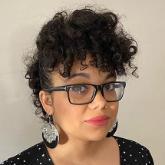
Abstract: Although spiritual and religious engagement that includes beliefs, practices, and community involvement has been found to offer numerous physical and mental health benefits, it can also be associated with problematic and dysfunctional perspectives and behaviors. Tragically, many people suffer from obsessive scrupulosity, guilt, anxiety, and depression, as well as discrimination, racism, and violence associated with their religious traditions and engagement or those of others. Mental health professionals must be mindful of both the upsides and the downsides of religiosity and find a way to secure appropriate consultation, embrace professional ethical principles, and support health and wellness for clients. This clinical reflection provides examples of religion getting in the way of health and wellness and offers several strategies for therapists to use to better address these issues in their clinical work.
This study compared two common study strategies: overt retrieval (actively saying or writing down an answer) and covert retrieval (silently thinking of the answer). College students learned key terms and definitions from cognitive psychology and then practiced them using one of three methods: overt retrieval, covert retrieval, or simple restudy. The study found that students remembered more when they used overt retrieval, especially for complex material like full definitions. This supports the idea that when information is harder to recall, physically producing an answer (typing it) helps solidify learning more than just thinking about it. However, covert retrieval was faster and still better than just re-reading—making it a more efficient strategy when time is limited. Key takeaway for educators: Encourage students to quiz themselves by writing or saying answers aloud, especially when learning complex material. But when time is short, even silently recalling information can be better than re-reading notes.
Get connected!      |
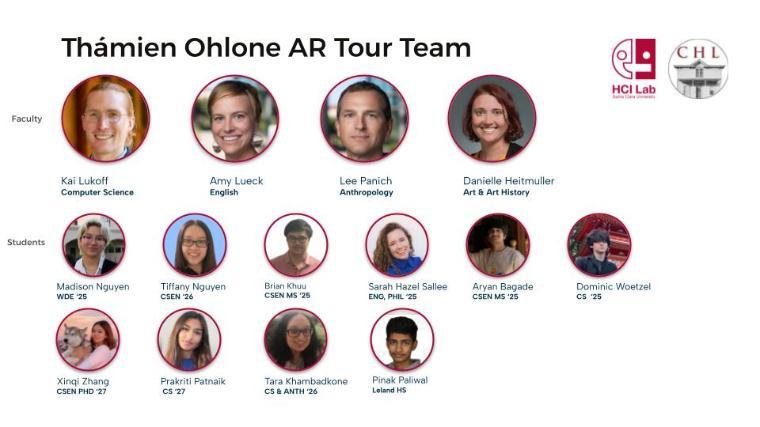 The interdisciplinary faculty and student team for the Thámien Ohlone AR Tour.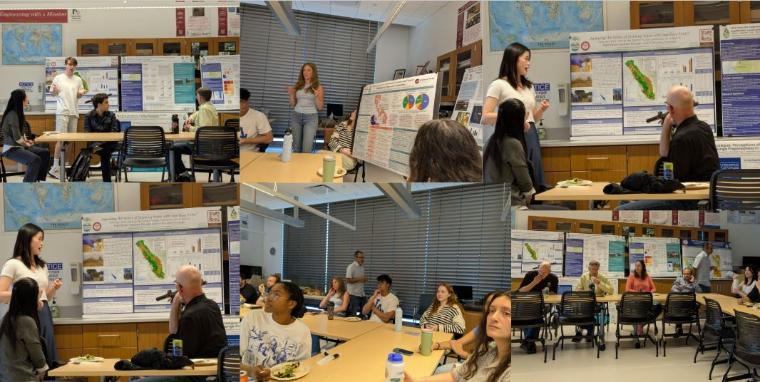
 Faculty and students at the Northern California Undergraduate Research Symposium.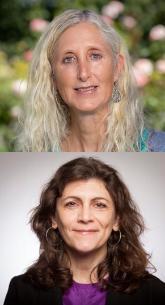
| College of Arts and Sciences |
|
Questions? Contact Sandy Boyer |