News Stories
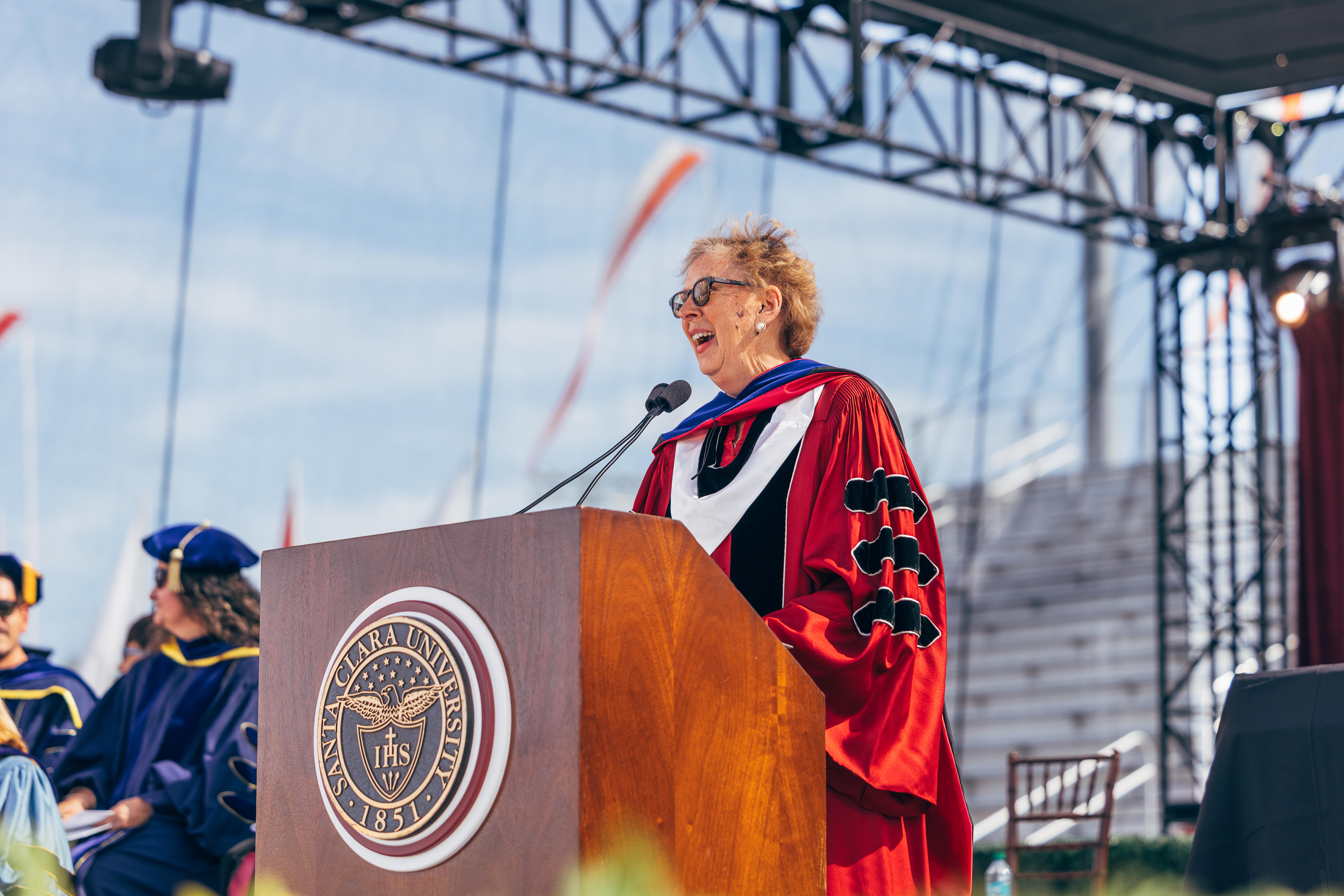
When a House Becomes a Home: Cura Personalis in Action
Kathy Nicholson Hull M.A. ’80
This summer, George Mark Children’s House (GMCH) welcomed a Yemeni family preparing to say goodbye to their two-year-old son, Mohammed, who was dying of cancer.
Nearly 20 relatives—at least three generations—filled the pediatric palliative center to support Mohammed and his mother. GMCH staff jumped to provide meals for the extended family, activities for the other children, and faith-based support. This was the same level of care GMCH offered to countless other families, every case personalized for each family’s unique needs.
“It’s remarkable what it takes to create a caring experience for a family of that size, across cultures and languages,” GMCH founder, Kathy Nicholson Hull M.A. ’80, reflects.
Over the past two decades, more than 1,200 families like Mohammed’s have found solace at GMCH. Yet for Hull, the true reward is seeing families supported in their hardest hours—something she lacked when her brother George died of melanoma at just 30, leaving four young children behind and a family bereft.
“At the time, there were no hospices for adults. We didn’t know how to manage his discomfort or support his kids,” she remembers. “That sense of helplessness made me want to ensure no other family had to navigate illness alone.”
Her path in health psychology crystallized while working at a children’s hospital in Oakland. There, Hull witnessed families grappling not only with terminal illness but with an often-overwhelming medical system and language and cultural barriers. She wondered: “Could there be a better system?”
When she looked around, she was shocked to realize the most established pediatric hospice models were only in Europe, so she and a colleague began visiting facilities like Helen House in Oxford.
“It was meant to feel like someone’s home,” Hull says. “When I walked in, there was a dog chasing a cat through the entryway. It wasn’t a hospital—it was a place of life and comfort.”
That vision of “home” grew into George Mark Children’s House, which opened its doors in San Leandro, California in 2004, and was named for her late brothers, George, and Mark, who died in his teens.
“We didn’t have MBAs or a business model,” Hull laughs. “What we had were good intentions and tenacity.”
As the first freestanding pediatric palliative care facility in the U.S., its model was simple yet revolutionary: pair state-of-the-art medical care with the warmth of home, keeping things small with just eight beds in order to provide extraordinary services.
With playrooms, kitchens for shared cooking, family apartments, and visits from therapy dogs (and even penguins from the local zoo), GMCH creates a space where seriously ill children can be children, caregivers can enjoy a short respite, and families can stay together.
Since GMCH’s founding, Hull’s leadership has been recognized with the Minerva Award, Purpose Prize Fellowship, and Jefferson Award for Public Service, and more importantly, at least 16 similar organizations have been inspired nationwide.
According to Hull, this “heartwarming” ripple effect is a credit to the Jesuit values she embraced at Santa Clara.
“Cura personalis—care for the whole person—is exactly what we do here,” she says. “It’s about dignity, family, and love.”