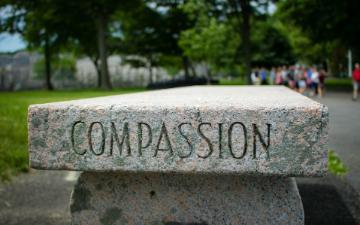
"Compassion" Bench near Trophy Point at West Point. Photo by Dave Lowe on Unsplash.
Hersh Shefrin is the Mario L. Belotti Professor of Finance at Santa Clara University’s Leavey School of Business and a faculty scholar at the Markkula Center for Applied Ethics. Views are his own.
A dictionary definition of compassion is the “sympathetic consciousness of others’ distress together with a desire to alleviate it.” Acting on that desire becomes an act of compassion.
The U.S. has arrived at an ethical inflection point, which features the following three features in respect to compassion:
- The current presidential administration’s economic policies not only reflect a lack of compassion for the least fortunate among us. Its policies are acts of un-compassion, kicking those who are down.
- The administration’s economic policies are the most uncompassionate in living memory.
- Many members of the working class voted Republican in 2024 because they felt a lack of compassion from Democrats.
1. Uncompassionate Economic Policies
The “One Big Beautiful Bill” which President Trump signed into law on July 4, 2025, is a main component of the administration’s economic policy. A second component is the imposition of tariffs. Over time, both will hurt the lowest income group and help the highest income group, which is why I would characterize both as uncompassionate.
Consider some specifics. For the top 20% of households, annual income is projected to rise by 2.2%. As the average income for households in this group is about $260,000, the 2.2% increase represents a gain of $5,700. In contrast, for the bottom 20% of households, annual income is projected to fall by about 3%. As the average income for households in this group is about $23,335, the 3% decline represents a cut of $700. Members of this group live hand-to-mouth, and struggle to make ends meet. For them, $700 is consequential.
The new law does not just constitute the absence of sympathetic consciousness of others’ distress, it exacerbates that distress. The lion’s share of the 3% income reduction to the bottom 20% stems from cuts in Medicaid and food assistance (SNAP).
2. Most Uncompassionate Policies in Living Memory
The cuts in Medicaid from the new law constitute about $1 trillion over a decade, and amounts to approximately 0.3% of gross domestic product. This is ten times the magnitude of the reduction in social safety net programs enacted during Ronald Reagan’s presidency, which removed about three million people from the Medicaid rolls. The new law will remove almost four times that number, which former Secretaries of the Treasury, Robert Rubin and Lawrence Summers, estimate will generate 100,000 deaths.
A related issue is “sludge,” the behavioral economics term for unnecessary bureaucracy. The new law imposes new work requirements for Medicaid eligibility and public health insurance eligibility. The additional paperwork creates a real burden on people facing hardship, and some will lack the strength to complete the paperwork. Adding sludge to the lives of people in distress is an act of un-compassion.
Climate change poses the biggest long-term threat to all humans, not just Americans. Losers from the new law include producers of electric vehicles, wind, and solar power. In contrast, winners include fossil fuel companies. This imbalance reverses important climate initiatives begun under the Biden administration, which represented the most serious public policy this country produced to deal with climate change. The reversal is an act of un-compassion directed against future generations who will bear high costs from global warming. As such, it qualifies as part of the most uncompassionate pieces of legislation in living memory.
The new law will balloon a government deficit that, at 7% of GDP, is already too large by more than a factor of two. The percentage of the government’s expenditures devoted to paying interest has more than doubled since 2020. The U.S. government now spends more money paying interest on its debt than it spends on any other budget category except for Social Security.
Excessive debt for governments is akin to excessive debt for people who have large student loans. High interest payments impose a large burden on finances, and threaten economic stability, both at the individual and the collective level. People with high levels of student loan debt find themselves having to reduce expenditures on food, shelter, clothing, and transportation, in order to meet their interest obligations. The higher the interest payments, the bigger the burden in terms of less food, lower quality accommodation, less clothing and less transportation. Economists generally agree that high government deficits typically lead the U.S. to borrow from abroad; and there is a high risk that creating such a situation will not be an act of compassion for our future selves. Indeed, the projected deficit is large enough for this provision of the new law also to qualify as being part of the most uncompassionate pieces of legislation in living memory.
The administration’s widespread imposition of very large tariffs has been the other highly visible component of its economic policy. Standard economic analysis concludes that tariffs harm the general public, even though they may benefit a few special interests. Tariffs work by imposing taxes on imported goods. These taxes are paid by the consumers of those goods, not the foreign companies or countries selling the goods. The point of these taxes is to reduce the cost advantage enjoyed by foreign competitors, thereby forcing Americans to buy “made in America” that is more expensive to manufacture, or of lower quality than what comes from abroad, or both.
Many products produced in the U.S. use inputs that are imported from abroad. Therefore, the administration’s tariffs will raise the prices ordinary consumers pay for a great many goods. There are varying estimates about how costly the administration’s tariffs will be. At the lower end of the forecast range are figures such as $1,250 per year in lost income. At the upper end are figures such as $5,000. For households in the bottom 20% of the income distribution, tariffs add insult to injury. Projections are that low-earning households will be disproportionately affected, sustaining a loss $2,600 per year.
The new law makes permanent a series of temporary tax cuts from President Trump’s first term. Now the Trump administration is trying to use tax revenues from tariffs, largely paid for by Americans, to offset tax cuts. Even with the additional revenue from tariffs, the deficit will grow, not shrink, under the new law. There is a high risk that future generations of Americans will pay the price. The lawmakers responsible for passing the Big Beautiful Bill into law appear to show little or no compassion for future generations.
The magnitude of the administration’s proposed tariffs are the largest in living memory, considerably larger than the much publicized Smoot-Hawley tariffs which exacerbated the Great Depression. As such the administration’s tariffs qualify as being part of the most uncompassionate policies in living memory.
3. Compassion, the Working Class, and Political Shifts
Historically, members of the working class have voted for Democrats, especially in presidential elections. However, in recent years, many in the working class have switched to voting for Republicans. I suggest that this is because they have felt that Democrats have lost compassion for them and their circumstances.
This feeling about lack of compassion could be discerned in the 2024 election. During the campaign, when voters expressed concerns about “the economy,” they typically meant that prices had increased more than their wages during Joe Biden’s presidency. In economic terminology, the “real wage” had declined. While Biden’s policies were not wholly responsible for creating a surge in inflation, his policies did exacerbate inflationary pressures that occurred as a result of the pandemic.
My judgment is that Biden made the choice he did out of compassion for the unemployed. His stimulus policy was intended to bring the unemployment rate down; and it did. However, the stimulus also amplified inflationary pressures which affected all Americans, especially working-class families with jobs; and these families did not feel they were being treated with compassion by a Democratic administration.
This particular episode of inflation added salt to an existing wound, the wound generated by the impact of globalization on working class jobs. Specifically, competition from abroad, and technology, led to many factory closures and associated job losses. These losses had negative implications for peoples’ self-worth, identity, and community. In this regard, a book by Ann Case and Angus Deaton, titled Deaths of Despair and the Future of Capitalism, analyzes the situation of white, working class men.
Case and Deaton point out that even as Americans have experienced a significant rise in life expectancy during the last hundred years, white men without college degrees, between the ages of 45 and 54, are experiencing an increase in death rates. These are the type of men who decades ago worked in manufacturing, in jobs associated with masculinity. Globalization led many of the jobs they had been holding to be relocated outside the U.S. In many cases, working class men turned to inferior alternatives such as temp agencies and contractors with little employer commitment. Not having college degrees made it difficult for these men to find better alternatives. Social activities such as attending company Christmas parties and participating in union baseball games declined. This decline contributed to a decrease in these men’s sense of self-worth. Likewise, it contributed to an increase in their rates of opioid use, addiction, and death.
Sociologist Arlie Hochschild’s recent book, titled Stolen Pride: Loss, Shame, and the Rise of the Right, describes her field work studying working class families in Pike County, Kentucky. Her research provides vivid examples of loss of identity and self-worth. She explains that many of those she studied blamed themselves for their low incomes and low social status. She also explains that these feelings made them vulnerable to a demagogue who would tell them that the blame for their predicaments lay not with them, but with immigrants; and they heard those words as a message of compassion.
We live in a complex world, where words of compassion are not always matched by acts of compassion. Messaging can be very powerful. Decades of psychological research have established conditions under which people experience difficulty separating fact from fiction. However, as long as we have a functioning democracy in this country, if enough Americans insist on economic policy being compassionate, it will happen.