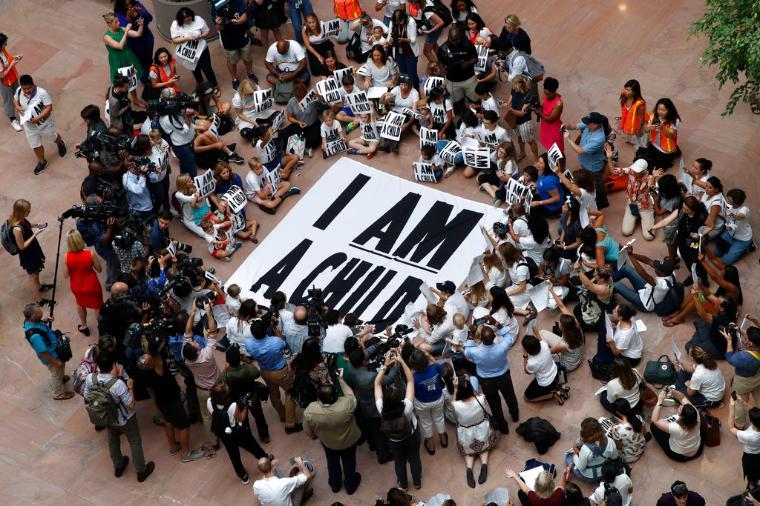
 Families with young children protest the separation of immigrant families with a sit-in at the Hart Senate Office Building, Thursday, July 26, 2018, on Capitol Hill in Washington. (AP Photo/Jacquelyn Martin)
This Ethics Spotlight explores the ethical dimensions of immigration enforcement and detention in the United States—particularly the role of ICE under the current administration.
Perspectives
Policing Thought at the Border: Civil Rights Ethics and the Weaponization of Immigration Law by Don Heider (@donheider), executive director of the Markkula Center for Applied Ethics.
From an ethical standpoint, immigration law should be applied consistently and fairly, not selectively based on ideology.
When Social Contracts Shatter: ICE and the Ethics of Belonging by Davina Hurt, director of government ethics at the Markkula Center for Applied Ethics.
When agencies such as ICE target identity rather than conduct, they violate fundamental principles of governmental ethics: that law enforcement must serve all persons equally and that government power must be exercised impartially under law.
Can't our Leaders Craft Laws Allowing us to Realize Immigration as a Net Benefit? by Ann Skeet, senior director of leadership ethics at the Markkula Center for Applied Ethics.
The current state of immigration in America reflects a systemic failure and only attention to addressing these long-term failures will set it on its correct path.
Third Country Removal by David L Sloss (@DavidSloss6), the John A. and Elizabeth H. Sutro Professor of Law at the Santa Clara University School of Law and a faculty scholar with the Markkula Center for Applied Ethics.
The Supreme Court’s decision in Department of Homeland Security v. D.V.D. raises the question whether the United States is violating both international law and fundamental ethical norms.
Our Current Immigration and Deportation Crisis Begs the Classic Ethical Question: ‘Who are we and how do we want to be in the world?’ by Thomas Plante (@ThomasPlante), the Augustin Cardinal Bea, SJ University Professor, professor of psychology and, by courtesy, religious studies at Santa Clara University and an emeritus adjunct professor of psychiatry at Stanford University School of Medicine. He has been a scholar of the Markkula Center for more than 25 years.
While reasonable people may disagree about the best practical strategies to manage immigration and deportation, certainly a complicated issue, core ethical principles should be considered and followed at all times.
“Unguarded Eyes”: The Doorway to a Politics of Conscience by David E. DeCosse (@daviddecosse.bsky.social), director of the Religious & Catholic Ethics program at the Markkula Center for Applied Ethics.
We need to develop a shared sense of conscience that binds people together across divides and becomes the basis of a story that leads to the renewal of our political world.
Related Resources:
Mass for the 111th World Day of Migrants and Refugees
Given by Robert Cardinal McElroy, Archbishop of Washington
Cathedral of St. Matthew the Apostle, Washington, DC
September 28, 2025 at 5:30 p.m.
What is Immigration Ethics? By Jonathan Kwan, former Inclusive Excellence Postdoctoral Fellow in Immigration Ethics with the Markkula Center for Applied Ethics.