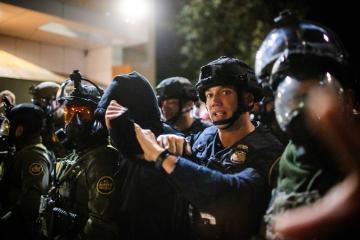
A protester is arrested by police and U.S. Border Patrol officers outside a U.S. Immigration and Customs Enforcement facility in Portland, Ore., Monday, Oct. 6, 2025. (AP Photo/Ethan Swope)
Don Heider (@donheider) is executive director of the Markkula Center for Applied Ethics at Santa Clara University. Views are his own.
In September 2025, a now-deleted social media post from U.S. Immigration and Customs Enforcement (ICE) sparked widespread outrage. The graphic, shared on X (formerly Twitter), claimed ICE enforces over 400 federal laws to “ensure public safety and national security,” and depicted the agency as stopping the crossings of people, money, products—and ideas. Though ICE later clarified that the post was an error and meant to reference “intellectual property,” the damage was done. The image and its implications ignited a firestorm of criticism from lawmakers, civil rights groups, and free speech advocates who saw it as emblematic of a deeper ethical crisis: the use of immigration law to persecute individuals based on their beliefs.
This essay uses a civil rights ethics framework to examine the growing tendency to weaponize immigration enforcement against people whose ideas challenge dominant narratives. Civil rights ethics demands that we protect individual liberties, ensure equal treatment under the law, and resist state overreach—especially when it threatens the foundational principles of free expression and democratic participation.
The Ethical Problem: Ideas as Contraband
ICE’s graphic wasn’t just poorly worded—it was revealing. It suggested that ideas themselves could be illegal, subject to surveillance and interdiction. That’s not an immigration issue. That’s a First Amendment issue. And it’s an ethical red flag.
The Department of Homeland Security’s recent announcement that it will monitor the social media of foreign students and immigrants for “antisemitic activity” adds another layer. While combating hate speech is a legitimate concern, the language used—“extremists,” “terrorist sympathizers”—is vague and politically loaded. Who decides what qualifies as dangerous speech? What safeguards exist to prevent ideological profiling?
Civil rights ethics insists that we treat speech as a protected form of expression, not a threat to be neutralized. When immigration enforcement becomes a tool for policing thought, we cross a line from national security into authoritarianism.
Immigration Law as a Weapon of Retaliation
This isn’t happening in a vacuum. The current administration has repeatedly used immigration law to punish perceived enemies. Visas have been revoked for pro-Palestinian activists. Journalists have been barred from covering events. Former officials have been investigated for allegedly “censoring disfavored speech.” These are not isolated incidents—they’re part of a pattern.
From an ethical standpoint, this is indefensible. Immigration law should be applied consistently and fairly, not selectively based on ideology. Civil rights ethics demands equal protection under the law. When enforcement becomes a tool for silencing critics, it undermines public trust and corrodes democratic norms.
It also disproportionately harms marginalized communities. Immigrants—especially those from politically sensitive regions—often lack the resources to challenge unjust treatment. Surveillance and visa revocation can derail lives, separate families, and endanger futures. Ethical governance must prioritize the dignity and safety of individuals over the preservation of political orthodoxy.
Transparency, Accountability, and Public Trust
ICE’s apology for the graphic—“We regret any confusion”—falls short. The issue isn’t confusion. It’s clarity. The image made clear that the agency sees itself as a gatekeeper of ideas. That’s not a mistake. That’s a mindset.
Civil rights ethics emphasizes transparency and accountability. When public institutions make statements that suggest a role in ideological control, they must be held to a higher standard. The public deserves more than retractions. It deserves answers.
Trust in government is an ethical issue. Citizens and non-citizens alike must be able to rely on institutions to act with integrity. When immigration enforcement becomes synonymous with censorship, that trust is broken.
Ethical Alternatives: What Should Enforcement Look Like?
If we’re serious about ethics, we need to rethink how immigration enforcement operates. Civil rights ethics offers a roadmap:
- Protect Free Expression: Immigration policy must distinguish between speech and action. Ideas—even controversial ones—should not be grounds for exclusion unless they incite violence or pose a clear, demonstrable threat.
- Ensure Due Process: Immigrants must have the right to challenge surveillance, visa revocation, and detention. Ethical governance treats individuals as rights-bearing persons, not as ideological risks.
- Demand Transparency: Agencies must clearly articulate their policies, especially when they intersect with civil liberties. Vague references to “extremism” must be replaced with specific, legally grounded criteria.
- Establish Oversight: Independent bodies should monitor enforcement practices to ensure civil rights are not being violated. Whistleblower protections, public reporting, and judicial review are essential.
Conclusion: Ethics at the Border
The controversy surrounding ICE’s social media post is more than a communications blunder—it is a window into the ethical tensions at the heart of immigration enforcement in the United States. When the border becomes a barrier to thought, and immigration law a weapon against dissent, we risk betraying the very values that define a free society.
Civil rights ethics calls us to defend the rights of all individuals—citizens and immigrants alike—to think, speak, and believe freely. In doing so, we uphold the principles that make democracy possible. We protect not just borders, but the moral boundaries of a just society.