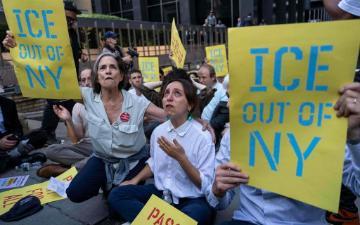
Demonstrators chant during a protest against Immigration and Customs Enforcement (ICE) outside the Jacob K. Javits federal building, Thursday, Sept. 18, 2025, in New York. (AP Photo/Yuki Iwamura)
Davina Hurt is the director of the Government Ethics Program at the Markkula Center for Applied Ethics. Views are her own.
"This land is your land. This land is my land … this land was made for you and me.”
I was sitting late at night in my neighborhood restaurant when the social contract shattered. The place was like a modern-day Cheers— immigrant-owned, filled with diverse community members who knew each other's names and prided themselves on civil discourse. We often debated difficult issues, and disagreements never turned personal in this small town.
Until this night.
As images of handcuffed families flashed across the news, I shared my concerns about the ethics of deportation raids. One patron snapped. He insisted deportations weren’t about ethnicity at all—that white people face discrimination too and his forefathers were not illegal. Then his frustration turned personal: my race, my last election, even comparisons to his ex-wife. It wasn’t about ideas anymore — it was about discrediting me, as others looked on in silence.
His rage-filled words felt ancient—an echo of something this country has never fully left behind. It brought to mind my own interwoven family history, one branch tied by blood to George Wallace, who declared “segregation forever,” and the other marked by military service and civil rights activism. Watching that man’s fury—I recognized the same impulse that put Wallace in power—the belief that some Americans are more American than others. Black family members in the South knew this thinking intimately, experiencing the racist treatment that made their American citizenship feel perpetually provisional. I hadn't felt that same conditional belonging so acutely since leaving Texas. That strand of family history has always reminded me how quickly private prejudice hardens into public policy.
The restaurant breakdown revealed how fragile the Common Good truly is. Exclusionary hostility corrodes the trust that makes democratic community possible. When shared norms collapse, core principles fall with them: public safety is threatened, equal treatment erodes, civility vanishes, and the vulnerable lose protection. The restaurant owner’s passive, but well-intentioned reminder that we were all friends could not repair what had been broken. The premise of respectful disagreement had shattered, and with it, our ability to navigate differences without destroying each other. When even one person abandons the shared norms that bind us together, the whole community can suffer. The same principle applies to institutions: when agencies abandon constitutional norms, the damage extends far beyond their immediate targets to the integrity of democratic governance itself.
As a former elected official, I’ve weathered hostility before. But what lingered from that night wasn’t his anger—it was the reminder of how quickly belonging can be declared conditional. In a restaurant, it creates discomfort. In government hands, it becomes dangerous. When identity, not conduct, determines how the law treats you, the violation extends beyond social trust to constitutional rights. With the U.S. Immigration and Customs Enforcement (ICE), the stakes are not awkward conversations, but far higher: families torn apart, rights denied, and communities living in fear.
Political leaders have made this connection explicit. At the National Conservatism Conference, Missouri Senator Eric Schmitt said the quiet part out loud: "America belongs to us… this is our home." This was no mere policy stance—it was a claim of ownership and sole belonging. Where Woody Guthrie sang of shared belonging, Schmitt’s phrasing of “our land” recasts the nation as a private inheritance, defined by exclusion. Commentators have noted that such language echoes themes of “blood-and-soil” rhetoric historically tied to white supremacist movements—celebrating European settler heritage while marginalizing immigrant and Indigenous histories. In this reading, Schmitt’s remarks carried the same exclusionary spirit that George Wallace once captured with his cry of “segregation forever”—updated with the polish of modern nationalism.
From Personal Prejudice to Institutional Practice
The ethical problem lies in how exclusionary thinking operates across scales. What I witnessed in that restaurant—one person dismissing me because of my race rather than engaging my ideas—reveals the same pattern that drives immigration enforcement when it systematically targets entire communities based on identity rather than conduct.
This isn't coincidence; it's how prejudice scales. The restaurant patron decided my race disqualified my opinions about deportation policy. ICE operations often decide that Latino appearance justifies questioning someone's right to be in specific neighborhoods, workplaces, or schools. Both rely on the assumption that identity predicts behavior, threat, or legitimacy. Both create hierarchies where some people's presence requires justification, while others' does not.
The same logic that once made segregation seem reasonable to its supporters—the belief that some Americans are more American than others—now underpins immigration enforcement where constitutional protections become privileges to be earned rather than rights to be upheld. When agencies target identity rather than conduct, they violate fundamental principles of governmental ethics: that law enforcement must serve all persons equally and that government power must be exercised impartially under law.
The Constitution's guarantee of equal protection prohibits differential treatment—it creates affirmative governmental obligations to ensure equal justice. Yet ICE enforcement patterns consistently violate these duties. Immigration raids concentrate in Latino neighborhoods while similar violations in predominantly white areas receive less attention. Workplaces are selected based on workforce demographics rather than verified violations. Children are separated from parents without meaningful hearings, reducing due process to paperwork. These practices extend beyond Latinos to Black and Asian Americans, folding anyone deemed "other" into a system that equates difference with illegitimacy.
This pattern reflects deeper failures in governmental ethics: agencies operating without adequate oversight to prevent discriminatory bias, insufficient accountability mechanisms to detect and correct problematic patterns, and leadership that tolerates practices undermining equal justice under law. This systematic profiling erodes constitutional protections and corrodes democratic legitimacy by transforming law enforcement into identity enforcement, violating the ethical foundations necessary for both individual rights and legitimate governance.
The Way Forward: Restoring Ethical Enforcement
The restaurant moment crystallizes the broader ethical challenge: what I felt that night—the sense that my belonging was conditional based on identity—mirrors what entire communities endure under current immigration enforcement. The patron who decided I didn’t belong at a table was exercising individually what ICE too often does institutionally: denying dignity, deciding whose rights count based on appearance rather than conduct. It is the same exclusionary impulse that once put George Wallace in power—segregation then, immigration enforcement now.
But this parallel also reveals a path toward ethical reform. Just as the restaurant could have maintained its social contract through consistent application of respectful norms regardless of who was speaking, immigration enforcement can uphold both law and constitutional principles through practices that focus on conduct rather than identity.
Ethical immigration enforcement would require several fundamental shifts: enforcement based on specific violations rather than demographic targeting, oversight mechanisms that actively prevent discriminatory targeting, accountability systems that track and correct biased enforcement patterns, due process protections that treat family unity as a constitutional consideration, and leadership committed to equal protection as operational principle rather than abstract ideal. Most importantly, it would require acknowledging that constitutional protections extend to all persons within American borders, rights inherent in personhood, not privileges earned through appearance or origin.
The Markkula Center's Framework for Ethical Decision Making demonstrates why this matters across multiple ethical dimensions. Through the lens of Rights, ICE's identity-based targeting violates equal protection and due process. Through Common Good analysis, such practices corrode the trust necessary for legitimate governance. Through the Virtue lens, they reflect institutional character of governance that prioritizes exclusion over justice.
The restaurant that night showed me how quickly social contracts can shatter when exclusionary impulses take hold. But it also reminded me why those contracts matter: they create spaces where people can belong together despite difference, where disagreement doesn't destroy community, where dignity is not conditional on identity.
That strand of family history connecting me to Wallace serves as a constant reminder that the choice between exclusion and inclusion shapes real lives, real communities, real futures. Wallace eventually sought redemption by recognizing the harm his segregationist politics caused. We face the same moral choice today: will we allow the exclusionary impulses that drive identity-based enforcement to define our institutions, or will we choose the moral clarity needed to build systems worthy of our constitutional ideals?
Woody Guthrie's vision—"this land was made for you and me"—remains achievable, but only if we insist that our institutions, like our communities, honor the promise of shared belonging rather than enforcing hierarchies of worthiness. The restaurant that night showed me both how quickly social contracts shatter and why they matter: they create spaces where people belong together despite difference, where dignity is not conditional on identity. In the end, how we treat the most vulnerable among us reveals not their character, but our own.