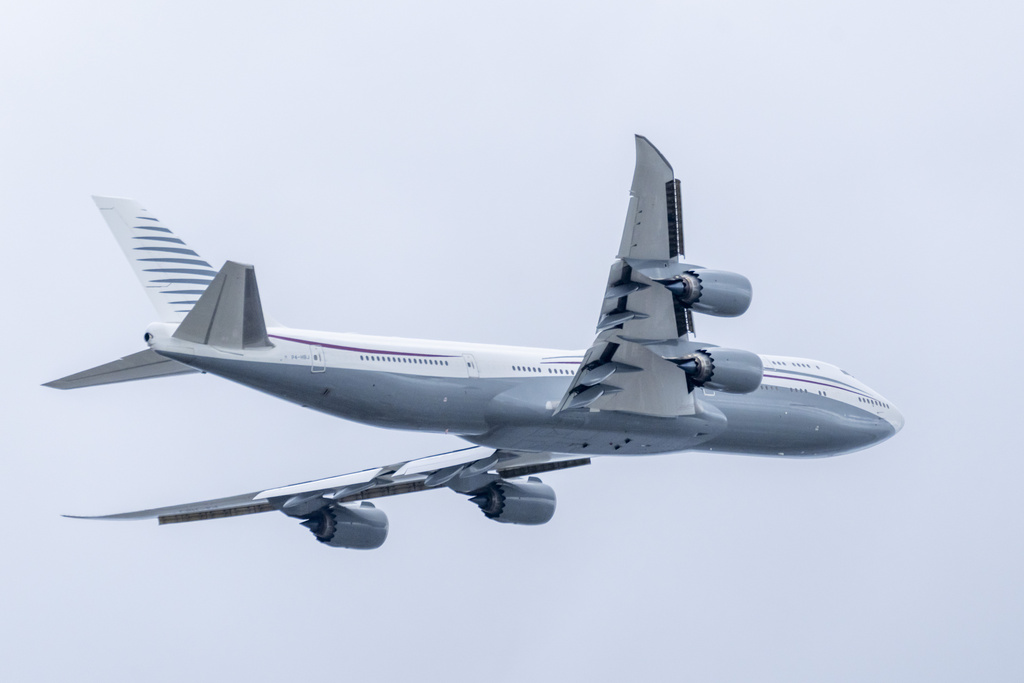
A 13-year-old private Boeing aircraft that President Donald Trump toured to check out new hardware and technology features, and highlight the aircraft maker's delay in delivering updated versions of the Air Force One presidential aircraft, takes off from Palm Beach International Airport, Feb. 16, 2025, in West Palm Beach, Fla. (AP Photo/Ben Curtis, File)
Davina Hurt is the director of government ethics at the Markkula Center for Applied Ethics at Santa Clara University. Views are her own.
Growing up, my parents taught me many lessons, but two simple rules stuck with me when visiting friends: don't accept expensive gifts, and never grab the last chip from the bowl. Both cross invisible lines of courtesy and respect. Those childhood lessons should echo loudly on today's national stage.
Four months after Qatar presented the United States with a $400 million luxury Boeing 747-8 aircraft, the Gulf nation found itself under deadly attack—first by Iran in June, then by Israel in September. The Trump administration's unprecedented response to these strikes against our gift-giving ally reveals exactly why government ethics experts have long warned against accepting lavish gifts from foreign powers.
This isn't theoretical anymore. The ethical concerns that should have prevented accepting Qatar's unprecedented gift have materialized into a real-world diplomatic crisis that undermines American credibility and exposes the cost of mixing luxury gifts with foreign policy.
From Red Carpets to Rubble
In May 2025, President Trump signed a $1.2 trillion economic agreement with Qatar amid fanfare and red carpets. The Defense Department officially accepted Qatar's "unconditional donation" of the presidential aircraft (“Glitterbomb One” by my account)—the most expensive foreign gift in American history, exceeding the combined value of all such gifts since 2001.
By September, Qatar was fielding deadly attacks by Israel—and Trump's response was unprecedented in American diplomatic history. The president publicly declared he was "not thrilled" about the Israeli strike, wrote that he "feels very badly about the location of the attack," called Qatar, "a strong Ally and friend of the U.S.," and personally assured Qatar's leaders that "such a thing will not happen again on their soil."
This wasn't normal diplomatic relations—it was an extraordinary security guarantee no American president has ever extended to Qatar. The reversal from Trump's own 2017 position is jarring: then, he claimed he accused Qatar of funding “radical ideology.” The sequence illustrates precisely what government ethics frameworks are meant to prevent: foreign powers buying goodwill in elected officials through extravagance and receiving unprecedented policy reversals and favorable treatment in return.
The Ethics Warning Ignored
When news of Qatar's aircraft donation first emerged, ethics experts raised predictable concerns about "obligational relationships"—the invisible bonds created when officials accept substantial benefits from foreign entities seeking influence. The gift created exactly such a relationship, one that would inevitably complicate American foreign policy decision making.
This complication became starkly apparent when Israel struck Hamas targets in Qatar—forcing Trump to choose between supporting a traditional ally's security operations or protecting a gift-giving ally's sovereignty. The $400 million aircraft ensured he chose Qatar?
Those warnings weren't partisan rhetoric—they were professional assessments based on decades of studying how foreign influence operates in democratic systems. The current crisis validates every concern raised about accepting gifts that blur the lines between diplomacy and dependence, real or perceived.
The Founding Fathers included the Foreign Emoluments Clause in the Constitution for precisely this scenario. They understood that foreign influence rarely arrives through obvious bribery—it comes wrapped in diplomatic courtesy and justified by legal technicalities, creating obligations that compromise independent decision making exactly when clarity is most needed.
The Real-World Consequences
Qatar's expectation of American protection wasn't unreasonable given the scale of recent investments. Beyond the aircraft, the May 2025 economic agreement represented a massive Qatari commitment to American partnership. From Qatar's perspective, they could easily perceive that these weren't charitable donations—they were strategic investments in a relationship they expected would provide security guarantees.
When Qatar came under attack, those expectations were fulfilled in unprecedented ways:
Compromised Decision Making: America's ability to respond clearly to Middle East violence is complicated by our acceptance of Qatari largesse–gifts. Every policy decision must now be weighed against obligations created by past gifts.
Alliance Hierarchy by Price: When America prioritizes gift-giving allies over traditional partners in regional conflicts, it signals that diplomatic relationships are for sale to the highest bidder.
Constitutional Violation in Practice: The dramatic shift from 2017 opposition to 2025 protection coincides directly with Qatar's massive financial investments, demonstrating exactly why the Founders included the Foreign Emoluments Clause.
Precedential Damage: Future foreign powers will study this sequence and draw conclusions about how expensive gifts can constrain American foreign policy responses, potentially encouraging more such "investments" in American officials.
The Returns Keep Coming
The pattern of reciprocity continued to materialize in October 2025. Just weeks after Trump's unprecedented security guarantee to Qatar following the Israeli strike, Defense Secretary Pete Hegseth announced that the United States would allow Qatar to build a dedicated Air Force training facility at Mountain Home Air Force Base in Idaho—a facility that would host Qatari F-15 jets and approximately 300 Qatari and American personnel.
While Pentagon officials noted that similar arrangements exist with other allies like Singapore, this announcement represents something more significant: Qatar will be constructing an entirely new facility from the ground up, an arrangement even close U.S. allies typically don't receive. The timing is impossible to ignore—coming just months after the $400 million aircraft gift and weeks after Trump's protective response to attacks on Qatari soil.
The Idaho facility underscores the cumulative nature of obligational relationships. Each benefit builds upon the last: a $400 million aircraft in May, a $1.2 trillion economic agreement with unprecedented fanfare, an extraordinary security guarantee in September, and now dedicated military infrastructure on American soil in October. This isn't diplomatic engagement—it's a pattern of escalating commitments that parallel escalating Qatari investments in American leadership. After the base is built, what will the Trump administration ask in return, especially when it comes to controlling states who are not favored?
Even the controversy surrounding the announcement reveals the ethical trap. When Trump allies and other MAGA figures expressed outrage about the facility, the administration found itself defending a decision that directly contradicts Trump's own 2017 characterization of Qatar as a "funder of terrorism at a very high level." The $400 million gift—and subsequent Qatari investments—made reversing that position not just possible but apparently necessary.
The Taxpayer Bill Comes Due
Even as Qatar faces deadly attacks, American taxpayers continue bearing the ongoing costs of their gift. Security modifications, specialized maintenance, insurance, and operational expenses for the presidential aircraft will continue for decades—costs we didn't choose and don't need, especially when the donor nation's security situation complicates every aspect of the plane's use.
As my mother used to say: "It's not the buying—it's the upkeep that breaks the budget." The aircraft now represents more than luxury—it's a flying symbol of compromised independence, a constant reminder that American foreign policy operates within constraints created by accepting foreign largesse. And, now the American taxpayer is footing the bill not just for its maintenance, but for an unnecessary military base built to satisfy an ally’s expectations. What began as a gift has become a tab the public never agreed to pay.
This is how ethical lapses metastasize into fiscal ones: what starts as a symbolic gesture of friendship ends as a structural obligation. The burden shifts quietly—from the decision maker who accepted the gift to the citizens who must fund its consequences. In ethics, as in economics, there’s no such thing as a free plane.
Beyond This Crisis
The Qatar situation illustrates broader vulnerabilities in American democratic governance. When officials across government—from presidents to city council members—accept substantial benefits from foreign entities, they create similar complications for American independence.
This crisis demonstrates that ethical guidelines aren't abstract principles but practical safeguards designed to preserve decision-making clarity precisely when it's most needed. Legal compliance that permits technically allowable gifts doesn't resolve the fundamental tension between accepting foreign benefits and maintaining independent judgment.
Other democracies have recognized this dynamic and developed clearer boundaries. Many require automatic transfer of substantial foreign gifts to state institutions. Others mandate legislative approval above specific monetary thresholds. These approaches acknowledge diplomatic realities while preserving governmental independence.
The Pattern Revealed
The sequence from May's red carpets to September's deadly attacks reveals the predictable progression of gift-based relationships with foreign powers:
- Initial Courtship: Expensive gifts presented amid diplomatic fanfare
- Expectation Creation: Donor nations reasonably expect favorable treatment
- Crisis Testing: International events force difficult choices between American interests and donor relationships
- Credibility Damage: Constrained responses undermine broader American diplomatic effectiveness
This pattern will repeat with other nations offering substantial gifts to American officials, each expecting similar consideration when their interests conflict with clear American decision making.
The Choice Still Before Us
While Qatar's gift cannot be returned, its consequences should inform future policy. Americans deserve leaders who recognize that ethical governance requires higher standards than legal minimums, who understand that accepting foreign largesse inevitably complicates independent decision making, and who prioritize institutional credibility over personal convenience.
The current crisis demonstrates that government ethics guidelines exist not to prevent diplomatic engagement but to preserve the independence necessary for effective diplomacy. When American officials become financially obligated to foreign powers, they lose the very independence that makes American partnership valuable.
Moving Forward
Reform requires acknowledging that this crisis was predictable and preventable. Clear monetary thresholds for gift acceptance, mandatory institutional rather than personal receipt of substantial donations, and enhanced transparency requirements could prevent similar complications in future administrations.
Most importantly, we need honest recognition that legal technicalities permitting gift acceptance don't resolve ethical concerns about foreign influence. The Qatar crisis proves that ethical warnings about compromised independence weren't theoretical—they were prophetic.
Qatar's attacks and Trump’s unprecedented protective response reveal the true cost of accepting substantial foreign gifts: not just taxpayer expenses or constitutional concerns, but fundamental policy reversals that prioritize donor interests over consistent American foreign policy. Trump's personal security guarantee to Qatar—unprecedented in presidential history—demonstrates exactly how expensive gifts create the obligational relationships ethics experts warned against.
The luxury aircraft may be beautiful to some and a “glitterbomb” to others, but the diplomatic obligations it represents have already transformed American Middle East policy in ways no previous president would have considered.