AI in Politics
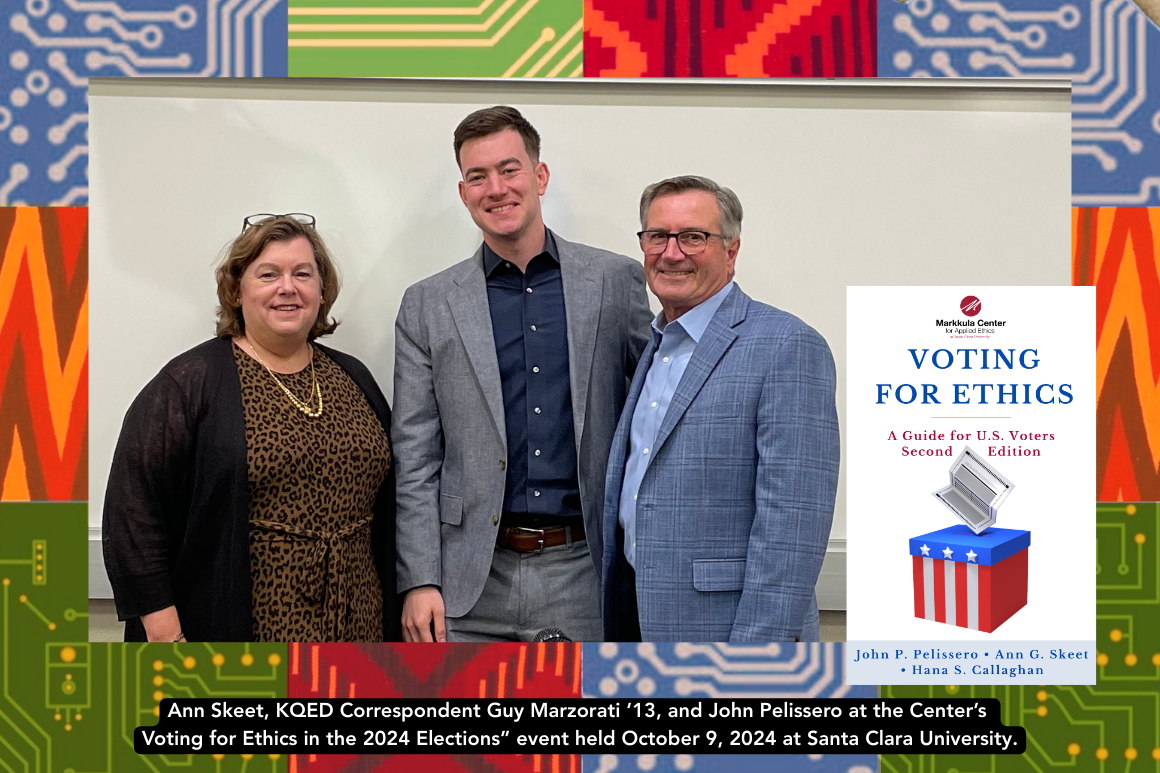
AI is constantly changing and reshaping our world, but nowhere is it more impactful than in politics and elections. In 2024, Ethics Center staff members John Pelissero, former director of government ethics, and Ann Skeet, senior director of leadership ethics, co-authored an update to “Voting for Ethics: A Guide for U.S. Voters,” including a chapter on artificial intelligence’s role in elections.
The book explores the absence of rules governing AI in politics, leaving both voters and candidates in a vulnerable position. As a result, voters must understand the influence they hold in shaping what constitutes acceptable behavior from candidates and in promoting best practices for AI’s use in campaigns. Given the power of AI, it is capable of potentially altering the outcome of elections. Voters have the opportunity to become advocates, educating others on how AI is transforming the electoral process. Additionally, it’s crucial for voters to understand the inherent biases within these systems, as the algorithms and data they rely on are shaped by humans with their own biases.
The book introduces us to “Ashley,” an AI campaign “volunteer” created by Civox. Fluent in over 20 languages, Ashley is an advanced robocaller that doesn’t rely on pre-recorded responses, but instead has customized one-on-one conversations with multiple voters. Candidates who choose to use this model feel like it’s worth the risk as it can communicate surprisingly well with many different audiences, but when a non-human AI system (such as Ashley) messes up, who is accountable? Mistakes made by AI reflect badly on candidates and their campaign values.
Voters cannot rely just on their own understanding of bias and AI, we have to use the tools provided to us. The book offers tips on how to protect one’s self during elections. For example, voters should proactively seek information about candidates instead of only consuming information delivered through mailboxes and social media. Voters should also be thinking about “the source of the information they are consuming, how it was gathered, what the process was for vetting or editing it, and how it is being reported or shared.”
The Center held two events leading up to the 2024 elections. The first, with Pelissero and Skeet, moderated by KQED Correspondent and SCU Alumnus, Guy Marzorati ’13, discussing the book and the importance of voting and considering ethics in voting decisions. The second event, moderated by Director of Journalism and Media Ethics, Subbu Vincent, focused on elections and the student experience, and the impact on misinformation in the election process.
Ann Skeet and John Pelissero also collaborated on an opinion article which ran in the Los Angeles Times. It advises voters to be extra vigilant: check who funded the message, inspect campaign media for signs of AI generation–such as missing fingers–and verify the source of what you receive.
Photo Credit:
Senior Director of Leadership Ethics Ann Skeet; KQED Correspondent Guy Marzorati ’13, and Former Director, Government Ethics, John Pelissero at the October 9, 2024 event, "Voting for Ethics in the 2024 Elections" held at Santa Clara University.