Convenings on AI
Every new technology forces us to ask if it honors or diminishes human dignity? Artificial Intelligence, more than any innovation before it, magnifies this question–shaping disciplines, workplaces, and even our sense of identity. As AI advances in current years and beyond, how are we to decide whether AI truly harms or benefits humanity for good?
Throughout the 2024-25 academic year, the Markkula Center for Applied Ethics brought together scholars, industry leaders, and technologists in a series of events to consider this question. From technology to education, these diverse events explored ways AI innovation can be guided by human values.
Digital Dignity Day
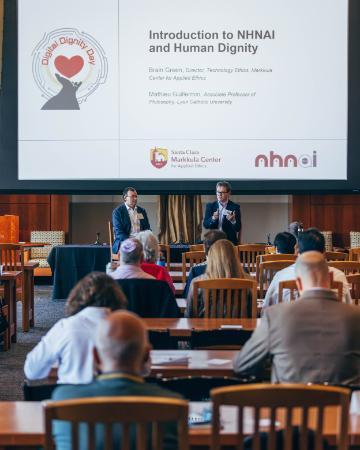
On May 2, 2025, The Markkula Center for Applied Ethics and the New Humanism in the time of Neurosciences and Artificial Intelligence (NHNAI) sponsored an insightful Digital Dignity Day, bringing together professionals and students. The event’s combination of presentations, panel discussions, and article submissions explored the impact AI is having on human dignity.
The Ethics Center’s director of technology ethics, and one of the event organizers, Brian Green, noted that human dignity is the foundation that should drive ethical judgements–particularly for those leading the development of AI.
“While many people might not think directly about dignity when making ethical judgments, it is there indirectly, a layer or two down. If we undermine dignity through bad choices about technologies, we put at risk a lot of other important ethical ideas–ideas which could collapse if their foundation is knocked out,” added Green.
Additionally, in her contributed essay, “Who Cares About the Ethics of AI? Women Do” Ann Skeet, Ethics Center senior director of leadership ethics, shed light on recent gender gaps of AI usage, emphasizing the different and consequential perspectives of men utilizing AI compared to women. These studies demonstrate the potential negative implications for women in the workforce–a unique byproduct of AI’s impact.
Looking into the AI Mirror with Professor Shannon Vallor
This year’s Regan Lecture featured Shannon Vallor, former Ethics Center faculty scholar, SCU professor, and current director of the Centre for Technomoral Futures at Edinburgh Futures Institute, University of Edinburgh. Author of The AI Mirror: How to Reclaim our Humanity in an Age of Machine Thinking, Vallor exposes the roots of AI and its reflective behaviors, using the analogy of a mirror.
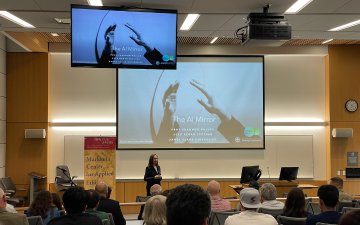
In her talk, Vallor posited that this reflection of humanity is simply that: an intangible, dependent reflection of what humanity feeds it. Vallor encapsulated the “common harmful misconceptions” classifying AI as a separate being rather than a representation of our pre-existing data.
Vallor discussed common harmful misconceptions, including the anthropomorphization of AI—descriptions implying it “thinks” and “hallucinates” rather than “calculates” or “fabricates”—and interpretations that classify AI as a separate being, rather than a reflection of our pre-existing knowledge and data: “A reflection of something is not something, just like the reflection of the mind is not the mind, because this reflection can’t think independently,” said Vallor.
Markkula Family Hosts Summit on Future of AI and Humanity
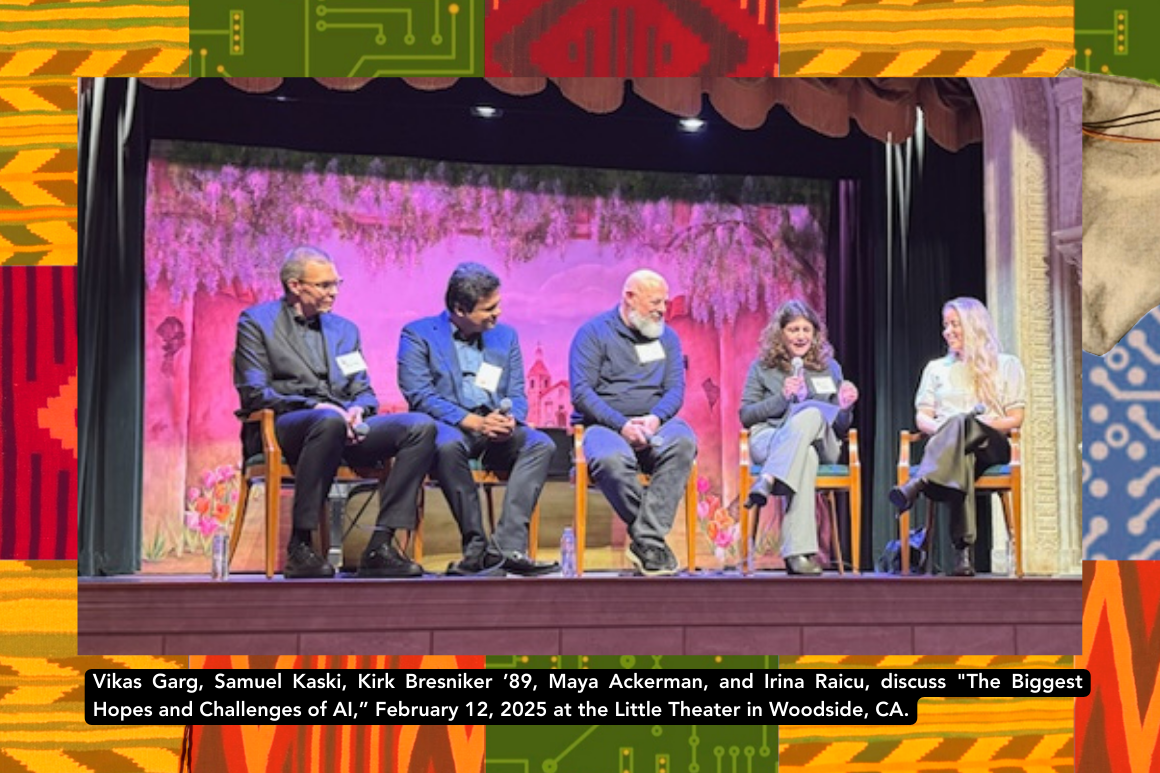
One of the events held during the year was hosted by the Markkula Family: the “Biggest Hopes and Challenges of AI.” Featuring AI experts from Finland and the U.S., the conversation of the panelists revolved around the question: “Will AI be a tool for enhancing humanity, or will it reduce us to passive bystanders in a machine-dominated future?”
Answers were defined by the many leaders in their respective disciplines. Kristi Markkula Bowers ’90 MBA ‘97, member of SCU’s Board of Trustees and co-founder and CEO of AI company, Grape.ag, emphasized that “Artificial Intelligence is no longer just a concept—it is a defining force shaping our evolving humanity. Its impact will inevitably touch every aspect of our lives, presenting both incredible opportunities and significant challenges…”
Others, like Irina Raicu, Vikas Garg (MIT PhD), Samuel Kaski (founding director of ELLIS Institute Finland), Maya Ackerman (Ph.D., CEO and co-founder of WaveAI, and SCU professor of AI), Kirk Bresniker ‘89 (chief architect of Hewlett Packard Labs and HPE fellow and vice president), and many more leaders shared thoughts about AI and its direct affect with start-ups and corporations. Amidst this round-table dinner, prominent figures like SCU President Julie Sulivan and Mike Markkula himself also closed the discussion by emphasizing on human moments– like the dinner– that defines our purpose for good.
As our director of Internet Ethics, Irina Raicu noted in her summary of Digital Dignity Day, “As the AI revolution continues, the upholding and protection of dignity in the digital realm will continue to be a focus of our work at the Ethics Center.”
Photo Credits:
Top: Aalto University Researchers, Vikas Garg and Samuel Kaski, Kirk Bresniker’89, Chief Architect of Hewlett Packard Labs, Hewlett Packard Enterprise Fellow and Vice President, and Maya Ackerman, Santa Clara University engineering professor and Generative AI pioneer, joined panel moderator, Irina Raicu, Ethics Center director of Internet ethics to discuss "The Biggest Hopes and Challenges of AI" on February 12, 2025.
Mid: NHNAI overview from Brian Green (Markkula Center for Applied Ethics) and Mathieu Guillermin (Lyon Catholic University) at the "Digital Dignity Day" conference held May 2, 2025. Photo by Miguel Ozuna, Santa Clara University.
Low: Professor Shannon Vallor, Baillie Gifford Professor in Ethics of Data and Artificial Intelligence and Director of the Centre for Technomoral Futures at the Edinburgh Futures Institute, University of Edinburgh discusses her book, "The AI Mirror" on April 28, 2025 at Santa Clara University.