"Our children should learn the general framework of their government and then they should know where they come in contact with the government, where it touches their daily lives and where their influence is exerted on the government."
Empowering Democracy: Educating an Ethical Citizenry
A collection of resources designed to support civic education and learning for higher education and high school curriculum.
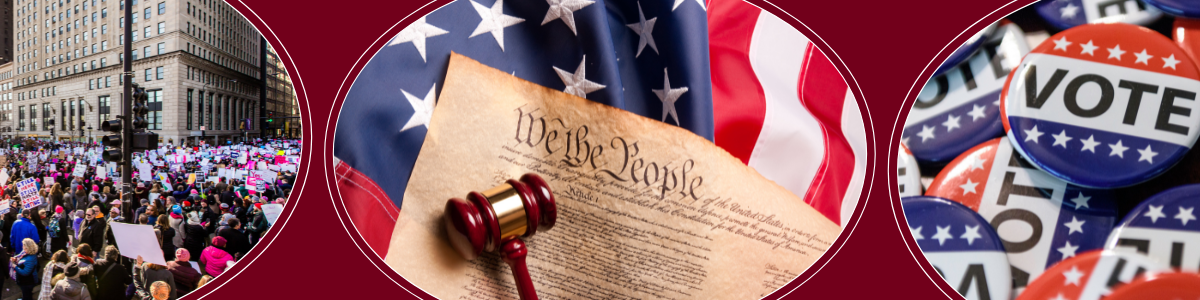
A democratic society requires an educated and informed citizenry that understands the purpose of democratic government and how the processes of a democracy work, especially voting and elections. Government has a special role in promoting the common good, an important ethical standard. As a society, we have moved away from formal civics education in our schools and colleges and the decline in civics education is producing a generation that does not understand or trust in the institutions and processes of democracy.
Youth are a key audience for civics education, not only for the broad notion that they are the future, but because they are already an important political demographic. Yet, the amount of training and education that students received in civics has dropped significantly since the 1950s. The Markkula Center for Applied Ethics has developed a curriculum on the ethical value of democracy, especially the duty to participate in voting and elections. This can be taught as a special undergraduate course (e.g. first-year seminar) in colleges and universities or as an augmentation to existing social science college courses or required social studies education in secondary schools in the U.S. The goal of this educational program is to enhance the education of young people on civics and ethics that will expand knowledge, empower democratic participation in our electoral processes, and help restore trust in government.
The Empowering Democracy curriculum will vary somewhat for college and high school students, but the learning objectives will be similar:
- Promote student learning outcomes related to the ethical foundation of democratic governments to act in the public interest and to promote the common good for society.
- Educate students on the mechanisms in place in each state, as well as nationally, to protect voting rights and implement fair and honest elections for public offices.
- Demonstrate how election authorities carry out their constitutional and legal duties to ensure fairness in voting processes and justice in the conduct and outcomes of elections.
- Demonstrate how democratic processes, including participation in civic life, are in concert with the constitution and rule of law that serve the common good.
- Empower good democratic practices that will enhance trust in the outcomes of elections and the policy-making role of government.
Empowering Democracy Resources
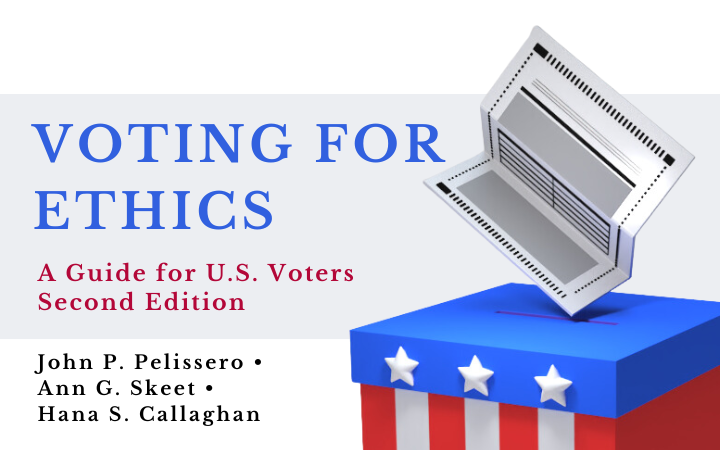
"Voting for Ethics: A Guide for U.S. Voters"
Voting for Ethics is a non-partisan, how-to guide for U.S. voters.
Authored by John Pelissero, Ann Skeet, and Hana Callaghan, this book will help you identify the hallmarks of an ethical candidate and make a more informed decision -- whether for your local school board or a national election. Voting for Ethics is available to purchase from Amazon.

Curriculum for Empowering Democracy
The curriculum consists of ten modules that can be used together or as single distinct topics to augment existing pedagogical approaches to college and high school curricula. Topics include:
- Democracy and Voting
- Conducting U.S. Elections
- Voting Procedures and Rules in the U.S.
- Ensuring Fair and Impartial Elections
- How Does the Presidential Election Process Work?
- What is an Ethical Voter?
- How to Learn about Candidates and Issues
- What is the Primary Role of the News Media in Elections?
- How Technology Impacts Information about Elections
- Why Citizens Should Have Trust in the Integrity of U.S. Elections

The headlines this election cycle have been dominated by unprecedented events, it’s no wonder other important political developments have been drowned out, including the steady drip of artificial intelligence-enhanced attempts to influence voters.

John Pelissero, director, government ethics, quoted by The Oaklandside.

The common good would be better served by debates that elevated voters’ confidence in our ability to engage in civil discourse, restoring some of the trust the public has lost in its elected officials.

Here are five of the most common conflicts of interest in government and how officials can avoid and prevent even the appearance of acting to benefit their personal and financial interests, at the cost of the public’s interest.

Why did the affordability crisis, misinformation, immigration chaos, and endless wars not split the Black women’s vote? Civic duty and protecting hard-won freedoms.

U.S. Journalism leaders offer lessons and moral framing to help political reporters better cover low-income and poor Americans as voters.

The Kamala Harris-Donald Trump presidential debate missed the voices of America's biggest category of 'swing voters'--low-income and poor people.
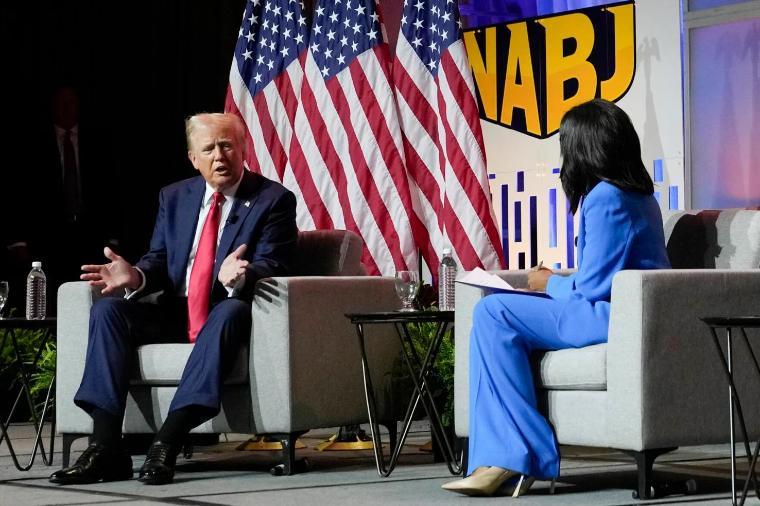
At the NABJ convention in Chicago on July 31st, Donald Trump Asked Rachel Scott To Define DEI. She Should Have.
- More pages:

Government Ethics
The Markkula Center for Applied Ethics explores Government Ethics issues including campaign ethics, conflicts of interest, gifts to officials, transparency, budgeting, and other topics.

Journalism & Media Ethics
The Markkula Center for Applied Ethics explores ethical issues in journalism and media.
American Political Science Association (APSA)
Secondary Education:
-National Council for Social Studies
For More Information
To connect about civic education modules, government ethics, or empowering democracy, contact Director, Government Ethics, Davina Hurt. For media commentary contact Joel Dibble, senior director, news and public relations at jdibble@scu.edu.

About John P. Pelissero
John Pelissero, the former director of government ethics at the Markkula Center for Applied Ethics, is professor emeritus of Political Science at Loyola University Chicago and served the university in leadership roles, including provost and chief academic officer. He is the author of several books on American politics and urban management, scholarly journal articles, and thought leadership essays on ethics and government. He is the coauthor (with Ann Skeet and Hana Callaghan) of Voting for Ethics, 2nd ed. (2024).

About Subbu Vincent
Subbu Vincent is the director of journalism and media ethics at the Markkula Center for Applied Ethics. He was a 2016 John S. Knight fellow at Stanford University and visiting scholar at Stanford's Human Sciences and Technology Advanced Research Institute. He was publisher and editor-in-chief of two award-winning public affairs news magazines in India. His focus is on developing tools and frameworks to help advance new norms in storytelling practice, ethical news product design, and to help the public process and demand ethical media. His recent work overlaps into ethical-AI to ingest, sort, and classify news.