By Julia A Scott, Ph.D, Bhanujeet Chaudhary, and Aryan Bagade.
XR is a powerful and flexible research tool in numerous disciplines. To continue productive research programs and support progress in innovation, practical steps can be taken to bolster human subjects protections and establish research guidelines that are applicable in both Social/Behavioral and Biomedical review processes.
The following checklist is intended to call attention to areas of additional levels of review for human subjects protections in XR research. The first goal is transparency in the collection, use, and storage of data. This will provide committees with the knowledge to evaluate the privacy risks to the participants. The second goal is to inform the participant of the planned and potential use of the data and provide choice on levels of consent. The third goal is ensure the safety of participants through research team empirical risk assessment and mitigation as well as relevant supplemental training beyond basic Human Subjects Research certification.
Review Criteria: Human Subjects Protections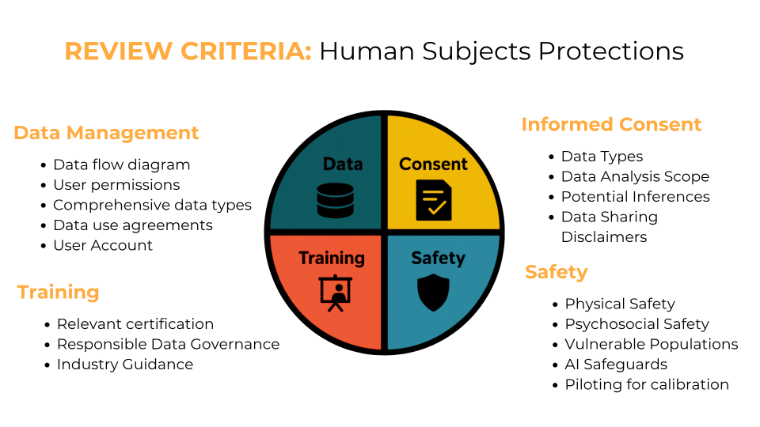
(Image: REVIEW CRITERIA: Human Subjects Protections. Source: Scott, Chaudhary, Bagade, 2024.)
Data Management
- Data flow diagram
A data flow diagram illustrate the data management plan and explicitly identifies how data moves through complex systems - User permissions
Limiting permissions to types of data within a research team with greater granularity than “de-identified” datasets - Comprehensive data types
Report all data types collected inclusive of intended, unintentional, and accidental - Third-party data use agreements
Include data use agreements of hardware devices and software applications used in the study - User Accounts
Provide justification for participant obligation to create user accounts with their personal identity
Informed Consent
- Data Types
List categories of data collected in lay terms - Data Analysis Scope
Describe both the intended use of study data and future use - Potential Inferences
Identify risks in inferences related to personal and sensitive data, including any inference made by automated decision making systems/AI models - Data Sharing
Name which data types and metadata plans to be shared - Disclaimers
Highlight groups that may be at greater safety risk, in addition to exclusion criteria
Safety
- Physical Safety
Identify environmental and personal safety measures implemented - Psychosocial Safety
Describe how psychological risks are accounted for and mitigated - Vulnerable Populations
Justify inclusion of vulnerable groups, especially those with mental health conditions - AI Safeguards
Determine whether participant is a data donor to AI models, describe potential for user manipulation by AI, and identify the boundary conditions of generative AI - Piloting for calibration
Submit pilot study data that calibrating the content and intensity of the user experience in the study
Training
- Relevant certification
Submit supplemental training for technology used - XRSI Responsible Data Governance
Consult industry standard for data management - Industry Guidance
Refer to domain specific guidance on best practices
Resources
| Role | Organization |
|---|---|
|
Developer |
|
|
Trials |
|
|
Medical |
|
|
Engineering |
|
|
Psychology |
|
|
Ethics |
|
|
Policy |
Comparison of Risk Categories
The inputs from the workshop respondents were mapped to the review criteria in the suggested guidance and ranked based on the frequency of mention and the severity of concern (Table 1). Data privacy and user safety experts (Expert) evaluated the review criteria for each case study as a compartor. There were many areas of alignment between the research compliance officers (Learners) and Expert’s assessments. Differences in risk assessment associated with AI and XR were evident, which were more associated with depth of technical knowledge rather than differences in policy interpretation. In some areas, Learners overestimated safety risks (e.g. AI safeguards in Haptics). Then on other dimensions, Learners overlooked relevant mitigation strategies (e.g. Industry guidance in Biodata). The greatest discordance was in Data Management across all case studies.
Table 1. Review criteria for study protocols and sample rankings of level of relevance in broad study types by Expert and Learner assessments.
| Review Criteria | Biodata | Haptics | Motion Tracking |
|
Data Management |
|||
|
Data Flow Diagram |
HIGH |
LOW |
HIGH |
|
User Permissions |
MED |
LOW |
MED |
|
Comprehensive Data Types |
HIGH |
LOW |
HIGH |
|
Third-party Data Use Agreements |
MED |
LOW |
HIGH |
|
User Accounts |
LOW |
NA |
MED |
|
Informed Consent |
|||
|
Data Types |
HIGH |
LOW |
HIGH |
|
Data Analysis Scope |
MED |
MED |
HIGH |
|
Potential Inferences |
HIGH |
LOW |
HIGH |
|
Data Sharing |
MED |
LOW |
MED |
|
Disclaimers |
HIGH |
HIGH |
HIGH |
|
Safety |
|||
|
Physical Safety |
MED |
HIGH |
LOW |
|
Psychosocial Safety |
HIGH |
MED |
LOW |
|
Vulnerable Populations |
HIGH |
HIGH |
LOW |
|
AI Safeguards |
MED |
NA |
HIGH |
|
Piloting for Calibration |
HIGH |
HIGH |
LOW |
|
Training |
|||
|
Relevant Certification |
MED |
HIGH |
NA |
|
Responsible Data Governance |
MED |
LOW |
HIGH |
|
Industry Guidance |
HIGH |
HIGH |
LOW |