Top Stories
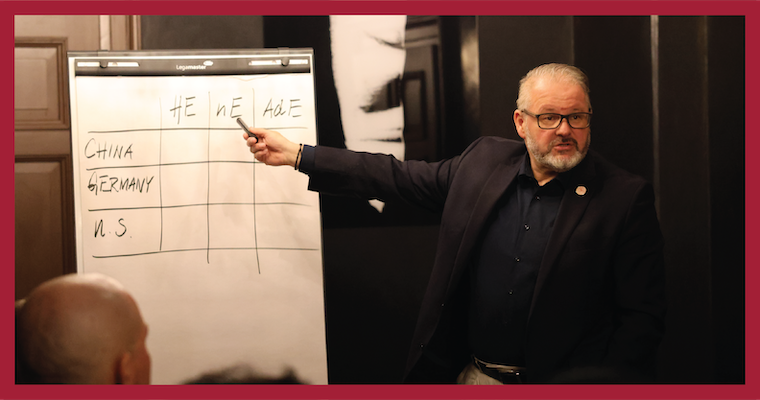
German Engineering Meets Silicon Valley Entrepreneurship
A partnership between the Leavey Executive Center and Deggendorf Institute of Technology supports smart, scalable startups and spinoffs.
The Silicon Valley Program at Germany’s Deggendorf Institute of Technology (DIT) ends with student teams pitching in front of the region’s heavy hitter venture capitalists. So perhaps it’s appropriate that the program itself began with a pitch.
The year was 2009, and Peter Schmieder had just taken over the MBA program at DIT. He was looking for a partner in the U.S. to expand the school’s yearly week-long travel programs. But he didn’t want just any location.
“I was looking for the place where they understood the real art of scaling entrepreneurship,” Schmieder says. “And I know there was this diamond in Silicon Valley at Santa Clara University.” Schmieder did what any aspiring entrepreneur would do before making a pitch: “I did a lot of background research, because you only have one shot.”
Schmieder outlined the potential benefits of such a partnership, both for DIT and for the Leavey Executive Center at the Leavey School of Business. Then he made the cold call that would lead to a long-running program that now serves 10 aspiring business ventures in Germany and at Santa Clara each year.
A Different Kind of Student
Using its own startup mentality — complete with iterations and pivots — the Silicon Valley Program has evolved from early cultural exchanges into a nine-month experience designed to introduce promising German businesses to the world of pitching and startup investment, all served through the lens of America’s tech landscape.
Schmieder worked closely with Leavey faculty to design a curriculum that would benefit a different kind of student. Those students include not only early-stage German startups but also Mittelstand companies — long-standing small and medium companies, many run by families — who have an enterprising new venture or spinoff to pitch. To develop the program, Schmieder leaned heavily on the knowledge of Leavey faculty such as Al Bruno, now professor emeritus, and Patrick Guerra, a Leavey graduate, institute director and angel investor.
“Together, we formed the curriculum for a program to go from, let’s say, a minimum-viable-product status to an invest-ready company,” Schmieder says.
Schmieder and team start each year of the program by whittling down roughly 200 possible ventures to 10 teams that have a minimum viable product with investment-worthy potential. From there, on its own dedicated campus in Germany, the Silicon Valley program begins with an intensive “bootcamp” designed to identify the core of each team’s scalable business model. Teams then move through months of mentorship and workshops on everything from market segmentation to risk management to go-to-market strategy. The experience culminates in a trip to Silicon Valley.
“We profit and gain a lot from the Santa Clara ecosystem,” Schmieder says. “And of course, in our final week, we bring all our ventures to Silicon Valley for an extreme deep-dive workshop with mentors, speakers and a final pitch in front of sophisticated VCs.”
The week spent is in and around campus is not just about the pitch. Teams visit companies to learn and practice, and the program brings in highly renowned speakers such as Michael Shepherd from GrowthPoint. But ultimately, that final pitch serves as the North Star as these entrepreneurial teams condense months worth of learning into a 7-minute presentation that has to wow people who sit through presentations for a living.
Jessica Laxa, who now works for DIT, had the experience of going through the program as a team member. She stresses how eye-opening the difference is for tech-minded German business-people pitching in America, many for the first time. Whereas in Germany potential investors may focus primarily on the engineering behind a product, their American counterparts have more of a keen focus on packaging, team dynamics and business modeling.
“In Silicon Valley, the team is very important, the business model is very important, and everything else may be at the second level of interest,” she says.
On-Point Pitches
Philipp Gellert, part of the German company team iVivid, says the trip to Silicon Valley was clearly a highlight: “During the program, you really learn a lot about priorities and the level of quality that is expected in regards to a ‘perfect pitching session.’ Be sharp and on point.”
During the program, iVivid was working on an AI product designed to tackle a “very German problem” in the healthcare industry related to billing for ambulatory services. iVivid did not gain U.S. investors because its market is specific to Germany, but Gellert says the entire program proved invaluable regardless.
“For us, the game changer was the early market validation,” Gellert says. “It is a very big difference if you create a product in “the lab” or if you speak directly to market participants. The program allowed us both, yet the work “in the lab“ was way more fruitful because of the input we got from countless interviews with people from the hospital world.”
The Silicon Valley Program has received its own validation, too. For one thing, the program was voted No. 1 in a worldwide ranking for “entrepreneurial spirit” by the World Conference of the Hanseatic League of Universities. For another, according to Schmieder, a survey of teams from the past five years reveals revenue growth quadrupling and employee size doubling.
DIT remains engaged with companies as they pursue additional funding and plans to go to market. Many past participants are at various stages of investment and market valuation at this point. Ultimately, the most promising teams are the ones that have lived by Schmieder’s idea that you only have one shot.
“The teams that come with a high-level, prepared pitch that is funded in numbers, market research, deep-dive customer interviews, testing, KPIs, they have a great time because they're just polishing their pitch,” he says. “They are the ones that succeed.”