Top Stories
The Sustainability Mindset
Kumar Sarangee challenges future leaders to view varied aspects of business through the lens of sustainability.
For Kumar Sarangee, sustainability is personal. The Leavey School of Business associate professor of marketing and longtime advisor to the Leavey Executive Center (LEC) became interested in the growing field not because of any particular bit of research or scholarship, but because he reconnected with nature during the pandemic.
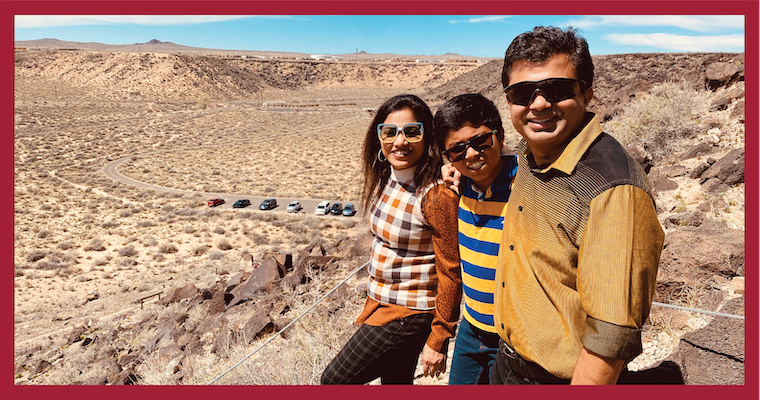
Like countless others who sought relief from cabin fever at the time, Sarangee, his wife and son discovered the joys of outdoor spaces. In the past five years, they’ve spent weeks exploring the wonders of the Oregon coast, the deserts and mountains of Arizona, the majestic forests of Northern California, and other gems across the country. They became devotees of the U.S. National Parks system.
“I just started appreciating nature more and more,” Sarangee says. “I had not done a lot of nature-based traveling before COVID happened, and I realized how much I’d missed out on in life.”
It didn’t take long for Sarangee to connect his newfound appreciation for the natural world with his professional expertise in marketing, product development and entrepreneurship. At roughly the same time, Dean Ed Grier’s new strategic plan for the business school, Leavey PLUS, put sustainability front and center. As executive director of the school’s MBA program at the time, Sarangee saw an opportunity to make business sustainability a core component of a Leavey education.
“We are building aspiring leaders that need to understand sustainability,” Sarangee says. “That’s not just a focus on the climate or a focus on certain types of companies. What I want is to develop a business sustainability mindset — a mindset you need to have irrespective of whichever company you work for or whichever industry you work in.”
Sarangee says far too often, companies look at sustainability as a buzzword, or they view it too narrowly. It becomes something “nice to have,” but the second budgets get tight, sustainability is one of the first things on the chopping block.
Treating sustainability as a core component of business education would ensure it’s ingrained in the minds of future leaders rather than being an afterthought. So would a curriculum that applies sustainability to everything from environmental impact to supply chain management to talent retention.
“It’s all integrative,” Sarangee says. “We know that eventually resources will dry up, so thinking about environmental impact is part of it. But we also know talent retention is crucially important, and we know companies need to invest in employees. If you take everything integratively as leaders, while also thinking about profit, it can be a major competitive advantage for firms, which people don't realize.”
Curriculum and Immersion
As faculty director of Leavey’s Sustainable Business Institute (SBI), Sarangee is partly responsible for how sustainability plays out across the school, including around scholarly research, expert speakers, extracurricular activities, and curriculum.
SBI and the school are working to create new and relevant courses that will provide undergraduate students with a Sustainable Fellows program. For graduate students, the school now offers the Business Sustainability MBA Concentration. Students at all levels also have research opportunities, and SBI has helped student clubs such as Net Impact connect with real businesses around the country and world for experiential projects.
Such experiential learning is a highlight, Sarangee says. People absorb ideas and information best via immersion, so Leavey students visit wineries and breweries to assess environmental sustainability practices in person. They travel to Washington, D.C., to analyze how policy affects business. They tour companies in Silicon Valley to see what best practices are being implemented in their own backyard.
Sarangee envisions a similar model for the Leavey Executive Center’s custom programming. He has worked with the center since 2011 and has designed courses for partners including Adobe, Cadence, the Deggendorf Institute of Technology, E3 and more. Future LEC custom programs could bring leaders from Silicon Valley and beyond together to explore the ways business sustainability affects every aspect of a company, with courses and programming led by faculty experts.
“We have a deep bench of expertise to draw on,” he says. “And if you look at it, sustainability is one of the most cross-disciplinary domains, along with innovation or entrepreneurship. There is an accounting aspect to sustainability. There is an investment aspect to sustainability. There is a marketing aspect to sustainability, there's a strategic aspect to sustainability. So how do you strategize? How do you create a vision around all of this?”
The Change Agent
SBI has sponsored research on sustainability, in part to examine companies that have built successful visions. For example, Sarangee and colleagues developed a case study on the San Antonio Spurs and their former chief impact officer, who built a culture of empathetic leadership that is largely seen as a model to aspire to in the sports business.
That case study brings together two of Sarangee’s interests and Leavey areas of expertise; under his leadership, the school also has launched a master’s degree in sports business. The program has hosted a workshop on the importance of people and culture in sustainability, led in part by representatives from the San Francisco 49ers and San Jose Sharks. Next year, they plan to host a panel about diversity in sports, leaning on the expertise of Santa Clara graduates who also happen to be former Olympic medalists.
All of the above are part of Sarangee’s comprehensive approach to business sustainability. In much the same way he hopes future leaders will automatically have an ingrained sustainability mindset, he applies a sustainability lens to nearly everything he works on.
“I would like to think that I've been a change agent,” he says, “and I want to be part of the change.”