Stories
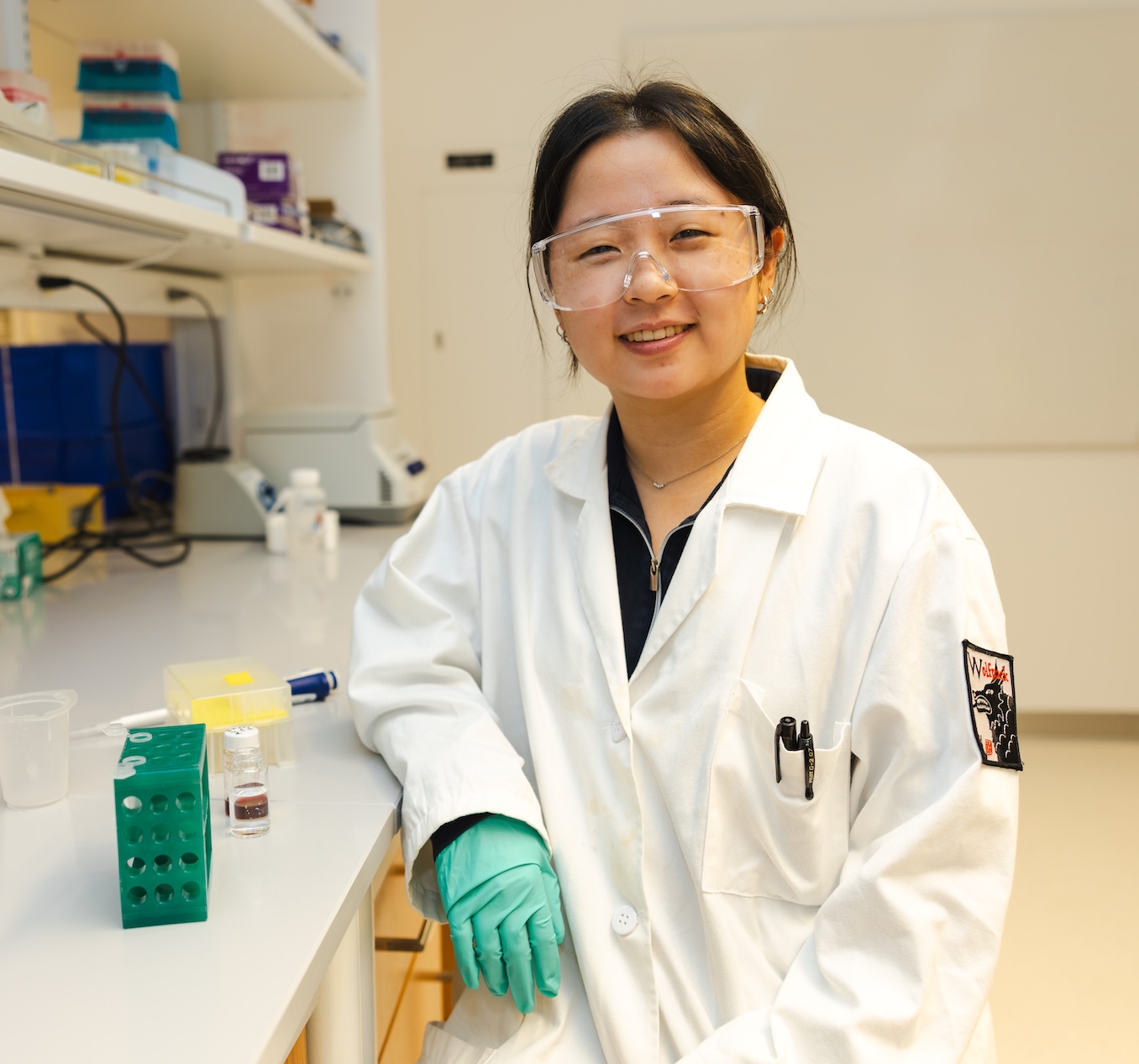
Rebecca An
Rebecca An ’27 wants to redesign how cancer drugs find their targets. This spring, she was named as a recipient of the Barry Goldwater Scholarship, one of the most prestigious undergraduate research awards in the United States.
The Goldwater Scholarship, established by Congress in honor of Senator Barry Goldwater, recognizes undergraduate researchers who demonstrate exceptional promise in science, mathematics, and engineering. This year, 482 academic institutions nominated 1,485 students from an estimated pool of more than 5,000 eligible sophomores and juniors. Jacqmotte-Parks and An were among the 454 selected this year. Since 2007, 11 Santa Clara University students have been named Goldwater Scholars.
The moment a nanoparticle enters human blood, it disappears. Not literally, but functionally. Within seconds, proteins swarm it, coating it in a layer that changes everything about how the particle behaves: where it goes, what it does, whether the drug it’s carrying ever reaches its target.
Rebecca An has a way of explaining this that makes it click. “When you put nanoparticles in the body, they form what we call a protein corona," she says. “If you think of a chocolate-covered macadamia nut, the protein corona would be the chocolate coating.” The nanoparticle is the macadamia nut. The coating is what the body actually sees.
An, a native of Los Gatos, California, approached the question the way she approaches most things: by reading ahead. As a first-year student, before she had joined any lab, she began attending office hours for a general chemistry course taught partly by Professor Korin Wheeler. She came with Wheeler's own published papers, already annotated. Wheeler invited her to join the lab.
“Rebecca had only been in college for a few months, but her questions made it clear she not only understood my research publications, but she was also already making connections and recognizing themes in the work,” Wheeler says. “That was an impressive feat at this stage.”
The work she’s doing is, by her own description, the first study of its kind. Fullerenes are hollow, spherical carbon nanoparticles that have attracted significant interest in drug delivery because they can pass through cell membranes and carry molecules, including cancer drugs, to specific targets. But until now, the protein corona that forms around them hadn’t been characterized, partly because the particles are so small that isolating the corona seemed methodologically impossible. Wheeler's lab developed new approaches to separate the nanoparticle from its coating. An spent the past year analyzing what’s in that coating and why.
The implications run toward something ambitious. “In an ideal world, we can fine-tune the chemical groups on the surface of the particle so it’s kind of like a built-in GPS,” said An. “When it attracts the right proteins, the body directs it to wherever it needs to go—your kidney, your lungs, wherever.” If researchers can predict and manipulate which proteins attach to a drug-carrying nanoparticle, they could theoretically design carriers that navigate the body with precision, reaching cancer cells while leaving healthy ones alone, potentially reducing the doses and side effects that make aggressive treatment so punishing.
But for An, the research carries a second obligation. “Nanotechnology has the potential to make really big impacts in personalized medicine and targeted therapies that are more humane,” she said. “It’s also important for us to understand the potential impact of these nanoparticles in our environment once we’re done using them.”
Upon returning to campus from a summer of research at the Adolphe Merkle Institute in Switzerland, An demonstrated a level of initiative that her faculty mentor, Wheeler, believes captures her essence. Rather than simply reporting on her experience, she presented the lab with concrete new directions, including a proposal to incorporate porous nanomaterials into their work. Wheeler notes that this specific contribution could represent a novel approach in the field and an interesting evolution of their team’s trajectory.
An is now a second author on a manuscript in preparation. Methods she developed have been formally added to the lab’s protocols. She has presented her work at the ACS Northern California Undergraduate Research Symposium.
“Coming into Santa Clara, I would have never imagined being interested in nanoparticle research or the possibility of continuing this research at the graduate level,” she says. “It kind of caught me by surprise. I wasn’t expecting to enjoy it this much.”
In the chemistry lab, An analyzes a nanoparticle sample.