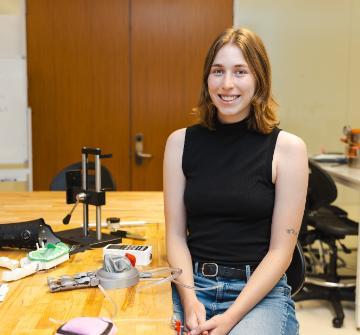
Sophie Jacqmotte-Parks
Sophie Jacqmotte-Parks ’27 wants to make functional prosthetic hands available to those who can’t afford one. This spring, she was named as a recipient of the Barry Goldwater Scholarship, one of the most prestigious undergraduate research awards in the United States.
The Goldwater Scholarship, established by Congress in honor of Senator Barry Goldwater, recognizes undergraduate researchers who demonstrate exceptional promise in science, mathematics, and engineering. This year, 482 academic institutions nominated 1,485 students from an estimated pool of more than 5,000 eligible sophomores and juniors. Jacqmotte-Parks and An were among the 454 selected this year. Since 2007, 11 Santa Clara University students have been named Goldwater Scholars.
For Jacqmotte-Parks, a more interesting number is 95%. That’s the share of amputees in the developing world who have no access to prosthetic care. She has known that number for a while, and it has never stopped bothering her.
Her path to the problem started earlier than most researchers. In middle school, her mother pulled her out of school for an exhibit at the Pacific Northwest College of Art. “The first thing I saw when I walked in was really old prosthetics—an ancient Egyptian toe prosthetic,” she says. “And as I’m going through, it’s moving forward in time. I see a $50,000 myoelectric hand constructed for a veteran. I see a rainbow unicorn 3D printed hand for a five-year-old girl that shoots glitter. I could see through the images how much of an impact it had on these people. That one stuck with me—this five-year-old was given not just equipment equal to others, but something better. It doesn’t have to look and work like a hand when it could be more than a hand.”
The question followed her into high school, where she spent a year writing a 5,000-word thesis on the lack of access to prosthetics in the developing world. “I went in knowing people probably don’t have access,” she says. “I left thinking it's crazy how many people don’t.”
A Portland native, Jacqmotte-Parks is a mechanical engineering major working in the Design for Assistive Robotics Technology (DART) lab under Assistant Professor Michael Abbott on a prosthetic hand that does something current low-cost devices can’t: hold on. The design uses jamming, a mechanism in which loose material inside a sealed chamber stiffens under vacuum, to create a palm that conforms to almost any object before locking around it. The fingers use a similar principle, with joints that can be frozen in position without requiring continuous tension on the hand’s cables. The result is a grip that doesn’t fatigue the user, addressing one of the primary reasons people abandon prosthetics altogether.
The palm itself is deceptively simple. “It’s essentially a party balloon filled with tiny glass beads,” Jacqmotte-Parks says. “It’s soft when it’s not under a vacuum. You can deform it around almost any object, but when you apply the vacuum, it stiffens and locks in place.” Elegant engineering, it turns out, doesn’t always require expensive materials.
Getting there required more than a few detours. The team of Jacqmotte-Parks, Elias Pedroza ’26, and Nicos Katigbak ’26 spent most of the summer designing with a sheet of latex because they felt it gave them more freedom, but four months in, they realized they could not seal it enough and started over with the balloon.
Jacqmotte-Parks co-developed the project with Abbott, cold emailing him within his first few months at Santa Clara to discuss research opportunities in low-cost prosthetics. These shared conversations led to the idea of incorporating jamming mechanisms into 3D-printed hands, a project that has become foundational to the newly established DART Lab.
“Sophie is exactly the kind of student you hope walks into your lab,” Abbott says. “She came in with a deep passion for assistive technology already based upon hundreds of hours of research, helped build a project from the ground up, and has grown into a research leader. Seeing her receive this recognition is a wonderful moment for everyone who has watched her work.”
Her ambitions extend well beyond the current prototype. The device still relies on a vacuum pump to trigger the jamming mechanism, which is neither cheap nor lightweight enough for real-world use in the field. Her stretch goal is to replace it with something far simpler. “I want to do the same thing with a syringe,” she says. “You grasp the object, pull a lever, and it triggers the jamming. Then it would actually be accessible.”
That last word carries weight. Through Engineers Without Borders, Jacqmotte-Parks has worked on infrastructure projects in Rwanda, and she sees that hands-on work as inseparable from her research. “It’s great if we have designs and academic papers, but that’s not really having an impact on users,” she says. “I would love to show up with grant money, put a 3D printer and filament in a community, and train someone to use it to help people. Implementation is really important to me.”
Jacqmotte-Parks in the DART Lab with the prosthetic hand prototype.