
Fellows work on projects at the intersection of policy and ethics with Davina Hurt, Director of Government Ethics at the Ethics Center.
This fellowship provides students with the opportunity to explore real-world ethics in public leadership, guided by the belief that ethical governance is the foundation of a just society. This fellowship is ideal for students who want to develop both critical thinking and applied experience in how ethical frameworks shape public policy decision-making.
Drawing on the rich tradition of public ethics and integrating future foresight in government, this program offers students a unique blend of academic research, civic engagement, and hands-on public service. Fellows will develop their ethical awareness and decision-making abilities, while exploring how ethical frameworks shape real-world policy. Through training in future foresight methods– such as trend mapping, scenario planning, anticipatory governance– the fellows will develop fluency in both ethical reasoning and future-focused leadership.
Fellowship Goals
- Deepen ethical awareness and strengthen decision-making skills through an applied government lens
- Conduct faculty-supported original research on a practical ethics issue in government
- Engage with the Markkula Center's initiatives at the intersection of political ethics and public policy
- Participate in a government internship for part of the year, gaining firsthand experience
2025–26 Fellowship Focus Areas
Fellows will work individually and collaboratively on research and curriculum projects, which may include:
- Civics education and civic engagement
- Ethical culture in government and democratic engagement
- Ethical approaches to voting, elections, and access in the United States
- Self-designed research projects on ethics in government aligned with students’ interests’.
Fellowship Commitment & Support
If selected, the fellowship requires approximately 4 to 5 hours per week working on the fellowship during the 2025-26 academic year. In addition to the time spent on research, each fellow will intern in a local government office for 5-10 hours a week for one quarter. Each fellow will be scheduled to meet with the director on a bi-weekly basis, members of the Government Ethics Council regularly, and will present a summary of their research at the annual student showcase in May 2026.
Eligibility
Eligible students should be in good academic standing, be a junior or senior during the fellowship year, and be majoring in the social sciences, humanities, or business. If students plan to study away during a portion of the academic year, you may still apply. Please indicate this information in your application.
Fellows receive an annual stipend of $4,000.
We are committed to making this fellowship inclusive of all students who are passionate about ethical public service—especially those whose lived experiences or leadership pathways may not align in traditional leadership roles or titles.
If you're unsure whether your background "fits," or if you encounter any barriers in the application process, please don’t hesitate to reach out. We encourage you to apply and welcome your unique perspective.
For questions or support, contact Davina Hurt, Director of Government Ethics, at dhurt@scu.edu.
Thank you for your interest in the 2025-26 Government Ethics Fellowship.
Application Deadline
All applications and references must be submitted via the Government Ethics Fellowship website no later than 11:59 p.m. PDT on Monday, October 6th, 2025.
The Importance of Civic Learning and Engagement
During Civic Learning Week, 2024-25 Government Ethics Fellows Christian Barnard, Bailey Black, and Ainsley Zapata, discuss the importance of civic education and engagement and how their studies and fellowship placements are impacted by their civic learning experiences.
Benefits of the Government Ethics Fellowship
Hear from 2022-23 Government Ethics Fellow Grace Davis about how the fellowship enhanced her learning experience and career preparation at Santa Clara University.
2025-26 Government Ethics Fellows
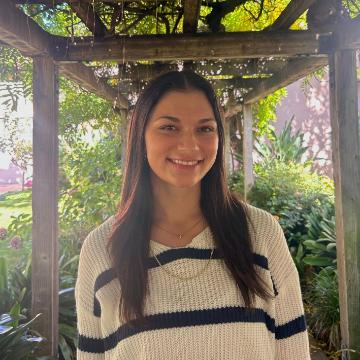
Kaylee Jensen '27
Kaylee Jensen is a third-year student majoring in Political Science with minors in Economics and International Business. Originally from Laguna Hills, California, she has developed a deep passion for social justice and public service. Outside the classroom, she is a Research Assistant for the SCU Unhoused Initiative as well as a Facility Supervisor at Campus Recreation.
She is beyond excited to pursue a project surrounding the ethics of political communication, specifically regarding fear based advertising, propaganda, and othering. She expects to explore how ethics can better be applied to the institutions responsible, as well as how a lack of ethical political communication leads to increased polarization, civic disengagement, and inadequate civic education. She hopes to use this research to reform means of political communication, expand voters’ understanding of public policy issues, and increase civic engagement to allow our democracy to flourish.
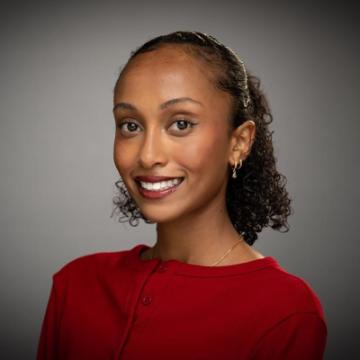
Hermon Welde '26
My name is Hermon Welde, and I am a senior majoring in Public Health Sciences with a minor in Medical & Health Humanities. Growing up in the Bay Area as the daughter of Eritrean immigrants has shaped my perspectives on the world and how I understand social justices, making me aware of how deeply rooted inequities are in our society. After completing the Health Care Ethics program last year, I developed a strong interest in ethics, specifically ethical decision making, and it has shaped how I view healthcare in the United States. I am also deeply interested in politics particularly the role that government plays in the lives of others. Through this fellowship I hope to deepen my understanding of how ethical governance can contribute to improving outcomes, specifically health outcomes and access to care for marginalized communities. I plan to use this learning to guide a future career in health management and health policy, where ethics and equity play a huge role.