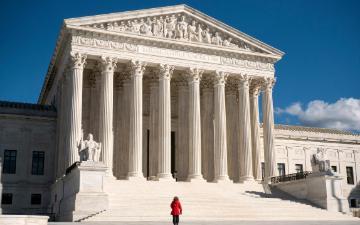
Supreme Court building, Washington D.C. Photo by Tom/Adobe Stock.
Bailey Black ’25 was a political science and economics double major and a 2024-25 Government Ethics Fellow with the Markkula Center for Applied Ethics at Santa Clara University. Views are his own.
The Question of Immunity
The proposition of granting public officials legal immunity for their conduct is an inherently contentious one. It stems from the conflict between the responsibility to protect individual rights and the need to promote the collective good—a conflict present in any system of government based upon principles of liberalism and the rule of law. Given that government is designed primarily as a tool to better promote and protect the public good, “[t]he interests of the people” in the effective administration of government might be able to justify some degree of immunity for public officials.[1] This is due to the fact that immunity can help ensure officials can take necessary action to promote the public good without concern for the risk of being held personally liable for any harms their actions might generate. At the same time, protecting the rights of individuals demands that those responsible for promulgating and carrying out government policies cannot be entirely unconstrained by generally applicable laws.
One need look no further than the ongoing debate surrounding the principle of qualified immunity as applied to police officers accused of the use of excessive force to understand the challenges involved in balancing these competing interests. On the one hand, there are undoubtedly significant benefits generated by a police force that is vigorous and responsive in promoting a collective interest in public safety. On the other hand, however, ensuring that the rights of individuals are protected—particularly the rights of life, liberty, and equal treatment under the law—requires that there be some way to ensure that those granted a monopoly on the use of force can be held accountable when that force is applied improperly or unjustly.
The stakes involved in determining the proper extent of immunity for a public official only become greater when that immunity is from criminal prosecution, rather than civil liability, and when the public official potentially being granted such immunity is not just any public official, but the nation’s most powerful public official—the president of the United States. Those were the stakes that the Supreme Court faced in the case of Trump v. United States (2024), in which the Court would not only be responsible for determining whether or not Donald Trump could be criminally prosecuted for his attempts to overturn the 2020 presidential election, but would also be defining the extent to which the law can serve as a check on presidential power.
Trump v. United States
The criminal prosecution at question in Trump v. United States stemmed from federal charges filed against Trump in the wake of his efforts to overturn the 2020 presidential election and for his role in the events of January 6. On August 1, 2023, a federal grand jury indicted him on four charges, alleging that Trump sought to advance his goal of overturning the election “through five primary means,” including using “knowingly false claims of election fraud” to get state legislators and election officials to change election votes, organizing “fraudulent slates of electors in seven targeted states,” attempting to “use the Justice Department to ‘conduct sham election crime investigations,’” and attempting to “persuade the vice president to use his … role at the January 6 certification proceeding to fraudulently alter the election results.”[2]
Trump filed a motion to dismiss the indictment “on the grounds that the alleged actions ‘fell within the core of his official duties’ as president and that he enjoyed ‘absolute immunity from criminal prosecution’ for such actions.”[3] The motion was denied by the federal district court, which held that “former presidents do not possess absolute federal criminal immunity for any acts committed while in office.”[4] This decision was affirmed by a “unanimous panel of the D.C. Circuit,” who reasoned that when “a former president allegedly violates federal criminal law … those acts cannot be properly viewed as ‘within the scope of his lawful discretion’ and, as a result, can form the basis for a criminal prosecution.” Additionally, in balancing the relevant interests, the court found that “the interest in criminal accountability … outweighs the potential risks of chilling presidential action and permitting vexatious litigation.”[5] The Supreme Court granted certiorari in the case to determine whether “a former president enjoy[s] presidential immunity from criminal prosecution for conduct alleged to involve official acts during his tenure in office,” and if so, to what extent that immunity reaches.[6]
In a 6-3 decision, the Supreme Court ruled that “former presidents can never be prosecuted for actions relating to the core powers of their office, and that there is at least a presumption that they have immunity for their official acts more broadly.”[7] Writing for the majority, Chief Justice John Roberts established a tripartite framework for determining whether a former president can be criminally prosecuted, dividing presidential conduct into official acts conducted within the scope of the president’s core constitutional powers, all other official acts, and unofficial acts. With respect to the first category—which includes “the power to issue pardons, veto legislation … and make appointments”[8]—the court ruled that “the president is absolutely immune from criminal prosecution for conduct within his exclusive sphere of constitutional authority.”[9]
For all other official acts “falling outside the president’s exclusive authority”[10]—which includes official actions that “involve shared powers with another branch or officers of another branch,”[11] the Court held that “the president enjoys at least a presumption of immunity.”[12] The Court added that this presumption of immunity covers all actions “within the outer perimeter of [the president’s] official responsibility,”[13] so long as they are not “manifestly or palpably beyond [his] authority.”[14] Additionally, the presumption of immunity, while not absolute, can only be overcome if “the government can show that applying a criminal prohibition to [the] act would pose no ‘dangers of intrusion on the authority and functions of the Executive Branch.’”[15]
Finally, the Court held that the president enjoys “no immunity” for unofficial acts.[16] The Court placed several restrictions, however, on how this rule could be applied. First, the court held that in “dividing official from unofficial conduct, courts may not inquire into the president’s motives,” because such an inquiry “would risk exposing even the most obvious instances of official conduct to judicial examination on the mere allegation of improper purpose, thereby intruding on the Article II interests that immunity seeks to protect”—in other words, that courts may not find an act to be unofficial simply because the president had impure motives in acting. Additionally, the Court held that courts may not “deem an action unofficial merely because it allegedly violates a generally applicable law,”[17] which is a response to the proposition present within Justice Sonia Sotomayor’s dissent and the holding of the D.C. Circuit that “unofficial acts are whatever acts for which presidents can be properly prosecuted.”[18] Lastly, the Court held that evidence of official acts cannot be considered as part of a prosecution for unofficial acts, writing that, “if official conduct for which the president is immune may be scrutinized to help secure his conviction, even on charges … based only on his unofficial conduct, the ‘intended effect’ of immunity would be defeated.”[19]
An Ethical Perspective
There are many reasons why analyzing the Supreme Court’s decision in Trump v. United States and its approach to the question of presidential immunity from an ethical perspective is valuable. First, just because something is the law—or, more pertinently, just because the Supreme Court says that something is the law—does not necessarily mean that that law is ethical. The law is certainly related to ethics, but the law can also “deviate from what is ethical” and “become ethically corrupt—a function of power alone and designed to serve the interests of narrow groups.” Second, a “good system of law” should “incorporate many ethical standards,” and therefore if a law is ethically flawed, there may be good reason to question its wisdom.[20]
There are three ethical lenses that are particularly relevant to the issue of presidential immunity generally and Trump v. United States in particular—the Justice Lens, the Common Good Lens, and the Utilitarian Lens. The Justice Lens is based on the idea that “each person should be given their due,” with what people are due generally being interpreted as fair or equal treatment. In this case, equal treatment does not mean that “everyone should be treated in the exact same way in every respect,”[21] but rather is best encapsulated by the maxim that “[i]ndividuals should be treated the same, unless they differ in ways that are relevant to the situation in which they are involved.”[22] In other words, from the perspective of the Justice Lens, the ethical approach to the issue of presidential immunity would be the one that gives each person what they are due, treating similar cases similarly and different cases differently.
The Utilitarian Lens, on the other hand, holds that “the morally right course of action in any situation is the one that produces the greatest balance of benefits over harms for everyone affected.” While ostensibly simple, this approach is entirely results-based, and therefore requires “an accurate determination of the likelihood of a particular result and its impact,” which can be challenging in many cases. Ultimately, the most important question from the utilitarian perspective is: “[W]hich option will produce the most good and do the least harm for as many stakeholders as possible?”[23]
Finally, the Common Good Lens asks us to consider the “common conditions that are important to the welfare of everyone—such as clean air and water, a system of laws, effective police and fire departments, health care, a public educational system, or even public recreational areas.” While this can lead to utilitarian-like conclusions in certain cases, the Common Good Lens, unlike the Utilitarian Lens, doesn’t just sum up and aggregate goods for every individual. Instead, the Common Good Lens “highlights mutual concern for the shared interests of all members of a community,” and asks us to answer the question: “Which option best serves the community as a whole, not just some members?”[24]
While these ethical lenses can be very useful for determining what the best approach to a specific issue may be, they cannot and should not be relied on as magical tools that can provide clear and unambiguous answers to every question. Not only may the different lenses point us towards vastly different answers to the question of what is ethical, but we also “may not agree on the content” of some of the specific lenses. For instance, determining what differences are relevant to the pursuit of justice, what elements are necessary for the promotion of the common good, or even what constitutes a good and what constitutes a harm are often easily debated. Considering the perspective of each ethical lens and the insights it can provide, however, can still be incredibly valuable in “the process of deciding what is ethical in a particular circumstance.”[25]
The Justice Lens
At its most fundamental level, the Justice Lens asks us to treat similar cases similarly and different cases differently. In the case of United States v. Trump, there is no question that the Supreme Court, in granting the president of the United States broad immunity from criminal prosecution, requires the law to treat the president differently than it would an average citizen. But under this ethical lens, the fact that treatment is unequal is not sufficient to judge said treatment unethical. The key question, rather, is whether that differential treatment is based on a relevant and justifiable distinction. And in the case of the president, the unique nature and importance of their responsibilities, many of which are constitutionally mandated and “cannot be performed by anyone else,” would seem to justify some form of legal treatment distinct from that granted to an average individual.[26]
Given that the broad responsibilities of the president will sometimes require them to “act in situations where the legality of their choices can reasonably be questioned,” the threat of criminal liability could greatly undermine their ability to fulfill the mandates of the office. Delahunty and Yoo (2024) give the example of President Obama’s decision to “order the launching of drones that targeted and killed Anwar al-Awlaki, an American citizen … who was supporting al Qaeda.” As a result of the attack, at least three other individuals were killed, including another American citizen. As Delahunty and Yoo (2024) argue, it is conceivable that President Obama might have hesitated to order such an attack if he knew he might be criminally prosecuted for doing so.[27] There is a reasonable concern that “allowing criminal charges against a former president for his official acts would affect his decision making while in office”—not because the president will be seeking to violate federal laws, but because the fear of criminal prosecution could limit their willingness to take certain actions to promote the public good.[28]
The extent to which the president’s unique responsibilities can justify disparate treatment is not endless, however, and the majority in Trump went too far in granting the president broad immunity for official actions. In particular, the majority’s recognition of absolute presidential immunity within certain limited zones of conclusive and preclusive presidential authority was applied “in an astonishingly expansive way,” holding that in addition to Trump enjoying immunity from criminal prosecution for “threatening to remove the acting attorney general,”[29] he was also “absolutely immune from prosecution for the alleged conduct involving his discussions with Justice Department officials.”[30] While the power to appoint and remove executive officers could reasonably fall within the president’s core constitutional powers, it is unclear why any and all discussions the president has with Justice Department officials should be considered to be within his exclusive authority. And yet the majority “applied a sweeping view of the president’s exclusive constitutional authority,”[31] and granting the president indefensibly “broad immunity from criminal prosecution.”[32]
Even though there are good reasons to ensure that the president “cannot be held criminally liable for conduct within his ‘conclusive and preclusive’ authority and closely related acts,” the majority’s expansive application of this principle cannot be justified on the basis of giving people what they are due. As Justice Amy Coney Barrett argues in her concurrence, “[p]roperly conceived, the president’s constitutional protection from prosecution” should be narrow.[33] Yet in broadly applying the concept of absolute immunity for core constitutional powers, the majority potentially insulates from legal oversight “a considerably larger sphere of conduct than the narrow core of ‘conclusive and preclusive’ powers that the Court previously has recognized,” and moves beyond the extent of absolute presidential immunity that can be justified on the basis of the unique responsibilities of the presidency.[34]
The Common Good Lens
The Common Good Lens asks us to focus our ethical analysis on the “common conditions that are important to the welfare of everyone.”[35] In this case, however, this analysis is complicated by the fact that there exists a tension between multiple potential “common goods”—promoting national security interests and the effective administration of the laws on the one hand, and ensuring a fair and effective criminal justice system on the other. Under the Common Good framework, then, it is vital that ample recognition be given to both sides of this conflict, as the flourishing of our shared community requires both a government that can ensure our safety and security and effectively execute the laws, as well as a criminal justice system that is empowered to hold all individuals properly accountable.
In her dissent, Justice Sotomayor writes that she is “deeply troubled by the idea, inherent in the majority’s opinion, that our Nation loses something valuable when the President is forced to operate within the confines of federal criminal law.”[36] This perspective, however, oversimplifies the true impact the threat of personal criminal liability would pose to the president's ability to confidently fulfill their duties. As Whittington (2024) argues, the key question “is not just whether the president operates within the confines of federal criminal law. It is whether presidents will hesitate to do their duty for fear that they might accidentally step over that line or be perceived by partisan political actors to have stepped over that line.”[37] This problem is analogous to the problem with criminalizing hate speech. It’s not that we would inherently “lose[] something valuable” by forcing people to operate within hate speech laws—it would certainly be preferable to be able to prevent the Ku Klux Klan or neo-Nazis from being able to host speeches and rallies—but rather that allowing hate speech to be criminalized could chill other forms of essential speech due to fear of criminal prosecution. The Court, therefore, is correct to be concerned about the chilling effect the threat of criminal prosecution could have on the ability of the president to promote national security interests and effectively execute the laws — but, just as is true in free speech jurisprudence, this concern must still be carefully balanced against any other compelling interests present.
From the perspective of the common good, the concern that the threat of criminal prosecution could chill presidential decision making is a valid one—yet this ethical framework also requires that this be balanced against the “compelling ‘public interest in fair and effective law enforcement.’”[38] And while the majority ostensibly recognizes this fact in their opinion, in order for the presumption of immunity to be successfully rebutted under the legal framework they outline, the government would need to show that “applying a criminal prohibition to that act would pose no ‘dangers of intrusion on the authority and functions of the Executive Branch.’”[39] Not only does this serve as an extremely high bar for prosecution, making the Court’s presumptive immunity for official acts “all but absolute in practice,” but it ostensibly borrows from the functionalist balancing framework found in existing court doctrine while also failing to actually engage in a true and fair weighing of the various interests.[40]
In Nixon v. Fitzgerald (1982), the Court held that “before exercising jurisdiction” over the Executive Branch, a court “must balance the constitutional weight of the interest to be served against the dangers of intrusion on the authority and functions of the Executive Branch”[41]—in essence, that courts must “[w]eigh the interest served by immunity (protecting against intrusions on the executive branch) against the interest served by allowing the case to move forward.”[42] Yet in his opinion, Roberts truncated the Fitzgerald Court’s holding, transforming the balancing approach into an absolutist standard—that there must be “no danger” at all of “intrusion on the authority and functions of the Executive Branch” in order for the President’s immunity shield to be pierced.[43] This, as Sotomayor argues in her dissent, effectively grants the president absolute immunity for any and all official actions, as “[i]t is hard to imagine a criminal prosecution for a president’s official acts that would pose no dangers of intrusion on [p]residential authority.”[44]
The Court, while correctly noting that criminal liability might have a “chilling effect on presidential action,”[45] blatantly neglects the potential public interest that might exist in ensuring “a federal criminal prosecution of a former president” can go forward.[46] Rather than granting the president a presumption of immunity for all official acts outside their exclusive authority, a more ethical and prudential approach would have set up the presumption to “run the other way,”[47] with Congress generally able to regulate actions outside the president’s exclusive authority by criminal statute unless the “dangers of intrusion on the authority and functions of the Executive Branch” could be shown to outweigh the “constitutional weight of the interest to be served.”[48] This approach would have served as a more careful balancing of the various “common goods” present—providing necessary protections for presidential prerogative, while also ensuring that the president, while acting in their official capacity, is not beyond the reach of the law.
The Utilitarian Lens
Lastly, the utilitarian approach asks us to determine what action will produce the greatest balance of good over harm. This determination, however, requires an accurate assessment of the likelihood of a particular result and its impact—a difficult task, given the complexity of presidential immunity and the many unknowns present. Therefore, how one assesses the Court’s approach to presidential immunity in Trump from a utilitarian perspective will largely turn on an assessment of the relative likelihood of certain outcomes. If one believes that the Court’s decision will encourage presidents to “behave in a more criminal fashion,” then it will likely be seen as unethical from a utilitarian perspective. If one instead is more concerned with the likelihood that political polarization will cause “politicized lawfare” to become “a routine feature of our domestic politics,” then looking at the Court’s ruling from a utilitarian perspective may cause one to look upon it much more favorably.[49]
Given the recency of this case, there is much we are still yet to learn about what the ultimate impact of the Court’s decision in Trump will be, and how we look back upon this case in years to come will be greatly shaped by the events of the future. It seems clear from what has been discussed previously, however, that in weighing the potential goods and harms, the Court’s approach temps far greater risk than necessary when it comes to opening the door for potential abuses of executive power, and therefore is difficult to justify from a utilitarian perspective.
The Bottom Line
The concept of some form of limited presidential immunity can, to some extent, be justified under all three ethical lenses. From the perspective of the Justice Lens, there are some good reasons to grant presidents some immunity from the normal processes of the criminal justice system. From the perspective of the Common Good Lens, we must ensure that presidents are empowered to take necessary action to promote national security interests and carry out the law. And from the perspective of the Utilitarian Lens, we should be concerned about the harms that would be incurred by the “prospect of an Executive Branch that cannibalizes itself, with each successive president free to prosecute his predecessors, yet unable to boldly and fearlessly carry out his duties for fear that he may be next.”[50]
Ultimately, however, the Court’s approach to the issue of presidential immunity is fundamentally ethically flawed. It fails to appreciate that the unique responsibilities of the presidency cannot justify a sweeping grant of absolute immunity. It fails to engage in a reasonable balancing of the relevant goods at stake, underweighting our collective interest in ensuring that presidents are not beyond the reach of the law. And it fails to fully grapple with the potential harms generated by a president empowered to act in a criminal fashion. In the coming years, we will likely learn much more about the ultimate ramifications of these striking ethical flaws present in the Supreme Court’s decision, for better or for worse. In the meantime, we are left to simply hope that the most worrying potential consequences never fully come to fruition.
References
Bobbitt, Philip. 2024. “A Prudential Way Forward in Trump v. United States.” Just Security.
Delahunty, Robert, and John Yoo. 2024. “The Presidential Immunity Decision.” Harvard Journal of Law & Public Policy: Per Curiam 34:1-8.
Garvey, Todd. 2024. “Presidential Immunity, Criminal Liability, and the Impeachment Judgment Clause.” Congressional Research Service.
Howe, Amy. 2024. “Justices Rule Trump Has Some Immunity from Prosecution.” SCOTUSblog.
Lempert, Richard. 2024. “Trump v. United States: Explaining the Outrage.” Brookings Institution.
Markkula Center for Applied Ethics. 2021. “A Framework for Ethical Decision Making.” Santa Clara University.
Markkula Center for Applied Ethics. 2014. “Calculating Consequences: The Utilitarian Approach to Ethics.” Santa Clara University.
Markkula Center for Applied Ethics. 2014. “Justice and Fairness.” Santa Clara University.
Markkula Center for Applied Ethics. 2014. “The Common Good.” Santa Clara University.
Morrison, Trevor W. 2024. “A Rule for the Ages, or a Rule for Trump?” Lawfare.
Nixon v. Fitzgerald, 457 U.S. 731 (1982).
Somin, Ilya. 2024. “Thoughts on the Trump Immunity Decision.” Reason Magazine.
Trump v. United States, 603 U.S. 593 (2024).
Whittington, Keith E. 2024. “Presidential Immunity.” Cato Supreme Court Review 23 (1): 283-317.
[1] Qtd. in Nixon v. Fitzgerald, 457 U.S. 731 (1982), p. 744.
[2] Trump v. United States, 603 U.S. 593 (2024), p. 2.
[3] Whittington, Keith E. 2024. “Presidential Immunity,” p. 288.
[4] Qtd. in Trump v. United States, 603 U.S. 593 (2024), p. 4.
[5] Garvey, Todd. 2024. “Presidential Immunity, Criminal Liability, and the Impeachment Judgment Clause,” p. 4.
[6] Trump v. United States, 603 U.S. 593 (2024), p. 5.
[7] Howe, Amy. 2024. “Justices Rule Trump Has Some Immunity from Prosecution.”
[8] Ibid.
[9] Trump v. United States, 603 U.S. 593 (2024), p. 9.
[10] Morrison, Trevor W. 2024. “A Rule for the Ages, or a Rule for Trump?”
[11] Bobbitt, Philip. 2024. “A Prudential Way Forward in Trump v. United States.”
[12] Morrison, Trevor W. 2024. “A Rule for the Ages, or a Rule for Trump?”
[13] Trump v. United States, 603 U.S. 593 (2024), p. 14.
[14] Qtd. in Ibid., p. 17.
[15] Ibid., p. 14
[16] Ibid., p. 15.
[17] Ibid., p. 18.
[18] Whittington, Keith E. 2024. “Presidential Immunity,” p. 304.
[19] Trump v. United States, 603 U.S. 593 (2024), p. 31.
[20] Markkula Center for Applied Ethics. 2021. “A Framework for Ethical Decision Making.”
[21] Markkula Center for Applied Ethics. 2021. “A Framework for Ethical Decision Making.”
[22] Markkula Center for Applied Ethics. 2014. “Justice and Fairness.”
[23] Markkula Center for Applied Ethics. 2014. “Calculating Consequences: The Utilitarian Approach to Ethics.”
[24] Markkula Center for Applied Ethics. 2014. “The Common Good.”
[25] Markkula Center for Applied Ethics. 2021. “A Framework for Ethical Decision Making.”
[26] Whittington, Keith E. 2024. “Presidential Immunity,” p. 289.
[27] Delahunty, Robert, and John Yoo. 2024. “The Presidential Immunity Decision,” p. 5.
[28] Howe, Amy. 2024. “Justices Rule Trump Has Some Immunity from Prosecution.”
[29] Morrison, Trevor W. 2024. “A Rule for the Ages, or a Rule for Trump?”
[30] Trump v. United States, 603 U.S. 593 (2024), p. 21.
[31] Morrison, Trevor W. 2024. “A Rule for the Ages, or a Rule for Trump?”
[32] Lempert, Richard. 2024. “Trump v. United States: Explaining the Outrage.”
[33] Trump v. United States, 603 U.S. 593 [Barrett, J., concurrence] (2024), p. 1.
[34] Trump v. United States, 603 U.S. 593 [Sotomayor, J., dissent] (2024), p. 24.
[35] Markkula Center for Applied Ethics. 2014. “The Common Good.”
[36] Trump v. United States, 603 U.S. 593 [Sotomayor, J., dissent] (2024), p. 18.
[37] Whittington, Keith E. 2024. “Presidential Immunity,” p. 306.
[38] Trump v. United States, 603 U.S. 593 (2024), p. 13.
[39] Ibid., p. 14.
[40] Whittington, Keith E. 2024. “Presidential Immunity,” p. 299.
[41] Nixon v. Fitzgerald, 457 U.S. 731 (1982), p. 754.
[42] Morrison, Trevor W. 2024. “A Rule for the Ages, or a Rule for Trump?”
[43] Trump v. United States, 603 U.S. 593 (2024), p. 14.
[44] Trump v. United States, 603 U.S. 593 [Sotomayor, J., dissent] (2024), p. 11.
[45] Somin, Ilya. 2024. “Thoughts on the Trump Immunity Decision.”
[46] Trump v. United States, 603 U.S. 593 [Sotomayor, J., dissent] (2024), p. 19.
[47] Morrison, Trevor W. 2024. “A Rule for the Ages, or a Rule for Trump?”
[48] Nixon v. Fitzgerald, 457 U.S. 731 (1982), p. 754.
[49] Whittington, Keith E. 2024. “Presidential Immunity,” p. 317.
[50] Trump v. United States, 603 U.S. 593 (2024), p. 40.