The Plan's Core
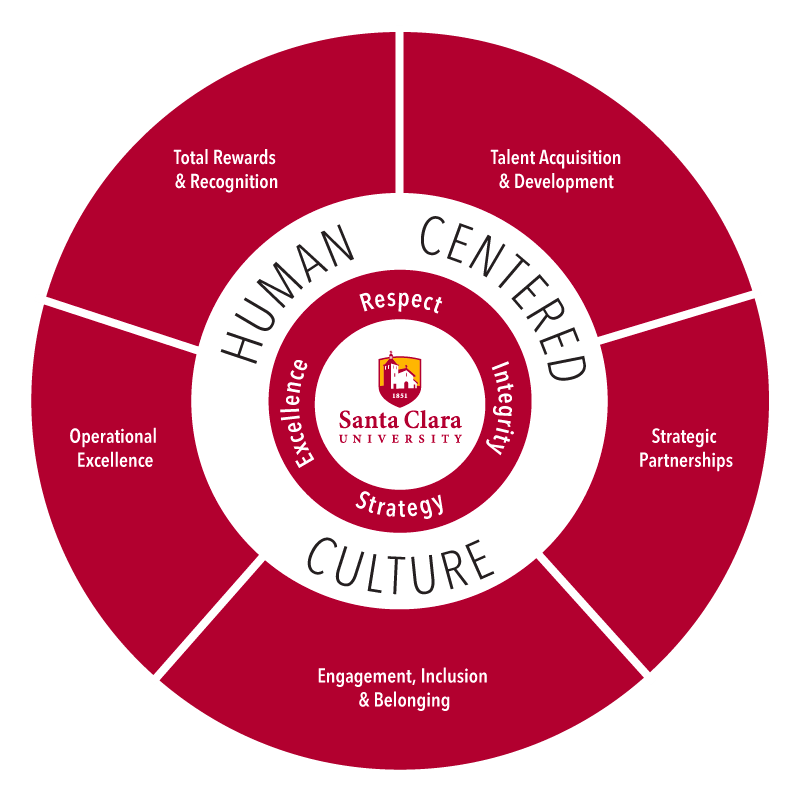
The core of the 2025-2030 HR Strategic plan is informed by the shared values, principles, and ethics of our human resources team- cultivating a human-centered culture via R.I.S.E. HR! The acronym R.I.S.E. builds on Santa Clara University’s vision of educating citizens and leaders of competence, conscience, and compassion.
-
- Respect: Every interaction, with internal and external clients, prospective clients, and partners will be rooted in treating others with compassion, dignity, and respect.
- Integrity: In all engagements, with every person, vendor, or provider, we will interact with others based on a foundation of honesty and credibility. Guided by our conscience, we will support our mission and deliver on our commitments.
- Strategy: Our connection to SCU’s strategic plan and the evolving needs of our clients will define our HR priorities. We will endeavor to apply the most strategic solution possible, while constantly searching for best practices to implement and improve upon.
- Excellence: Our behaviors and performance will be driven by innovation and creativity. Every interaction and deliverable will be an expression of competence, quality, distinction, and exceptional service.
Through a human-centered approach, the human resources team aims to provide an inclusive and empowering environment, which prioritizes the well-being, diverse needs, development, and potential of all employees.
The Strategic Priorities
The 2025-2030 HR Strategic plan supports the broader University strategic plan, Impact 2030.
Talent Acquisition & Development
Goal #1: Design and market a compelling employer brand that conveys an employee value proposition that drives talent acquisition efforts and employee engagement.
-
- Initiative: Develop and communicate a compelling Employee Value Proposition (EVP) that aligns with our university’s mission and the vision for talent management.
-
- Initiative: Design and communicate a comprehensive Talent Management strategy that is rooted in the EVP, and demonstrates the University’s approach to the employees’ full lifecycle.
Goal #2: Strengthen and enhance the recruitment & onboarding experience for managers, search committees, applicants and newly hired staff.
-
- Initiative: Expand and diversify the University’s talent sourcing pipelines, enhance passive recruitment efforts, establish strategic marketing strategies, and reduce the time to fill staff employment vacancies.
-
- Initiative: Strengthen the support provided to hiring managers and search committees, through streamlined recruitment, interview preparation, and reference checking processes.
-
- Initiative: Enhance the staff new employee onboarding experience through streamlining the orientation process, reducing the onboarding timeline, and collecting feedback from newly hired staff to support the maintenance of the onboarding program.
Goal #3: Expand learning and development opportunities for leaders and individual contributors at multiple levels of the University.
-
- Initiative: Establish learning and development programs that engage the University’s emerging leaders, providing development opportunities rooted in the University’s leadership performance competencies.
Goal #4: Expand learning and development opportunities for leaders and individual contributors at multiple levels of the University.
-
- Initiative: Assess learning outcomes and ROI for the Management Excellence Series, updating and expanding the format and offerings, as needed.
-
- Initiative: Design and deliver senior leadership development opportunities for high performing leaders to support an internal pipeline for career advancement and succession planning.
Goal #5: Redefine the staff performance management process to cultivate continuous feedback structures that drive accountability, outcomes, and strategic alignment.
-
- Initiative: Redesign the annual performance management process to introduce opportunities for ongoing real-time communications between managers and their direct reports, allowing for two-way performance feedback, accountability, and necessary adjustments in annual plans.
-
- Initiative: Develop and implement staff performance calibration tools and processes that support consistency and increase rater reliability.
-
- Initiative: Align the staff goal-setting process to reflect the strategic goals of their department/division, and ultimately the strategic priorities established for the University.
Total Rewards & Recognition
Goal #1: Develop and implement a market-driven staff compensation program that is maintained on an annual basis.
-
- Initiative: Implement a multi-year action plan to increase staff compensation to reflect the market demands and cost of labor in the Santa Clara/San Jose region.
-
- Initiative: Maintain the staff compensation program on an annual basis through applying incremental market adjustments to the staff salary structure and managing staff position placements within the salary bands.
Goal #2: Design and deliver competitive health and wellness benefits that meet the needs of eligible University employees and their dependents.
-
- Initiative: Collect ongoing feedback from benefits-eligible employees regarding the plan designs and their evolving health and wellness needs to inform the University’s benefits plan designs.
-
- Initiative: Launch a feasibility study to explore opportunities for self-funding, cost reductions, and resource reallocation.
Goal #3: Establish staff housing support resources to address the challenges of housing affordability in the Silicon Valley.
-
- Initiative: Establish a clear temporary transitional housing program for staff hired into positions via a national search and transitioning from areas outside of a 50-mile radius.
-
- Initiative: Establish external local housing resources to support staff access to affordable housing.
Operational Excellence
Goal #1: Streamline and enhance Workday and other HR systems to allow employees to decrease administrative burdens and focus their time on impactful outcomes.
-
- Initiative: Expand education and provide timely reference tools, work aides, and on-demand support resources for Workday HR.
-
- Initiative: Partner with Information Technology Services to streamline Workday HR processes and address existing post-implementation pain points.
Goal #2: Leverage opportunities to pilot and implement generative artificial intelligence in HR processes and systems.
-
- Initiative: Pilot and implement generative AI support tools that decrease administrative burdens associated with HR-related tasks.
Goal #3: Leverage HR systems and technology to support data analytics and informed decision-making.
-
- Initiative: Establish, develop, and deliver timely HR metrics and reports that add value for leaders and other decision-makers.
Engagement, Inclusion & Belonging
Goal #1: Implement and execute an HR Inclusive Excellence plan that integrates justice, equity, diversity, and inclusion in the University’s talent management practices.
-
- Initiative: Increase the racial, ethnic, and gender diversity of staff hired and promoted into staff positions.
-
- Initiative: Partner with the Inclusive Excellence Division to develop the Beyond Compliance accessibility plan, expanding the ability for all employees to thrive on campus.
Goal #2: Belonging for all Broncos- Foster a strong sense of belonging, connection and community for employees.
-
- Initiative: Partner with Inclusive Excellence and Staff Senate to develop a sustainable framework for current and future employee resource groups, which support employee retention and engagement.
-
- Initiative: Increase the campus presence of HR and establish integrated employee feedback programs that facilitate collaboration and continuous improvement via climate, engagement, and experience surveys/focus groups.
Strategic Partnerships
Goal #1: Establish trusted relationships with leaders to proactively address current and future workforce planning needs, as they evolve.
-
- Initiative: Leverage HR Partners, HR liaisons, HR systems and HR data analytics to project and plan for changing talent needs, including opportunities to streamline operations, reallocate resources, recruit, retain and develop talent.
Goal #2: Partner closely with employee governance groups to develop and evolve University programs, policies and procedures that align with Santa Clara’s mission and advance the University’s strategic priorities.
-
- Initiative: Integrate Santa Clara’s foundational commitment to operational excellence through developing and adjusting staff policies and programs that are compliant, accessible, transparent and meet the needs of our campus community.
Goal #3: Educate, empower and engage HR Liaisons to support the people management needs of their academic and administrative units.
-
- Initiative: Strengthen the education and HR support resources provided to HR Liaisons, including on-demand data, that will allow liaisons to work more autonomously.