Partnership Through Humility and Mutual Learning
The Impact of Thriving Neighbors

What does it mean to partner with a community? At Santa Clara University, that question is not just theoretical. It shows up in real relationships, in classrooms, and in community spaces like Abriendo Puertas and Caminos Al Bienestar (CAB). In speaking with faculty involved in this work, it became evident that meaningful partnership does not start with expertise, but with humility.
Abriendo Puertas
Abriendo Puertas provides iPad based tutoring in math and literacy for Pre-K to 2nd grade students in San Jose’s Greater Washington neighborhood, while also offering workshops for parents during each session. SCU students take on a dual role, serving as tutors for younger students while also mentoring high school students from the Latino College Preparatory Academy.
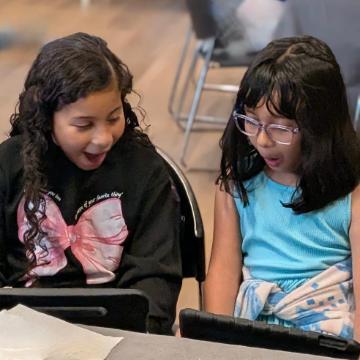
“I know for a fact that children in this program really develop a great sense of self-confidence,” he shared.
Through small group tutoring and consistent relationships with SCU students, children are supported not only academically, but also socially. They gain confidence, build meaningful connections, and begin to feel seen in ways that go beyond the classroom. Partnering children with mentors outside of their families who are dedicated to supporting their growth has been shown to create a meaningful and lasting impact.
This impact extends beyond the students and tutors, reaching into the families involved in the program. For the many of the mothers involved in the program, Abriendo Puertas becomes a space to better understand a school system that can often feel unfamiliar and overwhelming. Many are navigating a completely different educational structure than the one they grew up with, and that adjustment is not always easy. Through conversation, shared experiences, and support, they begin to build confidence in advocating for their children.
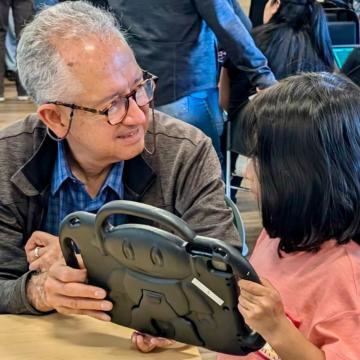
For Dr. Hernandez-Ramos, the reasoning behind his involvement and the ultimate impact of the program was meaningful in a few different ways.
“I wasn’t coming here to teach them a class,” he said. “I was here to listen to them, to work with them, to be a resource, and to learn from them.”
That mindset reflects a larger shift in how community engagement is understood. It is not about showing up with all the answers, but about recognizing that knowledge already exists within the community.
Camino Al Bienestar (CAB)
The same idea shows up in Camino Al Bienestar (CAB), a “train-the trainer” initiative, equipping Promotra (lay Latino community members who provide basic health education in the community) and community members with culturally and linguistically relevant mental health strategies through workshops developed in partnerships within the community. Based at Sacred Heart Community Service, the program focuses on creating community wellness modules that reflect local needs.
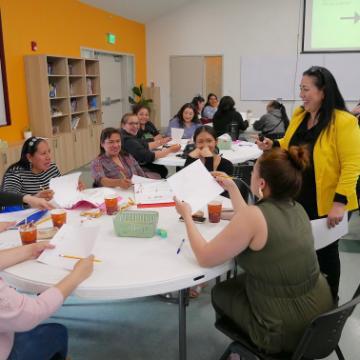
“Their understanding of community engagement really blossoms,” Dr. Llamas explained.
But that kind of growth depends on how faculty choose to show up.
“You have to come in with so much humility,” she said. “The community knows the community best.”
Jasmin also spoke about the importance of being aware of the power dynamics that naturally exist between universities and communities. Even when the intention is to help, there is still a hierarchy that needs to be actively challenged. For her, that means stepping back, making sure the work is centered on the community members, and remembering “this isn’t mine.”
Instead, it is something built together, shaped by the needs, ideas, and leadership of the community.
Dr. Hernandez-Ramos and Dr. Llamas highlighted the same lessons in their own approach. Community engagement is not fast, and it is not always structured. It requires flexibility, patience, and willingness to let go of control. In the process, something more meaningful is created.
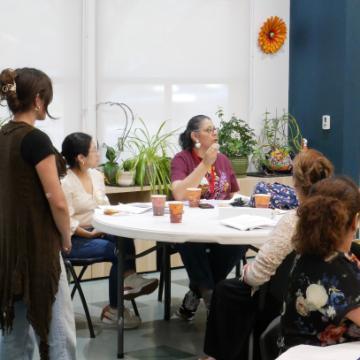
“I want this to be a long-standing relationship that is evolving and growing to meet everybody’s needs,” she said.
At its core, this work is not just about programs and outcomes. It is about how people choose to show up for one another. When partnership is rooted in humility and mutual learning, it creates a space for trust, growth, and lasting impact on all sides.
~ Camila Perez '27