Long before the arrival of the first Europeans, the South Bay was home to a large native population – numbering 10,000 people. They had occupied the Bay Area for thousands of years divided into as many as 40 independent tribes. One such community, called Thamien, was located where the SCU campus now stands. Today, descendants call themselves "Ohlone."
The Ohlone
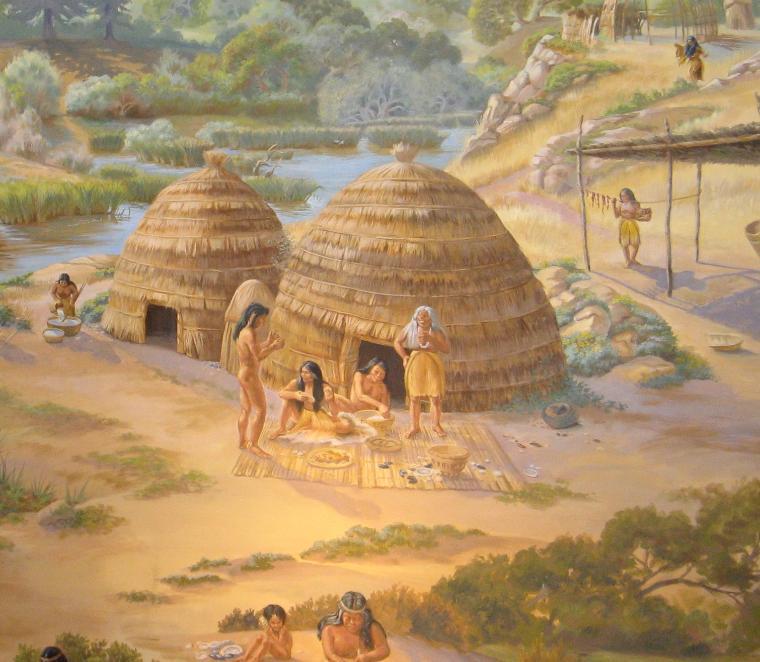
The Ohlone lifestyle can be described as “hunter-gatherer”. Though they did not cultivate crops or herd domestic animals, they used sophisticated landscape management practices, including prescribed burns, to make a living in the fertile south bay region. They lived in numerous settlements of 200 to 500 persons spread throughout the broad "Valley of Oaks” enjoying a diet of fish, shellfish, water fowl, venison, acorns, rabbit, and wild berries. From the tule reeds found near water’s edge they made their houses and boats and they wove baskets from the native sedge grasses. Ohlone religion revolved around elaborate ritual dances with dancers wearing colorful regalia and tribal members communing in the tribal sweat lodge—for ensuring good hunts, healing illness and expelling impurities.
The Ohlone lifestyle can be described as “hunter-gatherer.” Though they did not cultivate crops or herd domestic animals, they used sophisticated landscape management practices, including prescribed burns, to make a living in the fertile south bay region. They lived in numerous settlements of 200 to 500 persons spread throughout the broad "Valley of Oaks,” enjoying a diet of fish, shellfish, water fowl, venison, acorns, rabbit, and wild berries. From the tule reeds found near water’s edge they made their houses and boats and they wove baskets from the native sedge grasses. The Ohlone religion revolved around elaborate ritual dances with dancers wearing colorful regalia and tribal members communing in the tribal sweat lodge – for ensuring good hunts, healing illness, and expelling impurities.
This way of life had sustained the Ohlone for thousands of years, but the onset of Spanish colonization in 1769 introduced dramatic changes. Over the course of several generations, Ohlone society shifted from a traditional focus on hunting and gathering to agriculture; from holding strict tribal identities to having blended “mission” identities; from their native worldview to becoming, at least outwardly, Catholic Christian converts and citizens of the Spanish Empire.
Establishing the Mission
The story now turns to Mission Santa Clara de Asís, the 8th mission in the chain of 21 Franciscan missions established by Padre Junipero Serra. It was first founded January 12, 1777 on the banks of the Guadalupe River (just north of Highway 101, opposite the Mineta International Airport) and the first to bear the name of a woman, St. Clare of Assisi, an early companion of St. Francis. Flood, fire, and earthquake forced two relocations until the Mission finally settled on the current, third, site in 1822.
From the start, Mission Santa Clara was meant to serve as the sister mission to Mission Dolores in San Francisco. Spanish Viceroy Bucareli’s grand design intended Mission Dolores (and its Presidio) to anchor the mouth of San Francisco Bay with Mission Santa Clara anchoring the South Bay – receiving goods and services meant for the new Pueblo of San Jose.
Franciscan conversion practices began largely through attraction rather than conquest: starting with strategic trade and outright gifts. Yet, once individuals joined the mission they were not allowed to leave. Sadly, historical accounts reveal harsh punishments (by modern standards) of withholding food, corporal punishments, and imprisonment for wayward converts. Yet, there was another motivator for joining the mission: namely, the increasing scarcity of native game and foods brought about by the herds of cattle, horses, sheep, pigs, and goats imported by the Spanish. Over-grazing of the native grasses and growing displacement of the native game gave the mission an increasing monopoly over the local food supply. Eventually, the new trade skills of ranching, farming, tanning, adobe brick and tile making came to be seen as necessary skills for survival.
Mission Santa Clara seemed to thrive in its early years;: boasting the highest number of converts and recording record productivity made possible by the fertile, well-watered lands and temperate climate. Yet, this success proved fleeting. Weakened by the clash of cultures and waves of epidemics – chiefly smallpox and measles – the Ohlone population dwindled by 1830 to 2,500 people. Mexican independence from Spain in 1822 only hastened the collapse of the mission system due to lack of royal funding. The new government secularized all 21 missions, reverting the mission lands to Ohlone ownership, and expelled the Spanish Franciscans loyal to the King of Spain. In doing so, they inadvertently abandoned the Ohlone to the pioneers, profiteers, and unscrupulous wheeler-dealers of the Gold Rush, pushing the remaining Ohlone to the margins of California society.
From Mission to University
With insufficient funds to maintain the complex, and a single priest to operate the Mission as a parish church, the property fell into serious decay. In 1850, Bishop Joseph Alemany approached a Jesuit priest, Fr. John Nobili, S.J., to turn the parish and its adjacent lands into a college. This meant transferring the property from Franciscan ownership to Jesuit ownership. On March 19, 1851, Mission Santa Clara and its land became Santa Clara College, the first institute of higher learning in the new state of California.
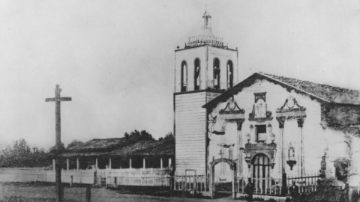
Soon after, the new college president, Burchard Villager, S.J., began a rebuilding campaign to upgrade the campus’ decrepit buildings. Fr. Burchard also enlarged the Mission Church, giving it a new facade. For a while, the building boasted an Italianate façade – with two bell towers – all made of wood (similar in style to St. Joseph’s Cathedral in San Jose). A devastating fire in 1926 totally consumed this remodeled building. It was decided to rebuild its replacement not in the style of the remodeled, Italianate building but in the idealized neo‑colonial style fashionable at the time. Drawing from actual historical photographs, they resurrected a building more in line with the original 1825 single bell tower structure. This is the building you see today; similar in length but twice as wide as the 1825 Mission and more sophisticated in detail. Fortunately, the building was also built of steel reinforced concrete – rather than adobe brick – making it much more resistant to earthquakes and fire.
Today Mission Santa Clara continues to serve as Santa Clara University’s student chapel and its image has become the icon for the local county, city, and university bearing its name.
Santa Clara University Land Acknowledgement
We pause to acknowledge that Santa Clara University sits on the land of the Ohlone and the Muwekma Ohlone people, who trace their ancestry through the Missions Dolores, Santa Clara, and San Jose. We remember their connection to this region and give thanks for the opportunity to live, work, learn and pray on their traditional homeland. Let us take a moment of silence to pay respect to their Elders and to all Ohlone people past and present.
The following material can be used to bolster a 4th Grade Mission Project, or inform those with a general interest in our historic Mission.
These diagrams show what the original Mission Quadrangle would have looked like. The additional material shares more information about what the Ohlone tribes used to regularly hunt, gather, eat, and craft. Feel free to download, print, and utilize any these materials.
The front facade of Mission Santa Clara, student chapel of Santa Clara University.
At over 160 years old, the wisteria continues to bloom every spring.
The Wisteria Arbor is over 160 years old, and continues to permeate the campus with its fragrant scent every spring.
This statue of the Sacred Heart of Jesus covers the old Mission water well.
Here's a closer view of the Sacred Heart of Jesus statue.
The Adobe Wall is a remnant of the 1822 Mission quadrangle, and is part of the oldest structure remaining on our campus, the Adobe Lodge.
Whether on your way to class or just visiting for the day, our Mission Gardens are an attraction to all who pass through.
This is the entrance to the Rose Garden Cemetery. The cemetery is closed to the public and a memorialized area for those still buried on our grounds.
The Rose Garden Cemetery Gates.
These walls memorialize those still buried on our grounds, however, the original cemetery area extended far beyond what you see today.
This overlook is actually comprised of the porch entrance to the old student chapel that was burned down in the fire of 1926. These steps are all that remain, and today give a nice view into the Rose Garden Cemetery.
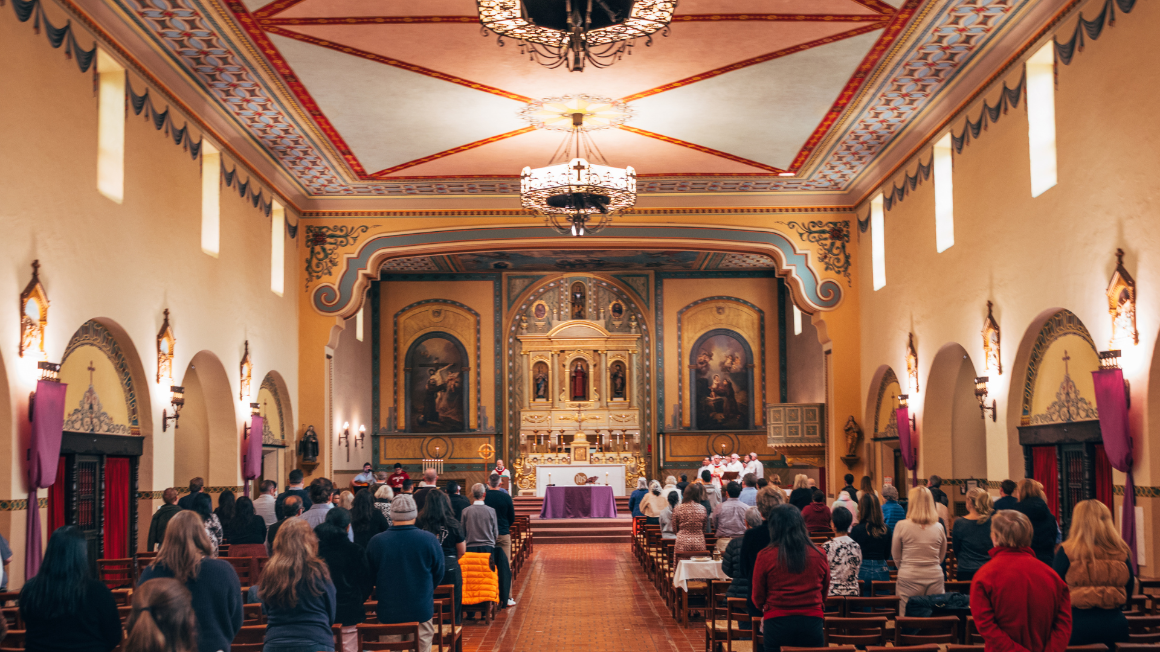
The Mission's sanctuary and high altar
The sanctuary's beautifully detailed arch and ceiling
The painting to the left of the high altar reredos was created by Candelario Rivas in 1931 and depicts St. Francis embracing Christ on the cross. These portraits are exact replicas of the originals that adorned the 1822 church's sanctuary.
To the right of the high altar reredos is a painting created by Candelario Rivas in 1931 depicting St. Anthony embracing the baby Jesus. These portraits are exact replicas of the originals that adorned the 1822 church's sanctuary.
The nave of the Mission Church, with it's 6 side chapels, 3 chandeliers, and 150 foot long aisle.
Our Lady of Guadalupe Side Chapel Statues of St. Anne and St. Joachim (Mary's parents) flank the lower level, while 2 portraits of Mary, mother of God, grace the center. The smaller portrait located above the larger is a remnant of the 1926 fire that destroyed the previous Mission.
Catala Crucifix Chapel Within this chapel is a large crucifix in front of which Padre Magin Catala prayed. It is a historic item that students were able to save from the 1926 fire.
St. Ignatius Side Chapel Prominently displayed in this chapel is a portrait of St. Ignatius, painted by Fr. Dan Sullivan, S.J.
Here's a closer look at the painting of St. Ignatius of Loyola, founder of the Jesuit Order.
St. Francis Side Chapel A Mission era statue of St. Francis of Assisi (center), is displayed along with St. Collette and St. Francis of Solano. The latter two statues were saved by students from the 1926 fire. The altar also houses a relic of St. Juniperro Serra, founder of the 21 Alta California Missions.
The Holy Family This impressive painting was done by Riva Giuseppe Bergamo in 1889 and portrays the holy family of Jesus, Mary and Joseph juxtaposed with God the Father, Son, and Holy Spirit. It originally graced the high altar of the adjacent student chapel but was pulled from the 1926 fire before the building was destroyed.
You are leaving the Santa Clara University Website for a site that is controlled by a third party not affiliated with Santa Clara University. The contents and policies on the third party site you are entering may differ from those of Santa Clara University. We are not responsible for the contents, policies, or the maintenance of the third party website.
You are leaving the Santa Clara University Website for a site that is controlled by a third party not affiliated with Santa Clara University. The contents and policies on the third party site you are entering may differ from those of Santa Clara University. We are not responsible for the contents, policies, or the maintenance of the third party website.