OVERVIEW:
Buying a franchise can be an exciting and rewarding path to business ownership. Rather than starting from scratch, aspiring entrepreneurs have the opportunity to join an established brand with a proven business model, systems, and ongoing support. However, purchasing a franchise is not without its considerations. In this session, we’ll explore the essentials of buying a franchise, including what a franchise is, the various types of franchise businesses available, the differences between owning a business and buying a franchise, and key factors to consider before making your decision. This session will guide you through the process and provide practical insights on how to choose the right franchise for you.
- What is a Franchise?
- Types of Franchise Businesses
- Franchise Business Models
- Owning a Business vs. Buying a Franchise
- Is Buying a Franchise Right for You?
- What Does it Take?
- How Much Money Do You Need?
- How to Find Franchises for Sale
- How to Buy a Franchise: Key Steps to Take
- What to Avoid When Buying a Franchise
- After the Franchise Purchase
- Professionals That Can Help
- Franchise Consultants vs. Franchise Brokers
- Top 10 Do’s and Don’ts
- Business Resources
Watch this session in video format. (43:29)
What is a Franchise?
A franchise is a business model. It's a way of operating a business where a company (the franchisor) allows individuals or other companies (franchisees) to operate their own businesses using the franchisor's brand, business systems, and support. In exchange, franchisees typically pay the franchisor an initial fee and ongoing royalties.
Instead of starting a new business, an aspiring business owner chooses to join a regional or national organization by purchasing a franchise opportunity. The franchisor organizations have a proven business, systems in place, established best practices, and extensive experience.
The franchise approach allows individuals to learn from the experiences of others and go into business for themselves but not by themselves. It’s often costly to learn from one’s own mistakes when managing a business. The key is gaining wisdom from the successes and failures of others, whether from the franchisor or other franchisees, which reflects the principles of franchising.
Types of Franchise Businesses
Often, when people start exploring the idea of franchising, they think of well-known fast-food franchises like McDonald's, Wendy's, or Subway. Then, they're pleasantly surprised to learn franchising extends beyond fast-food opportunities.
There is a vast universe of options with nearly unlimited franchise opportunities across many industries, including, but also beyond, food businesses. So aspiring business owners can find the right opportunity that fits their interests and budget. Here is a sample list of popular franchise industries:
- Fast-Food or Quick-Service Restaurants
- Retail and Convenience Stores
- Health and Fitness
- Home Services and Maintenance
- Education and Tutoring Services
- Beauty and Personal Care
- Cleaning and Restoration Services
- Childcare and Early Education
- Automotive Services
- Pet Services
Franchise Business Models
In addition to representing various industries, franchises also differ in their business model. Your role and responsibilities will vary depending on the franchise business model. For example, inbound retail businesses like fast food restaurants, dry cleaners, and beauty salons typically require a greater investment, they are location-dependent, and sales are largely driven by advertising rather than direct sales. On the other end of the spectrum, service businesses like interior decorating, commercial building maintenance, and management consulting tend to require a lower initial investment, they are not location-dependent, and they rely on direct sales more than advertising. There are also a variety of other business models in between. The “Spectrum of Franchising” chart below provides an illustration of different franchise business models.
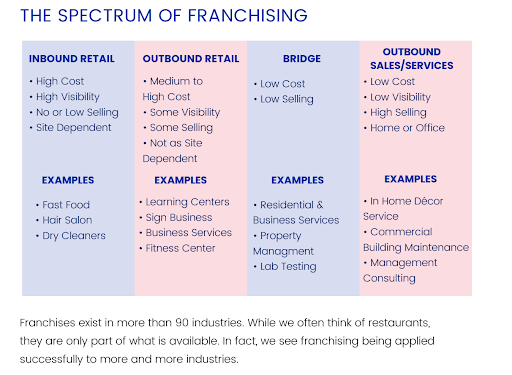
Image Source: FranNet "Roadmap to Success" (PDF)
Owning a Business vs. Buying a Franchise
There is essentially no difference between owning a business and buying a franchise, since purchasing a franchise means owning one’s own business. However, in this case, the franchisee utilizes the business plan, business model, branding, systems, and processes provided by the franchisor and operates that business in their local market. Aspiring entrepreneurs who buy a franchise become part of a system with ongoing support.
In contrast, when starting an independent business, an individual begins from scratch, developing a business plan, a business model, the product or service they will sell, creating all their own processes and systems, and navigating all the trials and errors that go along with launching a new venture.
Some aspiring entrepreneurs may also choose to buy an existing independent business, versus buying a franchise business. This option falls somewhere between buying a franchise and starting a new business, removing some of the risk and learning curve of starting from scratch, but without the system and ongoing support of a franchise.
With a franchise business, the franchisor has removed much of the uncertainty, allowing the franchisee to implement established practices that have proven successful for the business.
The chart below illustrates the key differences between these three options.
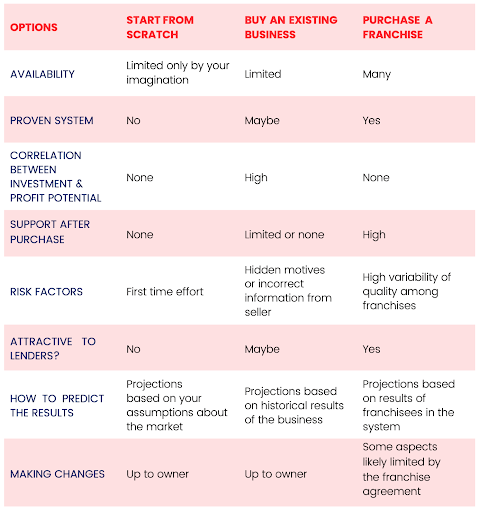
Image Source: FranNet "Roadmap to Success" (PDF)
Is Buying a Franchise Right for You?
Aspiring business owners interested in purchasing a franchise need to first consider whether buying a franchise is right for them. It’s one thing to want to own a business, it’s another to objectively evaluate whether it is the right decision. MOBI’s session on Choosing the Right Business can also be helpful in evaluating your business goals and discusses the key characteristics of an entrepreneurial mindset.
What Does it Take?
There are three key factors that contribute to successful franchise business ownership. These include Drive, Business System, and Fit.
Drive refers to the determination the business owner possesses to pursue success. Whether it’s the desire for greater flexibility, financial opportunity, independence, or to be your own boss, your determination is a key element contributing to a successful outcome. One reason is that while business ownership is often very rewarding, it presents many challenges as well. Without a high level of determination, it may be difficult to keep your motivation to overcome challenges and obstacles along the way. Another reason is that determination is not typically something that can be learned. If you enjoy the stability and predictability of working for someone else, your determination to own a business may be low, and buying a franchise may not be right for you.
Business system refers to the complete package provided by the franchise opportunity. It’s the business model, the location, the products or services themselves, the marketing, sales process, management, training, and ongoing support. The system the franchise provides is more important than the products or services on their own. Be sure to consider the entire package when evaluating the potential for success.
Fit refers to the alignment between you and a particular franchise. You can think of fit as comprising two parts: your business goals and your business preferences, or in other words, your financial and lifestyle goals. Your business goals are your motivations for wanting to buy a franchise. What are you hoping to change or achieve in your personal, professional, or financial situation by buying a franchise? List out your business goals and rank them as “must have” or “nice to have.” Your business preferences align with your desired lifestyle and role in the business. What transferable skills do you have that you’ll bring to the business? How do you see your working style, your interests, and your personality operating in the business? What structure would work best, how many employees, what type of operation, etc. Visit this Franchise Business Preferences Questionnaire to help you determine your business preferences. Consider not only your immediate financial and lifestyle goals, but your long-term goals as well. Think about the next year, five years from now, ten years from now, and even twenty years from now or more.

Image Source: FranNet
How Much Money Do I Need?
It is important to remember that there is no automatic correlation between what it costs to buy a franchise and how much money you will make. The cost of the business has little to do with how much you can make.
The cost to buy a franchise can vary widely depending on the type of franchise, the brand, the location, and the level of support and services provided. Based on some internet research, here are general estimates of the costs involved in buying a franchise, along with some additional information. It’s always a good idea to do your own research or consult an expert to gather accurate information for your specific situation. Typically, you will need 25-30 percent of the total investment in cash.
- Initial Franchise Fee:
- This is a one-time fee paid to the franchisor to use their brand and business model. Fees typically range from $10,000 to $100,000 or more, depending on the brand and the industry. In 2022 FranData estimated that 70 percent of franchise systems have a fee of $30,000 or less.
- Start-Up Capital
- This is the initial amount of money needed to cover the costs of purchasing the franchise, setting up the business, and covering initial operating expenses.
- According to FranData’s 2022 findings, about one-fourth of franchise systems require start-up capital of less than $100,000, while about one-half of franchise systems require an average start-up capital of less than $250,000.
- Ongoing Fees:
- Royalty Fees: Typically, franchisees pay an ongoing royalty fee based on a percentage of their revenue, ranging from 4 percent to 8 percent.
- Marketing/Advertising Fees: Most franchisors also charge an additional marketing or advertising fee, which is typically 1 percent to 4 percent of revenue.
Other Costs:
- Real Estate: Many franchises, especially in industries like restaurants, retail, and fitness, will require a lease or purchase of the commercial real estate where the business will operate. Costs will depend on location and size.
- Working Capital: You'll need extra funds for day-to-day expenses such as inventory, salaries, utilities, and operating costs until the business becomes profitable. This could range from $20,000 to $100,000. Be sure to understand the working capital needed to get you from starting to break-even (the point when the amount of money you have earned or received from your investment equals the amount you initially invested), and prepare financial projections for best case, worst case, and most likely case.
The total initial investment required to start a franchise, which includes the initial franchise fee, equipment, supplies, real estate, and other startup costs, can range from around $50,000 to $2 million for mid-size to larger franchises. Home-based and microbusinesses could also provide opportunities for a lower investment.
Evaluate your available capital and identify sources of financing if you need to borrow money. Visit MOBI’s Financing the Business and Microfinancing Basics sessions for more information on this topic.
It's important for prospective franchisees to thoroughly research the specific franchise they are interested in and review the Franchise Disclosure Document (FDD) for detailed cost breakdowns and requirements. The FDD contains essential information about the franchise's history, fees, financial performance, and legal obligations. If the franchisor is unwilling to provide this document or offers vague details, it could indicate a problem or scam.
How to Find Franchises for Sale
There are several resources available for aspiring business owners who are interested in purchasing a franchise. These include:
- Franchise websites and directories (www.franchisedirect.com, www.franchiseglobal.net, www.franchisegator.com)
- Franchise consultant and franchise broker services (FranNet, The Franchise Brokers Association, Transworld Business Advisors)
- Franchise trade shows and expos (International Franchise Expo, Franchise Expo West, Franchise Expo South)
- Franchise industry publications and blogs (Franchise Times, Entrepreneur Franchise 500, Franchise Business Review)
- Social media and online communities
- Franchisor websites
- Small Business Development Centers (SBDCs) and local Chambers of Commerce
How to Research a Franchise Opportunity
It can feel overwhelming to research and evaluate a franchise opportunity, especially since it is a good idea to research several before making a decision. Two pieces of advice are helpful to keep in mind: 1) you are under no obligation during the investigation stage other than polite and honest communication (as long as you don’t sign any paperwork), and 2) take it one step at a time. Here are four steps to help you through the research process.
- Step 1: Talk to the Franchisor
- Review any materials provided.
- Do your best to make a good impression.
- Read the FDD.
- Step 2: Call and Visit Some Franchisees
- Ask the franchisor for some recommendations of franchise owners who have a similar background to yours. Ask for recommendations of franchisees that are very successful as well as some that may be struggling. Develop a list that represents a good variety. Refer to this list of Questions to Ask Franchisees for ideas for your conversation.
- Call 8-10 franchisees and take careful notes.
- Visit at least 2-3 franchisees at their business.
- If possible, talk to a former franchisee.
- Step 3: Visit the Franchisor for a Discovery Day
- Competency: When assessing a franchise, the key question regarding competency is whether the franchise is skilled in its operations and knowledgeable about its processes.
- Chemistry: Within a franchise system, it is essential for individuals to enjoy working with their colleagues to some extent. Can you get a sense of the chemistry?
- Character: Ultimately, when aligning with a franchise brand, it is crucial to ensure that there is a strong alignment in terms of moral values and character between the individual and the franchise.
- Meet face-to-face.
- Evaluate fit with corporate culture considering the three “C”s: Competency, Chemistry, and Character.
- Ask any remaining questions.
- Step 4: Consult with Professional Advisors
- Hire a franchise attorney to review the agreement to make sure you understand all the provisions.
- Consider hiring a qualified accountant to assess the financial strength and opportunity.
- Talk with any potential lenders if you plan to borrow money.
- Use any other experts who would be appropriate and helpful.
How to Buy a Franchise: Key Steps to Take
- Identify your financial and lifestyle goals for the short term and long term before looking at specific concepts.
- Be clear on your budget for going into business. Don’t commit to more than you are comfortable with investing.
- Identify a franchise opportunity and talk with the franchisor. Here is a sample list of Questions to Ask Franchisors now and/or at the Discovery Day.
- Consider whether there is cultural alignment by examining three “Cs.”
- Conduct due diligence.
- Obtain and review the financial statement(s).
- Obtain Profit and Loss statements for the franchise location you select. (If purchasing an existing location.)
- Determine whether there are any franchisee lawsuits pending against the franchisor.
- Examine the business of the franchise location you intend to purchase unless you are opening a franchise in a new location. Questions to consider:
- Is there an order backlog?
- What is the term of the lease?
- What improvements are needed?
- What is the amount of the receivables (money owed to the franchise)?
- What is the amount of the payables (money the franchise owes)?
- How strong is customer loyalty?
- Is the industry of this business stable or changing?
- What is the status of any licenses or permits required to operate the business?
- What is the reason the franchise is being sold? (Is the seller motivated or anxious?)
- Talk to several current franchisees in a variety of circumstances. Refer to this list of Questions to Ask Franchisees for ideas.
- Review the Franchise Disclosure Document (FDD), including having a legal review by a franchise attorney.
- Outline the initial investment, all ongoing fees as well as the complete investment required to get started.
- Understand the working capital needed to get you from starting to break-even.
- Prepare best-case, worst case, and most likely case financial projections.
- Have a franchise attorney review the franchise agreement before you sign.
- Make sure to consult a FRANCHISE attorney, as this is a specialized area of law. Choosing the right expert ensures you receive informed advice without covering the cost of their learning curve.
- Attend a Discovery Day before you make the final decision to join the franchise.
- Look at three or more franchise concepts before making a final decision to buy a franchise.
- Secure your financing.
How Long Will it Take to Buy a Franchise?
The process of buying a franchise can take anywhere between eight weeks and five months (on average), or potentially more, depending on the amount of time you want to spend researching opportunities, the franchisor process, document reviews, etc.
What to Avoid When Buying a Franchise
Don’t Let Passion Be Your Guide when Choosing a Franchise
It’s important to keep a few considerations in mind when buying a franchise to help you avoid mistakes. First, sometimes aspiring business owners use their interest or passion for a product or service as the main decision criteria in deciding to purchase a franchise.
There are a few reasons why it can be problematic to purchase a franchise for a business because you have a personal interest and/or industry experience. First, most franchises are executive models. As a business owner, you are working on the business, not necessarily in the business. So, it's very important to make sure that you have the skill set necessary to run the business as an owner. You may want to purchase a bakery franchise because you love to bake. However, as the business owner you will be running the business rather than baking.
Another potential problem is that you may think you know better than the franchisor the way the business should be run, even though the franchisor has a proven system for this particular business. Using the bakery example again, you may have excellent recipes that are very popular among your family and friends, but as a franchisee you will use the franchisor’s established recipes.
Another problem that can come up is what is known as “misplaced passion.” Many people think, “If I have the passion for it, I can sell anything.” The reality is that selling also requires a particular skill set, and successful sales are critical for any business. Selling can be a very discouraging yet absolutely critical part of business ownership. Before buying a franchise, it’s important to understand the sales process and your role in that process as the business owner. Does your skill set align with the selling model and requirements for that franchise?
Successful franchisees are typically people who purchased a business opportunity they were passionate about running, regardless of the industry and regardless of what the business produced or sold.
Don’t Fall for a Scam
Avoiding franchise scams is crucial for aspiring business owners, as fraudsters often target individuals eager to invest their savings into what appears to be a real business opportunity. To protect yourself, it’s important to do thorough research and ensure that the franchise you’re considering is reputable.
One of the first steps is to review the FDD. As mentioned earlier, if the franchisor is unwilling to provide this document or offers vague details, it’s a significant red flag.
Another key step in avoiding scams is to research the franchisor’s track record. Look for established brands with a history of success and positive feedback from current franchisees. If a franchisor promises quick or guaranteed returns with little effort or makes unusually high financial promises, it’s likely too good to be true. Legitimate franchise opportunities generally emphasize hard work, proper training, and realistic expectations for growth.
Aspiring business owners should also be cautious of franchise opportunities that require a large upfront payment with little explanation of what that fee covers. Transparency about fees and support is a hallmark of legitimate franchises.
Finally, as included in the earlier section about how to buy a franchise, be sure to consider consulting a franchise attorney or financial advisor who specializes in franchising before committing. These professionals can help you review the FDD, evaluate the franchise’s financials, and identify any legal or financial risks.
After the Franchise Purchase
What to Expect
Everything you can expect from the franchisor is outlined in the FDD, so you cannot expect anything not specified within that document. To ensure you fully understand what to expect, make the most of your discussions with other franchisees. Ask them what they wish they had known before starting and what you can expect as a new franchisee. Is there anything that may not have been expressly stated in FDD? Refer to the Questions to Ask Franchisees mentioned earlier in this session.
After signing a franchise license agreement, you can generally expect the following from the franchisor:
- Training and Support: The franchisor should provide initial training for you and your staff. This often includes operational procedures, marketing strategies, and customer service practices.
- Operational Guidelines: You can expect detailed manuals or guidelines outlining how to run the franchise, including standards for site selection, design, and daily operations.
- Marketing and Advertising Support: Franchisors typically offer advertising materials and can coordinate marketing campaigns to promote brand awareness.
- Ongoing Support: This can include field support visits, regular communication, and updates on business strategies or new product launches.
- Supply Chain Assistance: Many franchisors help franchisees source products or manage vendors to ensure quality and consistency.
- Access to Proprietary Systems or Technology: Franchisors often provide access to specialized software, inventory systems, or business management tools essential for operating under their brand.
- Performance Benchmarks: Expect help in measuring your performance against established benchmarks and other franchise locations.
- Franchisee Community: Opportunities to connect with other franchisees to share best practices, challenges, and successes.
- Continued Training Opportunities: Regular training sessions and workshops to keep you and your staff updated on industry trends and new developments.
- Compliance Assistance: Guidance on legal, regulatory, or operational standards compliance.
Considerations for a Successful Operation
Here is some guidance for franchise owners to follow and considerations to keep in mind after purchasing a franchise to help ensure a successful operation:
- Utilize Training and Support: Fully utilize the training and support provided by the franchisor. This includes understanding the operational procedures, marketing strategies, and customer service expectations.
- Adhere to Brand Standards: Maintain the brand's standards and guidelines to ensure consistency across all franchise locations. This is vital for protecting the brand's reputation.
- Manage Finances: Keep a close eye on finances, including budgeting, cash flow management, and understanding all fees associated with the franchise. It's important to be prepared for both expected and unexpected expenses. Visit MOBI’s Financing the Business and Accounting and Cash Flow sessions to learn more about financial management for your small business.
- Implement Marketing Strategies: Implement the marketing strategies provided by the franchisor while also adapting them to local market needs. Engage with the local community to build brand recognition and loyalty.
- Prioritize Operational Efficiency: Regularly assess and improve operational processes to enhance efficiency and productivity. This includes managing inventory, staff scheduling, and customer service practices. Visit MOBI’s Business Operations session to learn more.
- Comply with Regulations: Stay informed about local regulations and compliance requirements that pertain to the business, including health and safety standards, employment laws, and zoning regulations. MOBI’s session on Licenses and Permits can be helpful with this information.
- Manage Staff Effectively: Focus on hiring, training, and retaining skilled staff. Foster a positive work environment to enhance employee satisfaction and reduce turnover.
- Foster Feedback and Communication: Establish open lines of communication with both customers and the franchisor. Regularly seek feedback to identify areas for improvement. Visit MOBI’s Customer Experience and Feedback session to learn more.
- Network with Other Franchisees: Connect with other franchisees within the network to share experiences, strategies, and best practices. This can provide valuable insights and support.
- Adapt: Be prepared to adapt to changing market conditions and customer preferences. Flexibility can be key to sustaining growth and profitability.
By being mindful of these aspects, franchise owners can enhance their chances of long-term success and satisfaction in their business venture.
Hiring and Retaining Employees
Hiring and retaining labor presents significant challenges. In today’s business landscape, entering any venture with the misconception that this aspect will be easy requires a shift in perspective. It is crucial for business owners to partner with a franchise organization that comprehends the current labor environment, including strategies for sourcing staff and team members, as well as effective retention practices that outpace the competition.
The reality across nearly every marketplace in North America is that finding and keeping qualified staff is difficult. However, viewing this challenge as an opportunity to collaborate with an experienced franchisor can provide a sustainable competitive advantage, as these franchisors often have a deeper understanding of how to attract and retain talent more effectively than their competitors.
Business owners must approach this endeavor with the awareness that building a successful team will be a vital component of their growth, continually prioritizing the recruitment and retention of the right people. Visit MOBI’s Hiring and Firing session for more information in this area.
Professionals That Can Help
Franchise Consultants vs. Franchise Brokers
These interchangeable terms mean the same thing, and both act as matchmakers for local entrepreneurs seeking a franchise opportunity. These are franchise consultants and franchise brokers. Some examples mentioned earlier include FranNet, The Franchise Brokers Association, and Transworld Business Advisors, among others.
Franchise consultants and brokers research, analyze and vet the top-performing franchise organizations across all industries. They work with aspiring business owners to understand their goals, objectives, and budget and then build a “blueprint” or a personal business model of what the ideal franchise business looks like. With that blueprint, the franchise consultants and franchise brokers look for matches with available franchise opportunities.
Franchise consultants and brokers aim to find performing brands that match the goals and ideal business criteria for each individual investor or investor group and introduce them to the research process. Their objective is to narrow the list of opportunities to those that align with the goals and priorities of the business owner. They typically also provide the tools needed so the business owner can conduct effective, efficient research on those businesses.
A good franchise consultant will also help educate the aspiring business owner about the universe of franchise opportunities and provide a process for due diligence and exploration.
Top 10 Do's and Don'ts
THE TOP 10 DO'S
- Research thoroughly before purchasing a franchise, including reviewing the Franchise Disclosure Document (FDD).
- Consider your budget, financial goals, and available capital before investing in a franchise.
- Speak with current franchisees to learn about their experiences with the franchisor.
- Consider the franchise culture and whether it aligns with your personal values and business goals.
- Conduct due diligence by reviewing financial statements, Profit and Loss reports, and any ongoing lawsuits involving the franchisor.
- Evaluate your transferable skills and ensure they match the requirements of the franchise business.
- Attend a Discovery Day to meet the management team and gain a deeper understanding of how the franchise operates.
- Have a franchise attorney review your agreement to ensure it is legally sound and that you understand the terms and obligations.
- Consider all associated costs such as initial fees, ongoing royalties, marketing fees, and real estate expenses before committing to a franchise.
- Leverage the support and training provided by the franchisor to enhance your chances of success and follow brand standards.
THE TOP 10 DON'TS
- Rely solely on your passion for the product or service as the main decision factor in purchasing a business or franchise.
- Skip the Franchise Disclosure Document (FDD) review—if the franchisor is unwilling to provide it, it’s a warning sign.
- Underestimate the importance of implementing the franchisor’s established systems and processes.
- Commit to a franchise without understanding the full investment required, including working capital and operating expenses.
- Ignore potential risks—be cautious of franchises that promise quick, guaranteed returns or require large upfront fees without clear justification.
- Forget to consult with a franchise attorney or financial advisor to protect your investment.
- Expect instant success—understand that building a successful franchise takes determination to overcome obstacles and challenges.
- Assume the only franchise opportunities are with food businesses.
- Overlook professionals who can help such as franchise consultants and brokers.
- Forget to think about what you will be doing on a daily basis as a franchise owner.
Business Resources
If you are currently writing or have developed a business plan, consider taking a moment now to include any information about your business related to this session. As a reminder, MOBI’s free Business Plan Template and any worksheets, checklists, and templates from this course are available for you to download. Just visit the list of MOBI Resource Documents on the Resources & Tools page of our website.
Glossary of Terms Used in this Session
Here are some key terms and definitions used in this session or related to this session:
|
Term |
Definition |
|
Business Model |
The plan or structure a company uses to generate revenue and profit. |
|
Franchise |
A business model where one company (franchisor), allows another person or group (the franchisee) to operate a branch or unit of their business using the franchisor’s brand, systems, and support, in exchange for a share of the profits. |
|
Franchise Disclosure Document (FDD) |
A legal document that franchisors in the United States must provide to prospective franchisees before they sign a franchise agreement. |
|
Franchisee |
An individual or group that purchases the rights to operate a franchise business. |
|
Franchisor |
The company that owns the overarching business, brand, and system, and licenses it to franchisees. |
|
Inbound Retail Business |
A business that relies on attracting customers to its products or services through marketing instead of directly reaching out to customers. |
|
Royalties |
Ongoing payments made by the franchisee to the franchisor, typically a percentage of the business’s revenue, in exchange for the right to use the franchisor’s brand and support. |


