This alum is shaking up the boardroom before the age of 30
These days, you don’t need to be an economist to be preoccupied with money. Sadly, two-thirds of American adults say money is a major source of stress. Nearly one in five people carrying debt don’t believe they’ll ever pay it off. And more than a quarter of Americans don’t have enough savings to cover a $400 emergency.
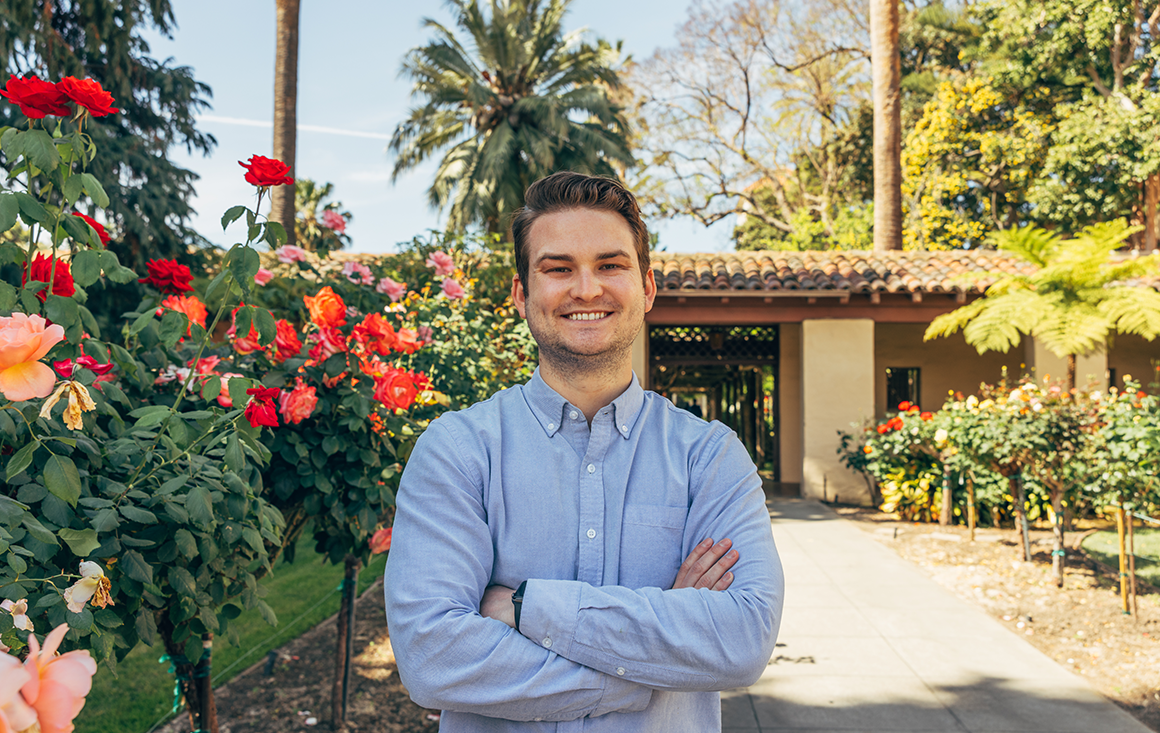
For Henry Ferguson ’18, these aren’t just statistics. They’re personal.
Ferguson grew up in Los Angeles, raised in a four-generation household helmed by his great-grandmother, a Japanese immigrant and single mother who arrived in the U.S. after World War II and worked as a kindergarten teacher. There, conversations about money were common, and personal finance education was a key tenet of his great-grandmother’s outlook that she passed on to Ferguson.
Every birthday and Christmas, she’d press cash into young Henry’s hands—never in one large bill, always broken into smaller ones—with the same instruction each time: “Buy something for yourself, save some of it, and then give to someone who needs it more than you.”
“Money is a deeply personal experience,” Ferguson reflects. “It can be joyful, it can be traumatic, it really hits all of the emotions.”
That empathy is a big part of why Ferguson, a venture capital investor, recently stepped into the role of board chair at 5 Buckets, a Bay Area-based nonprofit dedicated to closing the financial literacy gap.
With the average age of a nonprofit board member in their mid-50s, Ferguson takes on this leadership role at just 29 years old. But instead of seeing his success as a rung up the leadership ladder, he sees this role as living out that lesson his great-grandmother instilled in him all those years ago.
“That’s always been a thread throughout my life,” he says. “How can I give back?”
Values, activated
Ferguson arrived at Santa Clara already shaped by a family culture of service and education. The university deepened it.
As a double major in environmental studies and economics, he threw himself into the experiential learning that defines a Santa Clara education, working at the Center for Sustainability and Law School, and participating in several Ignatian Center immersion trips.
Two immersion experiences stand out: a spring break spent at the St. Vincent de Paul Center in the East Bay, living alongside unhoused community members; and a trip to Nepal led by a professor who had served there through the State Department three decades prior, focused on helping locals start and develop businesses.
“That was super interesting for me,” he recalls, “because it combined a lot of the things I was thinking about in terms of finance, service, and sustainability.”
During the St. Vincent de Paul Center immersion, a late-night conversation following a visit to Alameda Prison left a similarly lasting impression—the kind of uncomfortable, necessary dialogue that Ferguson says Santa Clara had a gift for creating.
“Men and women for and with others—it’s front and center, almost omnipresent,” he says. “It never felt like it was in your face, but it was always there.”
That ethos followed him into his first job at EY, where he spent five years as a consultant—a path shaped in no small part by a chance encounter at a Santa Clara career fair and a professor whose simple advice proved prescient: go build transferable skills first, then figure out the rest.
Early in his EY tenure, his manager—a mentor in San Francisco’s College MAP program, which supports first-generation college students—invited him along to one of her high school visits. It was an offhand invitation, but it changed the trajectory of how Ferguson thought about his career.
“I realized these things are not mutually exclusive,” he recalls. “You don’t have to choose. You can be a high performer and engage in the meaningful things.”
It was around that same time that Ferguson’s then-girlfriend—now wife—was serving as the first executive director of 5 Buckets, a Bay Area nonprofit teaching practical financial skills, including budgeting, credit, investing, and developing a positive money mindset, to students and adults through schools, nonprofits, and community partners.

Ferguson (right) strategizes with 5 Buckets President/CEO Victoria Terheyden—coincidentally, the daughter of another Bronco, William Terheyden ’65. Photo by John Paul Franzia.
Founded by CPA, entrepreneur, and financial advisor Steve Mayer, the organization was born from a simple but striking observation: even his most affluent clients were asking him to teach their children how to manage the money they’d one day inherit. If families with every resource at their disposal were struggling to pass down financial literacy, Mayer reasoned, what did that mean for everyone else?
In its seven years, 5 Buckets has served 5,600 learners across 225 workshops, partnering with 50 organizations to reach communities from high school classrooms to families in affordable housing programs—with 80% of learners coming from low-to-moderate income households and 60% being between the ages of 12 and 24.
After a few successful years, Mayer realized that if 5 Buckets was going to be an effective multi-generational organization, it needed a more diverse, younger board to match. Ferguson was part of the first wave of new, younger board recruits. While he initially joined with equal parts curiosity and uncertainty, what he found reshaped how he thought about nonprofit leadership entirely.
Leadership starts now
If you close your eyes and imagine a board, you’d probably picture a table of seasoned executives, semi-retired professionals, and other people who have spent decades building careers before turning their attention to giving back. But Ferguson is ready to change that image.
“I realized that you can really be an effective board member with the skill set that you have as an early career professional,” he says. “I don’t measure my success by the check size I can personally write right now, but more by the impact I can drive from an operational perspective.”

Photo by Miguel Ozuna
In practice, Ferguson has helped 5 Buckets scale its partnerships, establish a board mentorship program, and build out the governance structures for its next decade of growth. It’s the kind of hands-on, get-in-the-weeds work that, Ferguson argues, early-career professionals are uniquely positioned to do well—and especially something that young Bronco alums are suited for.
He points to fellow Santa Clara alumna, Jennifer Scharre, J.D. ’15, who serves alongside him on the 5 Buckets board. He doesn’t think it’s a coincidence that they ended up at the same table, given how they were both shaped by Santa Clara’s Jesuit values.
It’s that shared connection that Ferguson also found through a role on Santa Clara’s Young Alumni Advisory Committee, where he helped build community among graduates on the East Coast. That work, he says, was less about nostalgia and more about stewardship—keeping fellow Broncos tethered to Santa Clara values and inspired to put them to work.
For young alumni (and even students) wondering where to start, Ferguson’s advice goes back to Jesuit discernment: find where your skills, your passions, and the needs of the world overlap—and don’t wait to act on it.
“The world needs more empathy,” he says simply. “If you can meet someone, put yourself in their shoes, then it can really open up a world of possibilities of what can be accomplished.”

The Ignatian Center exemplifies and activates the Jesuit, Catholic character of Santa Clara University. We encourage our students, faculty, staff, and community to embrace Jesuit wisdom by inspiring awareness, thought, reflection, discernment, and action.