Speech: Convocation 2025
Convocation Remarks
Julie Sullivan
September 16, 2025
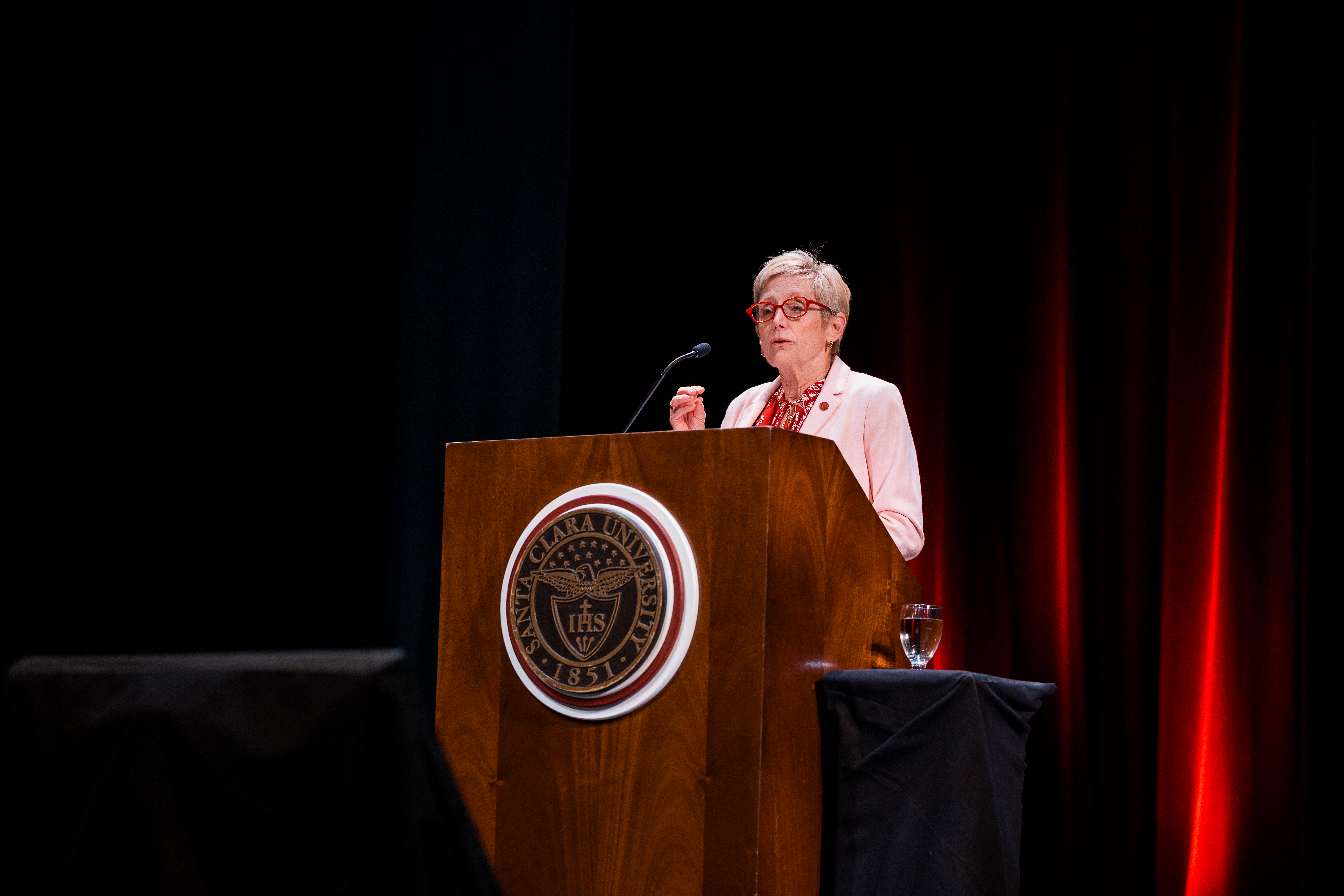
Photo: Miguel Ozuna
Introduction
Good afternoon! It is wonderful to see all of you! Today, we convene as a university community to mark the beginning of a new academic year, a time of renewal and fresh beginning.
Often at convocation, I reflect on our current opportunities and challenges and our hopes and aspirations for the year ahead.
Today, I want to do something a little different. I want to begin by reflecting on our identity as a Jesuit university.
Why?
First, we come together today at an historic moment in time. Transformational opportunities and unprecedented challenges are coming at us simultaneously—and at warp speed. Managing through such times requires us to stay grounded in our roots. And for our community, that is our Jesuit identity.
Second, over the past six months, my responsibilities have taken me abroad three times to university events and meetings that have deepened my understanding of the history, timelessness, and power of our Jesuit identity in helping us successfully navigate these tumultuous times.
We are part of a vast and diverse global network of Jesuit organizations. There is a broadened perspective and deep humility that comes from being a part of something much larger than ourselves or our university. It inspires us and elevates the personal meaning we find in our mission-driven work.
Last March, my husband and I made a pilgrimage to Spain with Santa Clara University’s Board of Fellows. We walked in the footsteps of St. Ignatius and visited sites pivotal to his conversion from soldier to founder of the Society of Jesus nearly 500 years ago. One particularly moving moment was when Fr. Matt Carnes celebrated Mass for us inside a small cave in Manresa where St. Ignatius lived for nearly a year and where he drafted the framework for the Spiritual Exercises. Being in this spot elicited a powerful connection to the Society’s roots. The entire trip was spiritually nourishing for me, and gave me a richer understanding of St. Ignatius’ influential spiritual journey, and his bold and global vision for the Society.
In early July, I attended the International Association of Jesuit Universities Assembly in Bogota, Columbia. That experience drove home for me the strength and connectedness of the global Jesuit higher education network. The Assembly brought together faculty and administrative leaders from the more than 200 Jesuit universities and colleges around the world. What struck me most was that while our work spans more than 50 countries and five continents, and thus many cultures and contexts, the mission of Jesuit higher education essentially is the same everywhere.
Then just last week, I traveled to Rome with Fr. Bator to meet with the Superior General of the Jesuits, Arturo Sosa, and with senior Vatican officials. Such personal meetings are very important, as Santa Clara University seeks to further collaborate with others around the world who share common hopes and concerns for the future.
These encounters made me even more aware of the responsibility we have as members of this university community to be stewards and innovators of the Jesuit tradition. Jesuits refer to this responsibility as Cura Apostolica. It means that as participants in a Jesuit work like Santa Clara University, we are called to manage our short-term challenges, while always envisioning and investing in our future. We must make complex decisions that both sustain our Jesuit values and enable us to adapt, so that we ensure the university’s long-run vitality to live these values for the betterment of our world.
So, to help us draw fresh strength and guidance from who we are, I would like to borrow from Fr. General Sosa, and devote the remainder of my remarks to the three C’s he shared with us in Bogota. They are different than the three C’s we often talk about:
- Our shared Charism—the Jesuit values and mission that undergird Santa Clara University and draw upon and unite our many individual faith traditions and beliefs
- The Context in which that charism is being called forth today, and
- Our Camino—our bold way forward, which is inspired by our Charism and adaptive to our Context.
Charism
So, let’s start by looking at who we are: our purpose, our mission, and our values. It is important to remember, that as a Jesuit university, the charism (or gift of the Holy Spirit) received by St. Ignatius and the Jesuits who followed him is what defines the identity of all Jesuit “works,” including our Jesuit university.
Thanks to the good work of our Division of Mission and Ministry and University Marketing and Communications teams, soon you will see banners on campus displaying six key aspects of our Jesuit identity. These are:
Cura Personalis – recognizing and promoting the dignity of all human persons; seeing the spark of the divine in each person and caring for each person in their own uniqueness
Faith That Does Justice – promoting justice and reconciliation in ways that are deeply rooted in—and strengthened by—faith and spirituality. In this, we are enriched by the diverse traditions, beliefs, and spiritual practices of every individual at Santa Clara.
People for and with Others – being people who live not just for themselves, but who empathetically care for and accompany others, especially those who are most vulnerable or marginalized.
Care for our Common Home – living, as Pope Francis reminded us in his encyclical Laudato si’, as stewards of this shared planet and ensuring that we can pass it on to future generations.
Discernment and Reflection – discerning the work of God’s spirit in our lives. Asking for ourselves and our University: Where and how are we being called?
Seeking God in all Things – seeing and being grateful for God’s presence in our everyday experiences and the beauty of nature.
These banners will be a visual reminder of our Jesuit identity and values.
While these values pertain to all Jesuit organizations, as a Jesuit university, we live them in a distinct way—a way that Jesuit universities have become known and respected for over centuries:
- We educate the whole person and foster intellectual, social, and spiritual development;
- We engage in rigorous scholarship that addresses the complex issues and challenges of our time; and
- We reach for global connection and engagement with diverse cultures, to foster global understanding and collaboration.
Context
Once we remind ourselves of our roots and common values as a Jesuit university, we can better contemplate the context in which we sit as we begin the 2025-26 academic year. Our context involves recognizing the external forces that create both opportunities and challenges for us. It also considers our relative strengths and our capacity to face these challenges and to keep imagining, investing in, and building our University to reach its full potential.
First, it is noteworthy that 2026 will mark 175 years since our founding. John Nobili and Michael Accolti, our founding Jesuits, came to California during the Gold Rush in 1850. They quickly realized a college was desperately needed to educate the children of those coming from all around the world, seeking their fortunes and a new life on this exciting frontier. For months, they sought permission from the Jesuit Superior General in Rome to start such a college.
At the end of that year, California’s bishop offered them a crumbling, formerly Franciscan-run mission to launch the college. Fr. Nobili had to make a choice in late 1850 or lose the offer. So, with a “can do spirit,” he unilaterally signed off on the transfer of the mission and launched the Santa Clara College in 1851.
Ironically, the letter from Rome finally arrived several months later – saying no, do not start this new college. But clearly, given where we sit today, Fr. Nobili made the right choice in seeking forgiveness rather than waiting for permission!
There’s a parallel, from the roots of our University’s founding to where we are today. We’re sitting in the heart of Silicon Valley, a magnet as strong as the Gold Rush for those seeking to be on the frontier of knowledge and change. Just like in 1851 — when metallurgy was our most popular major — we are moving quickly, and thoughtfully, to adapt our education to the skills and ethical frameworks needed now. That notably includes managing huge and disruptive technological innovations, including artificial intelligence.
Now, like then, this monumental technological change is colliding with our fundamental need to stay personally rooted and resilient as people. Adults of all ages, and especially young people today, are feeling an increased yearning for meaning and purpose, a yearning which is often filled by faith or spirituality practices.
This need is all the more urgent as we see our nation and our world becoming more and more polarized along political, religious, and ideological lines. Our society is losing its sense of a shared reality and witnessing the erosion of our collective respect for human dignity– too often leading to deadly violence. Universities are not immune, as we saw with the murder of political activist Charlie Kirk recently at Utah Valley University.
I find it reassuring, then, that in our recent Climate Survey and the Mission Priority Examen listening sessions, we learned that many characteristics of our Jesuit charism and identity resonate deeply with our faculty, staff, and students. Many expressed a desire to go deeper, to better understand Ignatian spirituality, and to strengthen the connections between their commitment to social justice and their spiritual lives.
Of course, when reflecting on our current context, we can’t ignore the federal government’s attack on higher education. We’re seeing executive orders, directives, and investigations seeking to eliminate diversity, equity, and inclusion programs. Long-standing programs supporting Hispanic- and Minority-Serving Institutions are at risk. There are constant threats of federal repeal or cancellation of research grants and student loan programs. International student visas are being delayed or denied, and the social media and protest activity of students is under new scrutiny.
This is all contributing to an erosion of what have long been the foundational tenets of American higher education: academic freedom, freedom of speech, world class research and discovery, and the contributions of talented faculty and students from around the world.
Here on our campus, these tenets are not in question. We are resolute in our efforts to join with other universities in collective advocacy to protect our university’s mission in the world. Be it our faculty’s academic freedom, or the importance we place on inclusive excellence—which is rooted in our Jesuit values—there are certain bedrock principles that require our unwavering support.
Moreover, even though we are in this challenging environment, we are blessed to remain in a position of considerable strength, especially relative to many of our peers in higher education.
- Yes, we are projecting a modest revenue shortfall this year, primarily related to the drop in international graduate student enrollment, and as a result have slowed down non-essential spending. I know this has created increased work and sacrifice, and we are grateful for your efforts. Once the actual shortfall is determined, we will strategically manage it to minimize impact on our community. Broadly speaking, we are in a stable financial position, and able to continue to imagine, invest in, and pursue our strategic priorities.
- In our planning, we continue to prioritize our most important investment: our people. We kept our merit and market salary pools and are moving forward with phase two of our staff total rewards plan, which adjusts staff compensation to updated market conditions. While other organizations face hiring freezes and layoffs, we are experiencing very strong candidate pools, and expect to be in a position to attract outstanding faculty and staff talent to the university this upcoming year.
- Our stellar faculty and staff, our reputation for providing an excellent whole person education, our location in the dynamic and innovative economy of Silicon Valley, and our strong, and well-connected Bronco alumni network are all strengths that draw many students to Santa Clara. For example, this year we had a second year of record applications – surpassing 20,000 for the first time – for our undergraduate programs in the College of Arts and Sciences, Leavey School of Business, and the School of Engineering. And we are excited to welcome a full class of first-year and transfer students at the end of this week. This fall, we also enrolled a robust and highly qualified class in the School of Law, with particularly strong LSAT scores. Our strengths also contributed to outstanding rankings of our graduate business programs this past spring.
- And perhaps most importantly, we have a 500-year foundation in our Jesuit mission that is as relevant to our university today as it was when we were founded in 1851.
Camino
So, what is our Camino, or way forward, given our Jesuit charism and our context?
Our Camino remains broadly defined by our Impact 2030 vision of becoming the leading Jesuit university in the world in service to global society and the global church.
It’s further defined by our Impact 2030 foundational commitments and four broad strategic pillars: global reach, solutions for the universal good, opportunity for all talented students, and belonging for all Broncos.
From the beginning, we stated that Impact 2030 is an “evergreen” plan. The broad pillars in our plan remain relevant. And we will continually evolve and clarify the plan’s goals and initiatives, in response to changes in our environment and input from our community. This past year, many people across campus provided input and recommendations through various means including their participation in advisory groups, committees, and working groups (some of which are still continuing). Thank you very much for sharing your creativity, imagination, wisdom, and vision.
This fall, we expect the Global Reach Working Group to share their recommendations for how we can expand numerous facets of the global engagement of our students, faculty, and staff, and significantly progress toward our Impact 2030 aspiration of becoming the leading Jesuit university in service to global society and the global Church.
Already, JST-SCU is playing a significant role as a leader for the global Church in increasing the understanding and practice of synodality, consistent with the visions of Pope Frances and Pope Leo XIV. In a recent interview, Pope Leo XIV defined synodality as “an attitude, an openness, a willingness to understand,” and as “an antidote to polarization.”
This past spring, JST-SCU hosted “Together at the Table,” an international conference on synodality keynoted by the Vatican’s General Secretariat of the Synod of Bishops, Cardinal Mario Grech. JST-SCU will be receiving a large grant from the Hilton Foundation to pilot a new Masters in Theology, with a concentration in synodal leadership.
Speaking of JST-SCU, this past year, their community and constituents engaged in a discernment process about relocating to our Santa Clara Mission Campus. I am pleased to share that the JST-SCU Board of Directors and the SCU Board of Trustees considered the results of this process and enthusiastically supported the relocation, which we hope will occur in fall 2027. The School will be located in unused space in Guadalupe Hall, which will be renovated and funded by the sale of properties in Berkeley. This move is part of a larger vision to strengthen collaboration, opportunities, and collective impact of JST-SCU, the Graduate Program in Pastoral Ministries, and religious studies. This will greatly advance our Impact 2030 goal of establishing Santa Clara University as a robust and distinctive hub of global theology.
Impact 2030 also includes our commitment to develop universal solutions to meet societal needs. As more powerful AI-fueled technologies rapidly emerge, we are called to assess their vast potential for solving problems and improving the human condition, as well as their risks and pitfalls. We have a particular sensitivity to ethical questions, as well as ensuring AI enhances, rather than diminishes, human flourishing and advances the common good.
When it comes to our mission of educating our students to be citizens and leaders of competence, conscience, and compassion, we must take a fresh look at what “competence” will mean in the future, and what AI-related skills our students will require to be leaders in their chosen fields. This is already a crucial question for our students seeking entry to the workforce, regardless of their majors. The mention of AI literacy skills on LinkedIn job posts has nearly tripled since last year, for technical and nontechnical jobs.
At the same time, we must ensure that we continue to excel in developing strong humanistic skills, such as critical thinking, creativity, collaboration and empathy. If anything, these skills will be even more important to our students’ futures.
We also must consider the workforce impacts of AI. What jobs will diminish or disappear, what jobs will grow, and what new jobs will arise? It will be important to anticipate how the answers to these questions will impact the growth and diminishment of students’ interest in our majors and degree programs.
Our faculty, staff, and students across all of our schools and the College have been integrating AI into courses, programs, and experiential learning activities, and creating new degrees, minors, student activities, and clubs. We’re conducting research on many facets of AI, including its potential to responsibly solve problems and create value, its risks and biases, and its environmental impacts.
This year, we are aiming to enhance university-wide support for teaching and research related to AI.
Our Center for Teaching Excellence, an Impact 2030 initiative, will soon launch with the hire of its inaugural director. We expect the center will support all facets of teaching excellence, including helping faculty adapt their pedagogy and course curricula to ensure all students develop responsible AI-use skills.
We also are continuing to pursue philanthropic funding to establish a university-wide Center of Distinction related to AI and human flourishing. This center will foster industry partnerships and support research and experiential learning. It will serve as an active portal between the university and the technology sector—ensuring we are at the forefront of creating our rapidly evolving technology-enabled future.
We are also forming a cross-functional working group to identify and evaluate opportunities to strategically integrate AI into the administrative units of the university.
Turning to our strategic pillar of providing opportunity for all talented students, this past year we homed in on a vision of ultimately meeting full demonstrated financial need for all students. As the first step in this journey, we rolled out two undergraduate Promise programs, and we are now meeting the full demonstrated need for Cal Grant-eligible students and students graduating from the national network of Cristo Rey high schools. As a result, in the incoming undergraduate class this fall, we estimate a 9% increase in the number of Cal Grant recipients and a 10% increase in Cristo Rey alumni. Thank you to all whose hard work made this possible.
We are actively exploring ways to expand our Promise programs to include additional subgroups of students—and should have more information on that later this year.
Many of you have asked about our Hispanic-Serving Institution initiative after legal challenges and recent federal actions to eliminate funding are putting the federal HSI program at risk.
The good news for Santa Clara is that our HSI initiative is not at risk because it was never about enrolling a specific percentage of Hispanic students. Nor was it to help us consider race or ethnicity in making admission and financial aid decisions, which we do not do. It also was never about obtaining the financial resources that historically have accompanied HSI designation.
Rather, consistent with our Jesuit values, it is part of our mission-driven work to attract and retain talented students from all backgrounds and communities. Our HSI initiative reflects changing demographics in the U.S. and especially California. We estimate 21-22% of our incoming first-year students this fall will identify as Hispanic or Latiné/x. And that number will only grow, as the Hispanic population continues to grow and our community outreach improves.
I am very grateful to the members of the HSI Advisory Group who developed a number of recommendations, which they will soon share with the community. Their recommendations emphasize “servingness”—how we become a stronger community where all of our students, including our Hispanic students, fully participate and flourish, academically and holistically. This year, the Provost’s Office will be discussing these “student servingness” recommendations with the HSI Advisory Group and other community members, and begin to integrate the recommendations into the University's structure, practices, programs, and culture.
Our work to further strengthen the sense of purpose and belonging of our entire Santa Clara community (faculty, staff, students, and alumni) also will continue unabated. To that end, we will further discern and reflect upon the input received from the Mission Priority Examen listening sessions and the Campus Climate Survey to develop and begin to implement recommendations. While this work is just beginning, we expect these recommendations will include providing more opportunities for members of our community to deepen their Ignatian spirituality and to strengthen the connections of our reconciliation, justice, and sustainability work to faith and spirituality.
Conclusion
So, to sum up, inspired by our Jesuit identity and values and guided by our discernment, our Camino is to boldly adapt to a rapidly changing world and to imagine, build, and invest in a hope-filled future for all.
Why do I use the word “hope?” Because, in educating our students as citizens and leaders who create a more just, peaceful, humane, and sustainable world, we must instill in them hope. We must help them believe at their core that such a world is possible, and equip them to play their role in building it. Thus, we also must believe it is possible!
I would like to conclude with a simple invitation, similar to the one Fr. General Sosa extended in Bogota to the leaders of Jesuit universities around the world: Let us walk together into the future inspired by the “magis” or “more” – not seeking more of the same, rather developing and embracing responses to our world that are better discerned, more innovative, and more transformative.
Let us go forward with clarity, courage, and joy - and be witnesses of hope!
Julie Sullivan
President, Santa Clara University
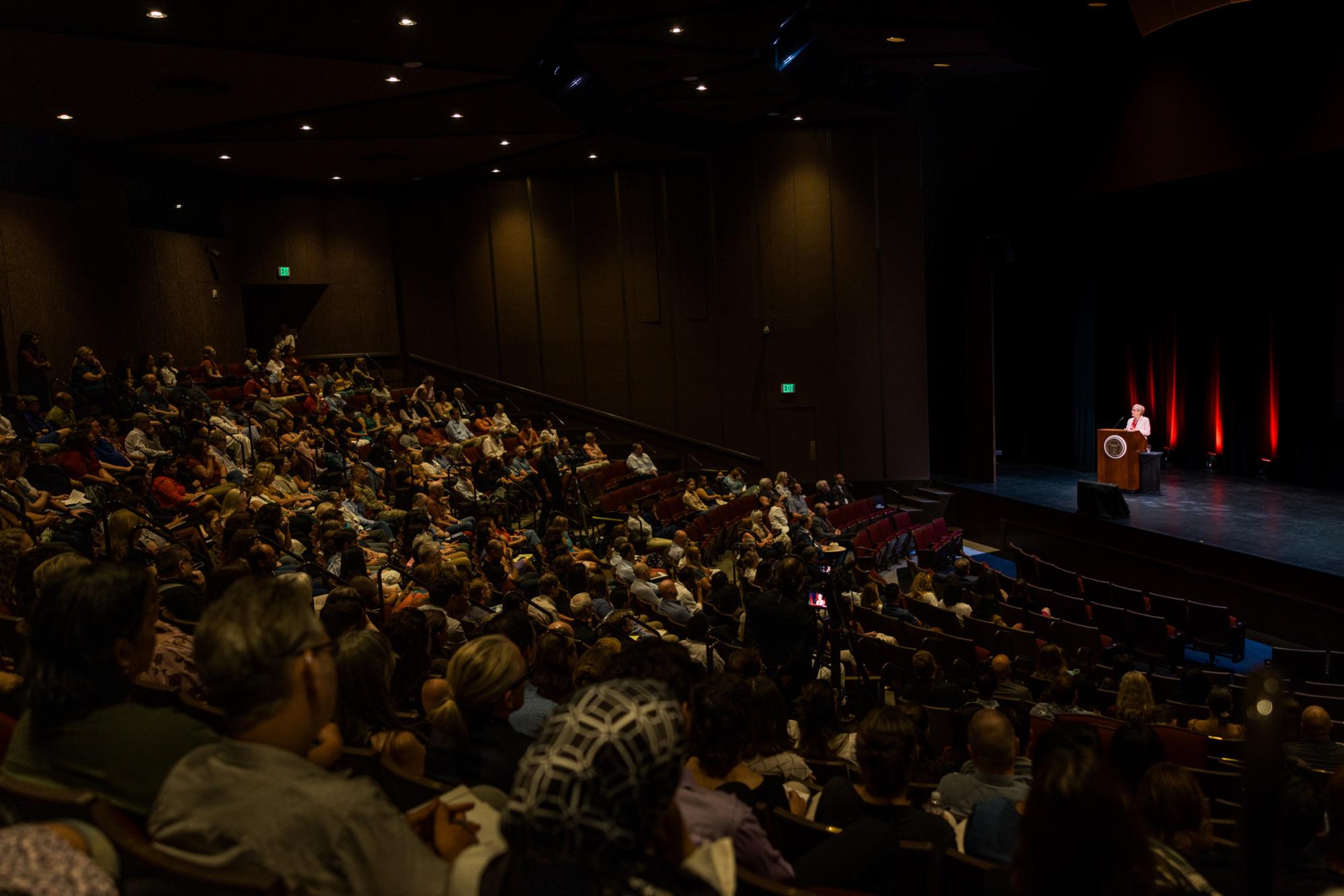
Photo: Miguel Ozuna