Inspiration Beside the Landscape
An interview with Professor Matthew Driscoll and Professor Nick Leither about their Fall 2024 writing retreat at the Blue Oak Ranch Reserve with their 18 CTW students
By Isabel Espinoza ’25
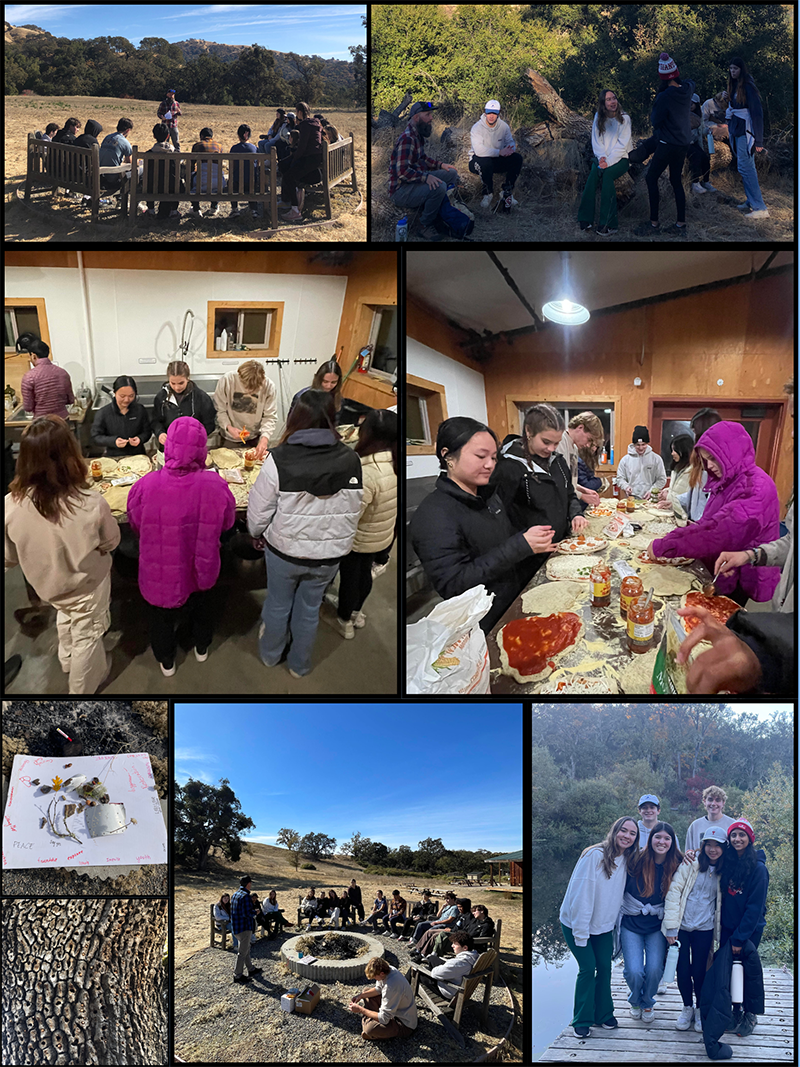
Below is an interview with English professors Matthew Driscoll and Nick Leither regarding their Fall 2024 writing retreat at the Blue Oak Ranch Reserve. The retreat served 18 Critical Thinking & Writing 1 students who were interested in expanding their written creativity while enjoying the beautiful Mount Hamilton scenery.
Tell me more about why the two of you decided to plan this trip to Blue Oak Ranch Reserve. You mentioned how you wanted to support students’ “creative processes from their experiences with the land.” Could you tell me more about what you mean by that?
Nick: The retreat involved opportunities to learn through reflections and observations in the field; small-group learning circles facilitated by instructors and student-leaders; co-creative food practices and rituals; and free time/space for writing/journaling. We hoped that the writing students produced at the retreat might support writing projects you are actively planning or working on, but there were no requirements for what you contribute or produce at the retreat, outside of your careful attention and presence.
Matt: The emphasis on process seemed particularly important in this intention. I find that students, even those in their first quarter at Santa Clara University, are already well-prepared to produce writing. Their early efforts at writing showed a desire to comply with expectations stated in assignments and in some cases also the course learning objectives. Sometimes, the work students did for their writing assignments (in essays and also in more low-stakes writing practices) also reflected creative thinking that allows student writers to learn more than they can when or if they’re more narrowly-focused on fulfilling all of the assignment’s stated expectations and requirements. These more creative products played with words, thoughts, feelings, and experiences in such a way that made it clear that their writers were learning what and how they think in the process of putting words together for an assignment.
The retreat was in many ways an opportunity to experiment and play with what it feels like to remove the pressure to produce work and instead make space for a more open-ended creative process in which we’re being present for experiences and reflecting conscientiously on our experiences, with the understanding that our experiences will weave their way into our thoughts and words. The particular spaciousness of “the outdoors” provided a compelling setting for this kind of open-ended process for a number of reasons—most notably for the generative/regenerative ecological processes that we witnessed in nature and for the invitation a poor cell signal provides (in some places) to take a break from media technologies. So much of our students’ education commands regular attention to digital technologies, and a break frees up interesting space for different learning experiences.
What activities did you plan to encourage students to write and expand their creativity?
Nick: We began the retreat by giving each student a writing journal and a fortune cookie. The fortune cookie acts as an initial prompt to start personal reflection. Each student attached the fortune to the front of their journal. From there, we invited students to write and reflect on anything relevant to them–their schoolwork, a creative project, personal reflection, the current experience, etc.
Writing in the classroom or in the library or the dorm can be isolating and difficult. It can often be distracting. Retreating to a beautiful place, and disconnecting from electronic devices and our routines can help us reconnect with our creative process. In the classroom, we often find ourselves working hard to encourage students to write, create, engage. But both of us were pleasantly surprised to watch students writing in their journals without prompting–testament to the importance of associating creativity with experience.
Matt: Nick had used the fortune cookie exercise in a previous class trip that he led called “Writing in the Wild.” I thought it was so cool to see the ways students integrated aspects of their fortunes into the ways they were thinking and speaking about their experiences at Blue Oak Ranch Reserve. I’ve found that I’ve been thinking more about my fortune in the weeks after the retreat. My fortune read: “Don’t put off till tomorrow what can be enjoyed today.” The words resonate for me as a reminder of why Nick and I put in the work to make this experience possible for their students.
I’ll add that I had the student-participants from my CTW courses primed for the practice of handwriting in journals. For the first time in a long time—maybe since when I taught high school writing—I have had students write free-write in journals for 10-15 minutes during class sessions. I never collect or see their journals, assigning in-class journaling sessions instead to get students reflecting on their learning. I think being outside definitely supports and often inspires meaningful journaling.
What did you hope to achieve through this trip?
Matt: We were retreating to the golden hills east of San Jose, in the Diablo Range, called Tuyshtak by the Chochenyo-speaking Ohlone people. Tuyshtak means “at the dawn of time,” a far more appealing place to retreat to than the devil’s range. Blue Oak Ranch Reserve was a mystery to us when I reserved the site, but I suspected that it would present a place very different from the Santa Clara Valley for our students and us to retreat to.
As I mentioned above, I also hoped we would retreat from a productivity-oriented climate to one that was more spacious.
What did you think your students would take away from this experience?
Matt: To put this simply, we hoped they would take away the experience. One more tangible outcome might be the relationships and connections they formed or grew with the people they shared the experience with. Another more ethereal outcome would be knowledge gathered about how our creative processes work.