Breaking News
Capstone students conducted community-based research, producing professional posters, robust reports, and partner-requested products.
Students in Chris Bacon’s two quarters collaborated with university-community partnerships and talented off-campus mentors to advance three projects related to food systems change. Student teams conducted original mixed-methods research to develop projects that foster food system innovations, advancing sustainability, resilience, and equity in Silicon Valley. The first project focused on a request from the County of Santa Clara for our help as they planned to reinvent a multi-stakeholder collaborative that supports native and drought-tolerant gardening in the Bay Area, as well as a dynamic teacher seeking a partnership to design a school garden. The second two capstone projects are linked to a broader collaboration between SCU’s Environmental Justice and Common Good Initiative and Veggieluton Community Farm. This collaboration advances several of the County of Santa Clara's Food System Workplan goals, including building a robust regional food economy where communities and individuals thrive, and enhancing community engagement in the food system toward greater food sovereignty.
We are grateful to the hardworking students, partner organizations, and especially the dedicated community mentors for their collaboration, which advances student learning, research, and project outcomes. Click on the titles to download the students’ final capstone posters.
----------------------------------------------------------------------------
PARTICIPATORY SCHOOL GARDEN DESIGN & STAKEHOLDER AGENCY ASSESSMENT
Authors: Zoe Hanshew, Sosna Araya, Quin Doughty, and Peter Godschalk
Community Partners and Mentors: South Bay Green Gardeners - Michele Young with County of Santa Clara’s Consumer and Environmental Protection Agency, and Justin Banks with Valley Water; Audrey Hinton, Pomeroy Elementary School.
Abstract: Where do California residents look to learn how to grow more sustainable gardens? In 2012, a group of public agencies (e.g., Silicon Valley Water and Master Composters) and non-profit organizations in Santa Clara County created the South Bay Green Gardens (SBGG) coalition to promote sustainable landscaping. The committee worked to streamline resources, events, and communication, emphasizing the impact of local actions on soil, water, energy, waste, and wildlife. Over time, it expanded its mission to include climate action through its website. Our research team distributed a set of three surveys to SBGG, the Santa Clara County Technical Advisory Committee, past workshop attendees, and website visitors to collect comprehensive data. Using a mixed-methods approach, the team conducted semi-structured surveys to assess community needs and evaluate the efficacy of the website. Pomeroy Elementary, a Title I school, asked our capstone course to help them design a school garden. The project explored community needs for an inclusive and culturally relevant school garden, gathering feedback on SBGG’s resources through surveys. Our team utilized data collected through guardian and teacher surveys, participant observation, a literature review, and a visual analysis of student drawings to create a garden design. This garden will be used as a case study for understanding both the resources and gaps on South Bay Green Garden’s website. This process will inform recommendations for enhancing SBGG’s offerings and identify strategies to attract new members, support local school gardens, and further its mission to promote sustainable practices throughout the South Bay communities.
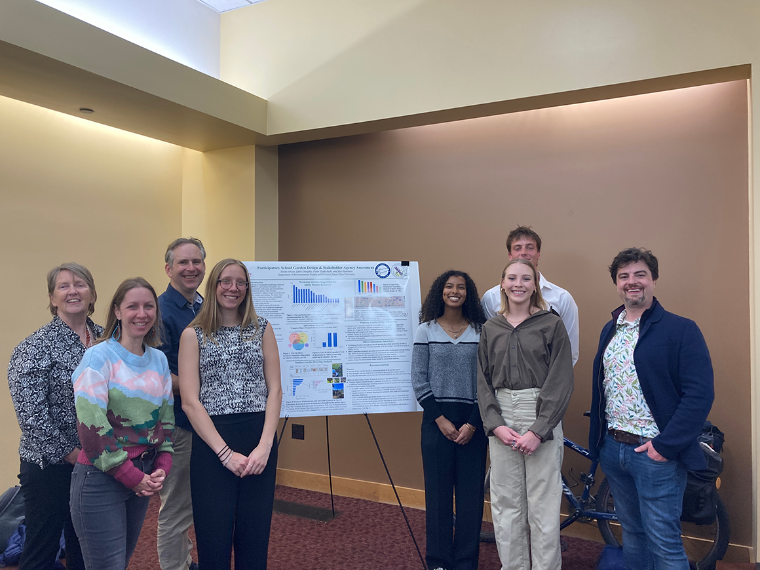
Photo caption: Students, instructor, and community partners celebrate the unveiling of the final poster on participatory school garden design and stakeholder assessment by the government. From left to right/front back: Audrey Hinton, Pomeroy Elementary School; Michele Young, County of Santa Clara, Consumer and Environmental Protection Agency; Quin Doughty; Professor Chris Bacon; Sosna Araya; Zoe Hanshew; Peter Godschalk; and Justin Burks, Valley Water.
----------------------------------------------------------------------------
COLLABORATIVE INNOVATION FOR FOOD JUSTICE IN EAST SAN JOSE: DEVELOPING A FOOD SYSTEMS DATA DASHBOARD
Authors: Leonie Casper, Gabrielle Henrich, and Ruby McBride
Community Partners and Mentors: Fernando Fernandez Leiva, Policy Director, Veggielution Community Farm.
Abstract: A high-functioning county-level food system reduces food waste, increases nutritious and culturally relevant food access, and supports local economic development. We collaborated with Veggielution Community Farm to conduct research that supports food entrepreneurs and informs community members about the food systems in Santa Clara County and East San Jose. Using a participatory mixed-methods approach, we researched food insecurity, the impacts of urban agriculture on community development, and strategies to strengthen the regional food system. We prioritized four primary audiences: (1) small-scale food entrepreneurs and cooperatives, (2) urban growers and farmers, (3) food advocates, and (4) policymakers and researchers. We held meetings with a board of relevant community stakeholders representing these audiences to understand what information would best meet the needs of audience groups. Our team’s final deliverable was a Data Dashboard that allowed relevant stakeholders to access information about their local and regional food systems and access culturally relevant foods. This dashboard also compiled information and resources specific to food entrepreneurship in San Jose, making them more readily accessible through language translation. Finally, Santa Clara County (SCC) was held accountable for its progress on its Food System Workplan Goals since 2021. Stakeholder feedback was collected continuously throughout the development of the Data Dashboard to ensure the deliverable was meeting the needs of all relevant audiences. Based on stakeholder feedback, we found that beyond resources made accessible by a dashboard, further actions are necessary to address the myriad of economic and political barriers restricting food entrepreneurship growth in San Jose.
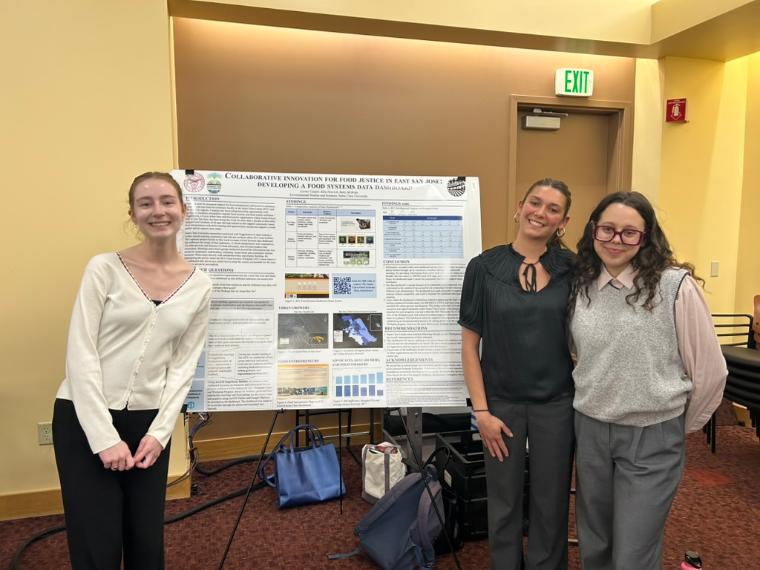
Photo caption: Leonie Casper, Ruby McBride, and Gabrielle Henrich (left to right) stand by their capstone poster.
----------------------------------------------------------------------------
A MIXED-METHODS ANALYSIS OF MARKET FEASIBILITY FOR A LOCAL FOOD CATERING CO-OP
Authors: Maylin Pollack, Josue Hernandez-Perez, Gabrielle Canola-Leach, and Sofia Perrone
Community Partners and Mentors: Antonio Amore Rojas - Cooperative Manager, and Claudia Damiani, Farm Director, Veggielution Community Farm.
Abstract: This study examines the categorization of the market for a new co-op catering to prepared food and catering businesses in East San Jose. Working with Veggielution, this study aims to understand the barriers faced by co-op and institutional buyers when establishing annual contracts. This co-op aims to provide locally sourced and culturally relevant food to the community and to secure an anchor client within the area. Through this work, we aim to gain a deeper understanding of the market and provide valuable insights to Veggielution and the co-op on how to launch the business with the desired clientele. To guide this research, we will answer the following question: What market barriers do the East San Jose food worker co-op, MEHKOs, and cottage food producers face when selling their prepared food to institutional buyers? What previous successful practices have value-based purchasing programs employed to foster relationships with institutional buyers? What resources do institutional buyers and cooperative producers need to develop a value-based contract, ensure fair pricing, and adhere to institutional standards? This study employs a mixed-methods approach, combining semi-structured interviews for qualitative analysis with quantitative data analysis from past surveys. We have conducted interviews with co-op members from both the new co-op and Veggielution’s existing co-op, as well as potential institutions that may act as clients.
