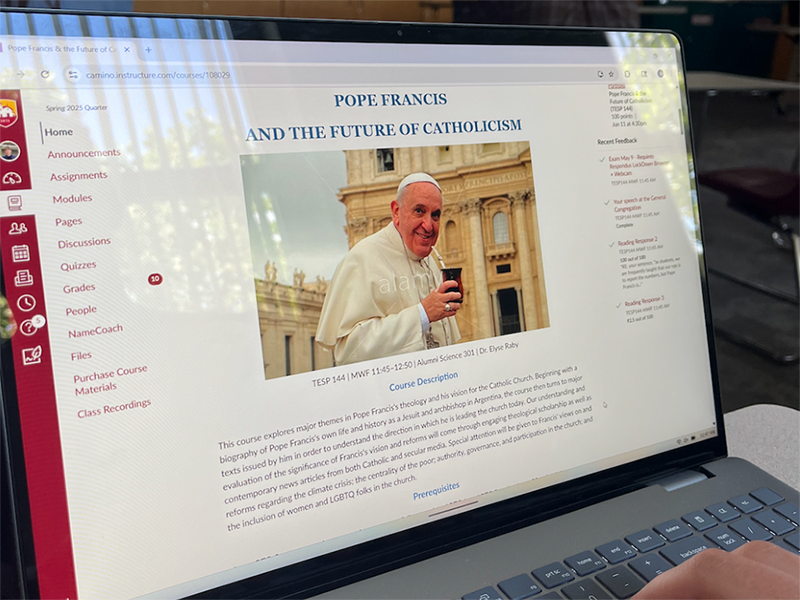
A Living Church: Professor Elyse Raby’s Class Adapts to a Historic Papal Transition
After Pope Francis’ unexpected death in 2025, Professor Elyse Raby reshaped her course into a real-time study of a Church in transition, giving students a front-row seat to history and earning recognition for her timely, dynamic teaching.
By Maggie Junkins ’26
When Pope Francis passed away in spring 2025, Santa Clara University students in Elyse Raby’s Pope Francis and the Future of Catholicism class suddenly found themselves studying a living history lesson.
As an assistant professor in the Department of Religious Studies, Raby specializes in Catholic theology, with a research focus in ecclesiology. Her work focuses on the study of the Church’s nature and structure, and often explores questions of embodiment and gender within the life of the Church.
Originally developed in spring 2024, Professor Raby’s course explored the foundations of the Church and the papacy, the Jesuit influences on Francis’ spirituality, and how Catholic social teaching informs issues like climate change, economics, migration, and the role of women in the Church. But midway through spring 2025, the class took an unexpected turn.
“Francis had recently been released from the hospital, and before the academic quarter began, I suspected we might see a resignation from Francis,” Raby said. “I didn’t expect his death, but when it happened, it was clear the class needed to change.”
Professor Raby restructured the course, shifting from thematic discussions to real-time engagement with unfolding events. Students examined what happens during a conclave, learned about the process of electing a new pope, and reflected on Francis’ legacy—applying his writings and encyclicals to pressing global and ecclesial issues.
“It was an astonishing gift to be able to teach during such a time when my niche expertise was publicly relevant,” Professor Raby said. “It felt like a moment to shine for all the experts in Catholic ecclesiology; it was one of the highlights of my teaching career.”
The result was an academic experience unlike any other: a dynamic, responsive classroom that allowed students to think critically about the evolving nature of Catholicism as history unfolded before their eyes.
“Sometimes Catholicism can be perceived as old, traditional, and unchanging,” Raby reflected. “But the Church is actually a living, dynamic organism. I hope my students saw that Catholicism is alive and changing.”
Professor Raby’s thoughtful and timely approach to teaching earned her the Public Intellectual Award at the College of Arts and Sciences Convocation Awards Ceremony earlier this fall. The award recognized the effective, far-reaching, and humane use of scholarly expertise to illuminate issues of major public concern, which is a fitting tribute to a scholar who turned an unexpected global moment into a transformative educational experience.
“Being in this class felt like watching history happen in real time,” said Stefan Halhjem ’26. “We weren’t just talking about the Church in theory, we were trying to understand it while everything was happening. It made the class feel both real and memorable.”
This fall, Raby continues to teach with an openness to current events. Her students are now exploring the first writings of Pope Leo, who recently signed his first apostolic exhortation on the preferential option for the poor. She plans to ask students about what they might make of Leo in light of Francis, how they may compare to one another, and what they hope to see in this next chapter for the Church. As Raby’s students have learned, the answers—like the Church itself—are still unfolding.